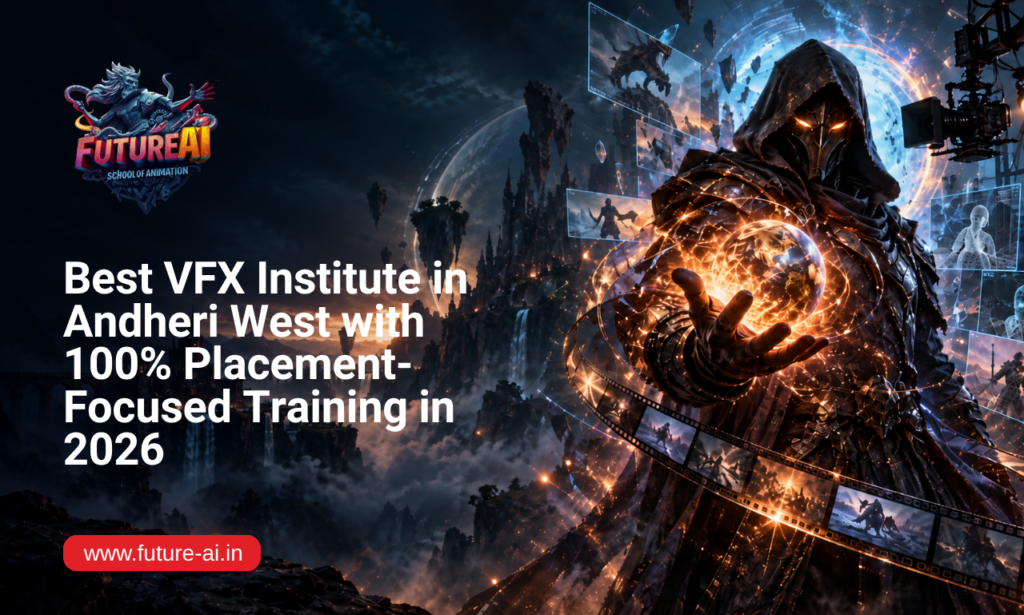
Visual effects have become an essential part of modern storytelling. From removing unwanted objects from a scene to creating imaginary environments, digital creatures, futuristic cities, explosions, weather effects and seamless extensions of live-action footage, VFX artists help filmmakers turn creative ideas into believable screen experiences. The same skills are now used beyond films in OTT content, advertising, branded videos, gaming, digital campaigns and other forms of visual media.
For students who want to enter this creative industry, choosing the right VFX Institute in Andheri is an important career decision. Modern VFX education should go beyond teaching software commands. Students need to understand how shots are planned, how footage is captured, how visual elements are integrated, how problems are solved and how finished work is prepared for professional presentation.
Future AI School of Animation in Andheri West offers a VFX Film Making program designed around this wider production approach. Its current course information lists an approximately 18-month program divided into four terms, covering areas such as visual fundamentals, cinematography, 3D, motion graphics, compositing, post-production, Cinema 4D, RealFlow, Houdini, particle systems, fluid simulations and showreel development.
Future AI also describes its training as 100% placement-focused, with students gaining real production exposure, portfolio support, interview preparation, studio workflow training and career guidance under professionals from Raj Studios.
For students searching for the Best VFX Institute in Andheri West with 100% Placement, it is important to understand that placement-focused training means structured preparation for employment. Final recruitment still depends on the student’s skill level, showreel, interview performance and available opportunities. This guide explains the complete picture before you choose a VFX course in 2026.
Which Is the Best VFX Institute in Andheri West with Placement Support?
The best VFX institute is not simply the institute offering the largest number of software applications. It should help students develop the practical, creative and professional abilities required to work on real visual-effects projects. Students should look for training that connects three important areas:
creative understanding + technical execution + career preparation.
Future AI follows a project-oriented approach in which students are introduced to production workflows rather than learning applications only as isolated tools. The institute says students gain exposure to real VFX shoots, live projects, editing workflows and production assignments based on studio-style tasks.
A Career-Focused VFX Institute Should Offer
- Visual and design fundamentals
- Cinematography knowledge
- Compositing skills
- 3D workflow training
- Camera tracking exposure
- Motion graphics
- FX and simulation learning
- Post-production practice
- Live production assignments
- Portfolio development
- Professional showreel creation
- Interview preparation
- Industry mentorship
- Placement assistance
Students should ask what they will be capable of creating by the end of the program rather than simply asking which certificate they will receive.
That shift in thinking can help identify an institute that actually prepares students for the creative industry.
What Should Students Look for in the Best VFX Institute in Andheri West?
Before paying course fees, students should examine how the institute approaches learning. A VFX course should not be evaluated on promotional claims alone. Look at the syllabus, faculty, production exposure, software environment, practical projects and placement preparation.
1. A Curriculum That Builds Skills Step by Step
Beginners need a foundation before attempting advanced effects. Understanding composition, perspective, storytelling, cinematography, color and lighting can make later VFX work stronger.
Future AI’s published VFX curriculum begins with subjects such as graphics and illustration, digital illustration, storytelling and script writing, character design, animation principles and cinematography before students move into more advanced production topics.
2. Practical Learning Instead of Only Lectures
Watching a trainer create a shot is different from solving the shot yourself. Students should spend significant time creating, making mistakes, receiving feedback and improving their work.
3. Industry-Relevant Mentorship
Professionals who understand studio environments can explain real production expectations, including deadlines, revisions, shot quality and workflow discipline. Future AI states that its training is guided by Raj Studios professionals and designed around practical industry requirements.
4. Strong Portfolio Support
Your final portfolio should demonstrate what you can actually create.
Ask whether the institute helps students select, refine and professionally present their strongest work.
5. Transparent Placement Assistance
Students should understand exactly what placement support includes. Useful assistance may include interview training, resume improvement, showreel feedback, referrals and industry networking rather than vague employment promises.
Why Choose a VFX Institute in Andheri West for Career Training?
Andheri West sits within one of Mumbai’s major entertainment and media zones. Students interested in films, advertising, television, post-production and digital content often prefer learning in an area closely associated with the industry they hope to enter.
Future AI operates from Chandak Unicorn, off Veera Desai Road in Andheri West, Mumbai. Its programs cover animation, VFX, broadcast media, design, dynamics, gaming and AI-driven creative learning.Choosing a VFX Institute in Andheri may therefore offer students the advantage of studying in a creative environment while building skills relevant to Mumbai’s production ecosystem.
Why Location Can Matter
A suitable location can make it easier to:
- Attend regular practical classes
- Participate in workshops
- Visit the campus for additional practice
- Attend industry interactions
- Explore nearby creative opportunities
- Remain connected with Mumbai’s media ecosystem
However, location should never replace training quality. A student should choose a program because its curriculum, mentorship, projects and career preparation align with their goals.
What Is the Eligibility for a VFX Course After 12th?
Students can begin professional VFX training after Class 12. Future AI currently states that students who have completed either Class 10 or Class 12 can enroll in its animation, VFX, gaming and design programs. It also states that students do not require a technical background before joining.
That makes VFX accessible to students from different academic backgrounds.
Do You Need Excellent Marks?
VFX is primarily a skill-based creative field. Academic performance can be important in education generally, but professional VFX development depends heavily on practical abilities such as:
- Observation
- Creativity
- Problem-solving
- Patience
- Visual awareness
- Software proficiency
- Ability to accept feedback
- Attention to detail
- Consistent practice
A student who practices regularly and develops a strong portfolio can build valuable professional skills regardless of whether they studied a highly technical subject in school.
Can Students from Any Stream Learn VFX?
Yes. VFX can be learned by students from Arts, Commerce or Science backgrounds. There is no rule saying a VFX artist must come from Science or computer studies. Different academic backgrounds can actually contribute different strengths.
Arts Students
Arts students may already understand areas such as visual communication, drawing, storytelling, photography or design.
Commerce Students
Commerce students can enter VFX without needing to complete an additional technical degree. The required software and production concepts can be learned through structured training.
Science Students
Students from Science backgrounds may be especially interested in technical areas such as procedural effects, simulations, lighting, 3D or technical workflows.
What Matters Most?
Your interest in creating visual content matters more than your school stream. If you enjoy asking questions such as “How was that movie scene created?” or experimenting with video, images and digital effects, VFX may be worth exploring.
Students considering an Animation course in Andheri can follow the same principle: select the specialization based on what you want to create, not merely your previous academic stream.
Do You Need Coding Skills to Become a VFX Artist?
No. Coding is not required to start learning VFX. Many VFX roles rely more heavily on visual judgement and software operation than programming. A compositor, for example, may spend time working with:
- Keying
- Masks
- Tracking
- Rotoscoping
- Cleanup
- Color integration
- Layered imagery
- CG elements
- Light matching
These tasks primarily require artistic judgement and technical understanding of compositing software.
When Can Programming Become Useful?
Coding can become valuable later in more technical areas such as:
- Pipeline development
- Procedural workflows
- Workflow automation
- Technical direction
- Custom tools
- Advanced simulations
Students interested in these technical paths can gradually add scripting or programming skills after understanding VFX fundamentals. So, not knowing coding should never stop a beginner from exploring a VFX career.
What Is the VFX Course Duration and Syllabus in 2026?
Future AI currently lists its VFX Film Making program at approximately 18 months across four terms, with each term lasting around 4.5 months. The course moves from foundational creative concepts toward more advanced visual effects and dynamics.
Term 1: Develop Creative and Visual Thinking
Students begin with areas including:
- Graphics and illustration
- Typography
- Digital illustration
- Storytelling and script writing
- Anatomy study
- Character design
- Digital painting
- Animation principles
- Portfolio development
- Cinematography and photography
This foundation helps students understand why visual choices matter before they begin working with complex effects.
Term 2: Learn VFX and 3D Fundamentals
Students progress into areas such as:
- Broadcast design
- 3D fundamentals
- Modeling-to-animation workflows
- Motion graphics
- 3ds Max
- Rendering
- Cinema 4D
- Visual effects
- Compositing
- Advanced post-production
The aim is to connect visual thinking with actual production tools.
Term 3: Strengthen Post-Production Skills
The third term includes areas such as:
- Broadcast media
- 3D
- Motion graphics
- Video editing
- Storyboarding
- Animatics
- Digital animation
- Post-production
- Portfolio creation
By this stage, students begin combining multiple techniques within larger creative assignments.
Term 4: Learn Advanced Dynamics and FX
The final published term covers areas including:
- Cinema 4D animation
- Environment creation
- Generator modeling
- Materials
- Particle systems
- RealFlow
- Viscous liquids
- Houdini
- Hybrido simulations
- Fluid effects
- Showreel development
Future AI’s course page describes the program as covering cinematic VFX from illustration and compositing through fluid simulations, camera tracking and real-film workflows.
Which VFX Software Should Students Learn in 2026?
Students should learn software according to the role they eventually want to pursue. A compositor does not necessarily need the same software expertise as an FX artist, and an FX specialist may use different tools from an editor or motion designer.
Future AI’s published curriculum references software and workflows involving Nuke, 3ds Max, Cinema 4D, RealFlow, Houdini, Adobe Premiere Pro, After Effects and additional creative tools.
Nuke
Nuke is associated with professional compositing workflows. Students interested in compositing should learn concepts including:
- Keying
- Rotoscoping
- Tracking
- Color matching
- CG integration
- Image cleanup
- Multipass compositing
Houdini
Houdini is particularly relevant for procedural and simulation-based VFX. It is commonly associated with effects involving:
- Fire
- Smoke
- Particles
- Destruction
- Fluids
- Procedural environments
Cinema 4D
Cinema 4D is useful across areas such as motion graphics, 3D design, animation, environments and visualization.
RealFlow
RealFlow focuses strongly on liquid and fluid simulation workflows and is also included in Future AI’s Dynamics training.
After Effects
After Effects can be useful for:
- Motion graphics
- Compositing
- Tracking
- Masking
- Titles
- Effects
- Digital post-production
The goal should not be to memorize every application. Students should understand how different tools work together to complete a shot.
How Is AI Being Used in Modern VFX Training?
Artificial intelligence is changing how artists approach certain production tasks. Modern creative tools can increasingly assist with processes such as object selection, masking, tracking, image generation, concept exploration, cleanup and repetitive workflow tasks.
This does not mean traditional VFX skills are becoming irrelevant. Instead, students need to understand both how to create a convincing visual and how to use AI-assisted tools efficiently.
Future AI identifies AI-integrated creative learning as a core part of its approach. Its current site highlights areas including generative AI, machine learning for VFX, computer vision, AI-assisted content creation and creative automation.
Why Fundamentals Still Matter in an AI Workflow
Imagine an AI tool generates a background quickly.
The student still needs to judge:
- Does the perspective match?
- Is the light direction correct?
- Does the depth feel natural?
- Does the color match the foreground?
- Is the camera movement believable?
- Does the generated element support the story?
AI may speed up parts of execution, but artistic judgement determines whether the final shot works. A future-ready VFX course should therefore teach both production fundamentals and responsible use of emerging tools.
Why Are Live Projects and Real VFX Shoots Important for Students?
Professional VFX begins long before an artist starts compositing. The quality of the original footage, camera setup, lighting, green screen, tracking information and shot planning can significantly affect what happens during post-production.
Students who participate in shoots can understand these relationships firsthand. Future AI says students participate in real VFX shoots, editing workflows, live projects and production assignments designed around studio tasks.
A Live Shoot Can Teach Students About
- Green-screen preparation
- Lighting consistency
- Camera movement
- Lens perspective
- Tracking markers
- Actor positioning
- Reference images
- Shot continuity
- Production planning
This knowledge can make students more thoughtful compositors and VFX artists.
Projects Also Teach Professional Habits
Students need to learn how to:
- Understand a brief
- Organize their files
- Work within deadlines
- Receive feedback
- Make corrections
- Manage multiple versions
- Complete final output properly
These skills may not feel as exciting as creating explosions or digital environments, but they are essential in professional studios.
How Does Industry Mentorship Improve VFX Training?
VFX education becomes more valuable when students can receive feedback from people familiar with production expectations. A beginner may judge a shot only by whether the effect looks impressive. A professional may notice entirely different issues: the light is inconsistent, the contact shadow is missing, the camera perspective is wrong, the edges are too sharp or the CG object does not match the grain of the original footage.
Learning to identify these details helps students improve their visual judgement. Future AI states that its training is guided by professionals from Raj Studios and focuses on actual studio workflows and production-oriented teaching.
Industry Mentors Can Help Students Learn
- How professional shots are reviewed
- What studios expect from junior artists
- How to respond to feedback
- How to improve efficiency
- How to present projects professionally
- Which specialization matches their strengths
- What should and should not go into a showreel
This type of guidance can make the transition from classroom learning to studio work easier to understand.
How Do Students Build a Job-Ready VFX Portfolio and Showreel?
A portfolio is where training becomes visible. Instead of simply stating that you know VFX, a showreel gives recruiters an opportunity to see the quality of your work. Students should begin thinking about their showreel before the final month of the course.
Choose Your Strongest Projects
Do not include every classroom exercise. A shorter collection of well-finished work generally communicates skill more effectively than a long reel filled with unfinished shots.
Include Relevant Shot Breakdowns
For selected VFX work, students can show stages such as:
Original Plate → Tracking → Cleanup → CG Integration → Compositing → Final Shot
This demonstrates the actual work involved.
Create Work Related to Your Target Role
Students interested in compositing should emphasize:
- Chroma keying
- Screen replacement
- Cleanup
- CG integration
- Tracking
- Matte work
Students interested in FX may instead highlight:
- Particles
- Smoke
- Fire
- Liquid
- Destruction
- Procedural effects
Keep Refining Your Work
Portfolio development should involve multiple rounds of feedback. Future AI states that professional showreel and portfolio development are part of its training and placement-preparation approach.
Does Future AI Provide 100% Placement-Focused VFX Training?
Future AI currently states that it offers 100% placement-focused training guided by Raj Studios industry experts. The institute connects this career preparation with real projects, professional studio workflows, portfolio development, interview preparation, studio exposure and mentoring.
What Does 100% Placement-Focused Mean?
The phrase refers to training designed to prepare students for industry opportunities. It does not mean employment can be guaranteed regardless of individual performance.
A student’s final placement can depend on:
- Skill development
- Portfolio quality
- Showreel presentation
- Attendance and consistency
- Communication
- Interview performance
- Specialization
- Employer requirements
- Available job opportunities
Students comparing institutes should always distinguish between placement assistance and a guaranteed job claim. A good institute can prepare and support you, while the quality of your work remains a critical factor in hiring.
What Placement Support Does a Good VFX Institute Provide?
Strong placement support should help students become better candidates rather than only giving them a list of vacancies.
Future AI currently states that its career-support process includes showreel and portfolio development, resume and interview preparation, studio workflow training, communication enhancement, industry networking and job referrals through Raj Studios and partner networks.
Resume Preparation
Students should learn how to clearly communicate:
- Their specialization
- Software knowledge
- Important projects
- Portfolio link
- Relevant skills
- Practical experience
Interview Preparation
Students may need to discuss individual portfolio shots during an interview. They should be ready to explain what they created, what software they used and how they solved technical problems.
Portfolio Review
A mentor can help students identify weak shots, incomplete details or presentation problems before a recruiter sees the work.
Career Guidance
Not every student should apply for the same role. One learner may have excellent compositing skills, another may prefer simulations, while someone else may be better suited to motion graphics. Career mentoring can help students focus on roles that match their strongest abilities.
What Are the Career Options After Completing a VFX Course?
Visual effects is not one single profession. A completed VFX program can introduce students to several specializations across creative production. Potential career roles include:
- VFX Artist
- Compositor
- Rotoscopy Artist
- Paint Artist
- Matchmove Artist
- Tracking Artist
- Motion Graphics Artist
- 3D Artist
- Lighting Artist
- FX Artist
- Simulation Artist
- Video Editor
- VFX Generalist
- AI-VFX Creative Artist
Future AI also identifies career pathways such as Animator, VFX Artist, Compositor, Video Editor, Simulation Artist and AI-VFX Specialist across its creative programs.
Industries Where VFX Skills Can Be Used
Students may explore opportunities in:
- Films
- OTT productions
- Advertising
- Television
- Post-production
- Gaming
- Digital media
- Music videos
- Branded content
- Creative agencies
As experience grows, artists can also move toward leadership or specialist positions depending on their chosen field.
What Are the Most In-Demand VFX Jobs in India in 2026?
Rather than choosing a specialization only because it is described as “high demand,” students should build strong foundations and then develop deeper expertise in an area they genuinely enjoy. Several VFX disciplines remain important across modern production pipelines.
Compositing Artist
Compositors combine live footage, CG, backgrounds and additional visual elements into a finished image.
Important abilities can include:
- Keying
- Tracking
- Rotoscoping
- Cleanup
- Color matching
- CG integration
FX Artist
FX artists create dynamic effects such as:
- Fire
- Smoke
- Water
- Debris
- Destruction
- Particles
Houdini and related simulation tools are particularly relevant for this specialization.
Motion Graphics Artist
Motion graphics artists create animated visual communication for advertising, broadcast content, social media, titles and branded videos.
3D Artist
3D artists may work across modeling, materials, lighting, environments, animation and rendering.
Matchmove and Tracking Artist
Tracking artists reconstruct camera or object movement so digital elements can align correctly with live-action footage.
Technical VFX Roles
Students who later develop scripting, pipeline and automation skills can explore more technical areas of production.
AI-Assisted Creative Roles
As generative and machine-learning tools become incorporated into creative workflows, artists who understand both conventional VFX and AI-supported techniques may become useful across evolving production pipelines.
The safest career strategy is therefore not chasing one software trend. It is building transferable visual knowledge and a strong specialization.
Is VFX a Good Career in India After 12th?
VFX can be a suitable career after Class 12 for students who enjoy creative technology, visual storytelling and detailed problem-solving. However, students should understand that professional growth requires continuous practice. Learning does not stop after completing a course because production tools, software and workflows keep evolving.
VFX May Be Right for You If You Enjoy
- Movies and filmmaking
- Digital art
- Editing videos
- Photography
- Creative software
- Building imaginary environments
- Solving technical problems
- Experimenting with visuals
- Learning new tools
Students should also be comfortable receiving feedback. A shot may require several corrections before it reaches the required quality. Patience and attention to detail are therefore important professional qualities.
For students who would rather focus on character movement, modeling, rigging and animated storytelling, an Animation course in Andheri may be another path worth exploring. The best choice depends on what kind of work you want to create every day.
Why Choose Future AI for a VFX Course in Andheri West?
Future AI School of Animation combines several elements that students typically look for when researching professional VFX education.
Structured VFX Film Making Program
The current program is listed at approximately 18 months across four terms and develops from visual fundamentals into 3D, compositing, post-production and advanced simulation workflows.
Real Production Exposure
Future AI says students participate in VFX shoots, live projects and production assignments rather than relying only on classroom exercises.
Raj Studios Industry Guidance
The institute’s training is guided by professionals connected with Raj Studios, helping students understand how studio environments approach creative production.
AI-Integrated Learning
Future AI’s curriculum approach incorporates generative AI, machine learning for VFX, computer vision and AI-assisted creative workflows.
Specialized Dynamics Training
Students can also explore technologies such as Houdini, RealFlow and Cinema 4D through Future AI’s dynamics-related learning.
Portfolio and Showreel Development
Professional presentation is built into the training approach so students can convert assignments into portfolio-ready work.
Placement Preparation
Future AI highlights interview preparation, resume support, career mentoring, studio exposure, professional networking and industry referrals as part of its placement assistance.
Andheri West Campus
The campus is located at Chandak Unicorn, Dattaji Salve Marg, off Veera Desai Road, Andheri West, placing students within Mumbai’s wider creative and media environment.
Students comparing an Animation course in Andheri and VFX training can also explore Future AI’s Animation Prime program, which is currently listed as an 18-month, four-term program covering the animation pipeline from creative fundamentals to advanced 3D character work and FX.
Future AI’s main differentiator is therefore not a single piece of software. It is the combination of production-oriented training, current creative technologies, professional mentorship and career preparation.
Frequently Asked Questions About VFX Courses in Andheri
1. Which is the best VFX Institute in Andheri for career-focused training?
Students should compare VFX institutes on practical projects, trainer experience, curriculum, software, showreel development and placement assistance. Future AI in Andheri West offers an approximately 18-month VFX Film Making program with production-oriented learning and Raj Studios guidance.
2. Can I learn VFX immediately after Class 12?
Yes. Students can begin VFX training after Class 12. Future AI also states that students completing Class 10 can enroll in its relevant creative programs and that no prior technical background is required.
3. What is the duration of Future AI’s VFX course?
Future AI currently lists the VFX Film Making program at approximately 18 months, structured into four terms of around 4.5 months each.
4. Does Future AI provide 100% placement after a VFX course?
Future AI describes its approach as 100% placement-focused training. It provides portfolio preparation, interviews, studio referrals, mentoring and placement support. Employment itself depends on the student’s skills, performance and available hiring opportunities.
5. Can a student without drawing skills learn VFX?
Yes. Advanced drawing is not compulsory for every VFX specialization. However, developing visual skills such as composition, perspective, lighting and color can significantly improve a student’s work.
6. Can Commerce students join a VFX course?
Yes. Commerce students can study VFX. Arts, Commerce and Science students can all enter the field because beginners can learn the required creative and technical skills through structured training.
7. Which software should a VFX beginner learn?
The right software depends on specialization. Students may encounter Nuke for compositing, Houdini for procedural FX, After Effects for motion graphics and compositing, Cinema 4D and 3ds Max for 3D workflows, and RealFlow for simulation-related work. Future AI’s current curriculum incorporates several of these technologies.
8. Does Future AI teach AI tools with VFX?
Future AI states that its creative learning approach includes generative AI, machine learning for VFX, computer vision and AI-assisted content creation alongside traditional creative training.
9. Should I choose VFX or an Animation course in Andheri?
Choose VFX if you are particularly interested in compositing, tracking, simulations, post-production and integrating effects with live footage. Animation may suit students more interested in character animation, modeling, rigging, movement and animated storytelling.
10. Can I see Future AI’s training approach before enrolling?
Future AI currently states that prospective students can request a free demo class or in-person counselling session at its Andheri campus to understand the course structure, tools and career paths before joining.
Conclusion: Turn Your Interest in Visual Effects into Professional Skills
Choosing the Best VFX Institute in Andheri West with 100% Placement-Focused Training should begin with understanding what professional VFX education actually requires. Software is only one part of the process. Students also need visual awareness, cinematography knowledge, problem-solving ability, project experience, professional feedback, specialization and a showreel capable of demonstrating their skills.
Future AI’s current VFX Film Making program offers an approximately 18-month learning path covering creative fundamentals, 3D, compositing, motion graphics, post-production, Cinema 4D, RealFlow, Houdini, particle systems, fluid simulations and showreel development.
Its practical learning approach adds real VFX shoots, live assignments and studio-style production exposure, while Raj Studios professionals provide industry-oriented guidance. Future AI also integrates emerging areas such as generative AI, machine learning for VFX and AI-assisted content creation into its broader educational approach.
Most importantly, its 100% placement-focused training is designed to prepare learners through portfolio development, resume and interview support, studio workflow preparation, networking and industry referrals rather than relying only on classroom certification. For students looking for a professional VFX Institute in Andheri, the goal should be to choose a program that enables them to create, experiment, receive feedback and steadily improve until their work reaches a professional presentation standard.
Students interested in character animation and broader 3D production can additionally explore an Animation course in Andheri at Future AI. The software used by VFX studios will continue to evolve. AI workflows will become faster. Production techniques will change. What will continue to differentiate strong artists is their ability to understand a visual problem, select the right approach and deliver convincing work. That is the skill set worth building from the first day of VFX training.
Contact Future Ai
Future Ai Animation Andheri – Animation & VFX Courses in Andheri, Mumbai
Address: Unit No. 1606, Chandak Unicorn, Dattaji Salvi Marg, Off Veera Desai Rd, Andheri, Mumbai, Maharashtra 400053
Phone: 08879998001
Website: www.future-ai.in
Google Maps: https://maps.app.goo.gl/cLeb9zBsJJEADR9x6