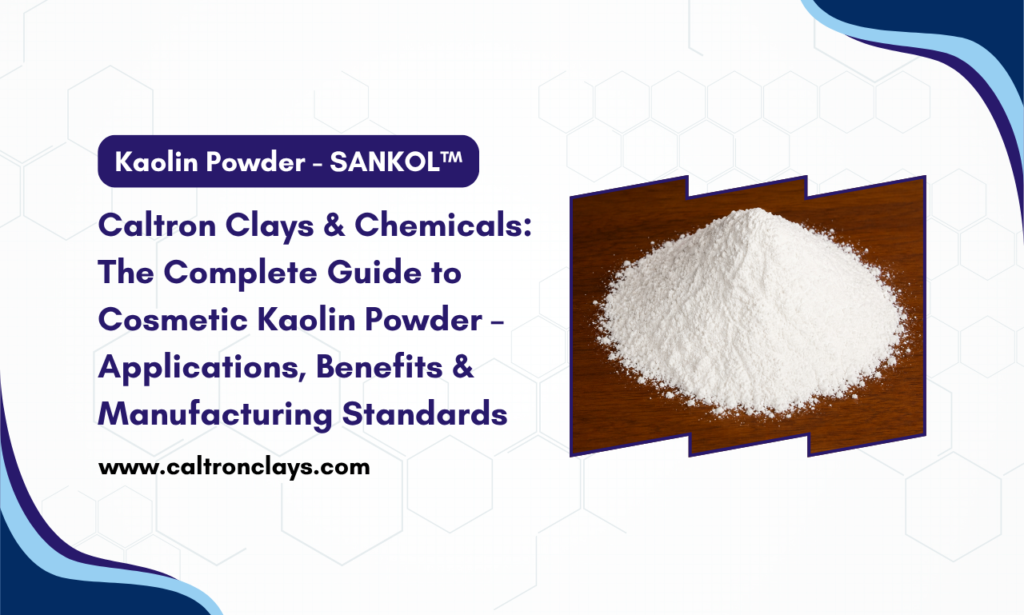
Introduction: Cosmetic Kaolin Is Simple on the Label, but Technical in the Formulation
Caltron Clays & Chemicals approaches cosmetic mineral ingredients from a formulation and manufacturing perspective. A label may identify an ingredient simply as kaolin, but for an R&D chemist, quality professional or procurement manager, that single name leaves several important questions unanswered. How fine is the powder? How consistent is its appearance? What is its mineral profile? How does it disperse? Will the next commercial batch behave like the material approved during development? These questions become especially important when sourcing Cosmetic Grade Kaolin Powder for professional cosmetic manufacturing.
Kaolin has earned a long-standing place in skincare and personal-care formulations because its physical mineral characteristics can serve several formulation purposes. It can contribute to surface-oil management, powder body, texture and matte appearance. This versatility enables formulators to investigate kaolin for clay masks, face powders, foundations, soaps, cleansing systems and other suitable cosmetic products.
The challenge is that cosmetic manufacturing requires consistency at a scale far beyond a laboratory sample. A promising prototype must eventually become hundreds or thousands of repeatable finished units. At that stage, variations in mineral colour, texture or physical characteristics can become a production issue rather than a minor laboratory observation. Choosing an experienced Kaolin Powder Manufacturer in India is therefore closely connected to formulation reliability and commercial scalability.
Caltron Clays & Chemicals offers SANKOL™, its cosmetic-focused kaolin developed for B2B formulation requirements. With high-whiteness positioning, ultra-fine physical characteristics and dedicated mineral processing at Vapi, SANKOL™ gives cosmetic manufacturers a specialised kaolin option for technical evaluation and commercial sourcing.
What Is Cosmetic Grade Kaolin Powder?
Cosmetic Grade Kaolin Powder is a processed mineral raw material primarily associated with kaolinite, a naturally occurring hydrated aluminium silicate clay mineral. Cosmetic grades are selected and prepared with attention to characteristics that matter when the material is incorporated into skincare, beauty and personal-care formulations.
This definition is important because kaolin is not exclusively a cosmetic ingredient.
Different kaolin grades may be manufactured for very different industries and end uses. Those applications may have specifications unrelated to the expectations of a cosmetic manufacturer. Consequently, buyers should not consider every material sold as “kaolin powder” interchangeable.
For cosmetic R&D teams, grade selection can involve examining appearance, particle characteristics, whiteness, mineral composition, consistency and other relevant quality parameters. Procurement and quality teams may additionally evaluate supplier capability, traceability, specifications, documentation and commercial availability.
The result is a more meaningful approach to sourcing. Instead of asking only whether a supplier sells kaolin, manufacturers can determine whether the particular grade has been developed and processed with cosmetic formulation requirements in mind.
Why Is Kaolin Powder Used So Extensively in Cosmetics?
Kaolin remains relevant because its value extends across multiple formulation objectives.
Its mineral particles can contribute absorbent and adsorbent characteristics, powder body, texture and a matte sensory or visual effect. These characteristics can be useful in products where formulators want to manage surface oil while maintaining a recognisable mineral profile.
In face masks, kaolin can become an important part of the product’s structure and identity. In powder cosmetics, it can contribute to dry-touch and mattifying characteristics. In selected foundation systems, it may support texture and oil-management objectives. In soaps and cleansers, it can add mineral character to the formulation.
This breadth gives formulators considerable flexibility.
However, the same kaolin concentration will not perform identically across every product format. A powder system has different technical requirements from a water-based mask, and a foundation has different performance expectations from a cleansing bar.
The real formulation advantage of kaolin therefore comes from understanding how to match the correct grade and concentration to the intended product.
How Does Kaolin Interact with Oil in Cosmetic Formulations?
One of the reasons kaolin is widely considered for cosmetic applications is its interaction with oils.
The mineral surface can retain materials at its surface, while clay systems may also display absorbent behaviour depending on the material and formulation environment. This is why both “adsorption” and “absorption” appear in technical discussions surrounding clay minerals.
For cosmetic manufacturers, the practical result is more important than terminology alone.
Kaolin can support formulations intended to manage excess surface oil and reduce an overly shiny appearance. This makes it particularly relevant to mattifying face powders, clay masks and selected cleansing products.
The formulation objective, however, should not be maximum oil removal at any cost.
A consumer product still needs an acceptable sensory profile. Excessive powder loading may increase drag, dryness or difficulty in spreading. The developer must therefore determine a suitable balance between mineral loading, oil management and overall product feel.
SANKOL™ can be evaluated within this type of formulation strategy where a fine, high-whiteness kaolin is required.
Why Mineral Purity and Composition Deserve Careful Attention
Natural minerals are shaped by geology before they ever reach a manufacturing facility.
This means the origin and mineral characteristics of a kaolin deposit can influence the raw material subsequently processed for commercial use. For cosmetic manufacturers, appropriate sourcing and controlled processing are therefore important considerations.
Kaolinite is associated with hydrated aluminium silicate chemistry. Yet commercial kaolin should be assessed as the actual supplied mineral grade rather than simply against an idealized chemical description.
R&D teams need to know whether the material works consistently in the formula. Quality teams need clearly defined criteria for incoming-material assessment. Procurement teams need confidence that future supplies will continue to meet agreed requirements.
This is why specifications are essential.
SANKOL™ is positioned by Caltron Clays & Chemicals around a suitable alumina-silica mineral profile together with characteristics such as high whiteness and fine texture.
Manufacturers should review the current product specification and relevant supporting information as part of their own qualification process.
Why Whiteness Is a Functional Consideration, Not Just a Cosmetic Detail
In mineral-based cosmetic products, raw-material colour can influence finished-product appearance.
A manufacturer developing a bright white clay mask, for example, may want the mineral base to remain visually consistent from one production run to another. A noticeable shift in the colour of the kaolin could influence the appearance of the finished mask.
Colour cosmetics present another challenge.
In foundations and face powders, mineral ingredients form part of a complex system containing pigments, fillers, binders and oils. The starting colour of the base powders can influence how formulators achieve the intended final shade.
High-whiteness kaolin can therefore provide a useful formulation starting point.
SANKOL™ is specifically positioned by Caltron Clays & Chemicals around high whiteness, making it relevant to cosmetic products where visual consistency matters.
Whiteness alone should never be used as a complete measure of raw-material quality. It should be evaluated together with identity, physical characteristics and other specifications relevant to the intended application.
How Particle Fineness Influences Texture, Dispersion and Skin Feel
Particle characteristics can determine whether a mineral ingredient feels refined or unsuitable within a cosmetic formula.
In dry powders, fineness can influence flow, pickup, application and tactile perception. In masks, particle behaviour can affect dispersion and the smoothness of the applied product. In foundations, the mineral interacts with pigments, oils and other fillers, making its physical profile relevant to the entire system.
This is particularly important because cosmetic performance is highly sensory.
Two materials may share the same broad mineral identity but create noticeably different formulation experiences because their physical characteristics differ.
Fine particles can contribute to smoother mineral texture when the grade and formulation are appropriately designed. At the same time, processing, mixing sequence and the surrounding ingredients also influence final performance.
SANKOL™ is positioned as an ultra-fine cosmetic kaolin. This provides cosmetic R&D teams with a grade designed around applications where mineral fineness and texture are important considerations.
Key Benefits of Cosmetic Grade Kaolin Powder for Formulators
Supports Oil-Management Formulations
Kaolin is frequently selected for formulations where control of surface oil is part of the product objective. This makes it relevant to mattifying masks, powders and selected cleansing products.
Helps Develop Matte-Finish Products
The mineral’s powdery physical characteristics can contribute to a less shiny visual finish in suitable cosmetic systems.
This property can be particularly valuable in colour cosmetics and skincare products designed around a matte positioning.
Contributes to Powder Body
Kaolin can provide body and mineral character in dry cosmetic formulations.
Formulators can evaluate it alongside pigments, fillers, binders and other powders according to the desired product profile.
Supports Clay-Mask Texture
In mask formulations, kaolin helps establish the characteristic body consumers associate with clay-based skincare.
Its loading must be balanced with spreadability, drying behaviour and ease of removal.
Provides a High-Whiteness Mineral Base
A high-whiteness grade can support visual consistency in pale or colour-sensitive formulations.
Offers Multi-Product Versatility
A major advantage of Cosmetic Grade Kaolin Powder is the ability to evaluate the same mineral category across multiple skincare, beauty and personal-care development projects.
Where Can Cosmetic Manufacturers Use Kaolin Powder?
Face Masks: Building the Right Mineral Base
Face masks remain a core application for cosmetic kaolin.
Kaolin can provide the mineral body, texture and oil interaction required for many clay-mask concepts. Depending on the desired product experience, it may be formulated alongside humectants, emollients, rheology modifiers and other compatible ingredients.
For R&D teams, the main challenge is achieving balance.
A formula with too little mineral may not deliver the intended clay character, while excessive loading can affect spreading, drying and removal. Testing at realistic prototype concentrations is therefore essential.
Face Powders: Supporting a Refined Matte Finish
Kaolin can be evaluated in loose and pressed powders where formulators want mineral body and oil-management properties.
The developer may assess pickup, payoff, spreadability, flow and overall tactile feel.
Whiteness can also influence how the mineral works within the colour system, particularly when pigments and other fillers are present.
Foundations: More Than Just a Powder Ingredient
Selected foundation systems may use kaolin as part of their mineral and powder phase.
The objective may involve oil management, texture or appearance rather than treating kaolin as the primary performance ingredient.
Foundation performance remains dependent on the complete system, including pigments, oils, binders and film-forming ingredients.
Cleansers: Adding Mineral Character
Kaolin can be evaluated in selected facial cleansing formulations where mineral texture and surface-oil interaction fit the product concept.
The developer should confirm that the kaolin disperses appropriately and remains compatible with the cleansing base.
Soaps: Supporting Mineral-Based Product Concepts
Soap manufacturers may incorporate kaolin where they want to introduce mineral character or specific visual and tactile properties.
Compatibility with the complete soap formulation remains essential.
Talc-Free Powder Development
Kaolin is increasingly evaluated by brands developing powder systems without talc.
It should not, however, be treated as a direct one-for-one replacement. Talc and kaolin have different mineral and physical characteristics.
Any substitution strategy should therefore involve reformulation and performance testing.
Baby-Care Concepts
Kaolin may be considered for selected mineral powder formulations, but baby-care applications require careful product-specific safety and exposure evaluation.
Natural origin alone does not establish suitability for every consumer group or application.
Sun-Care Products
Kaolin may support texture, sensory characteristics or appearance in certain sun-care systems.
It should not be described as an independent sunscreen active or as providing a guaranteed SPF contribution. Sun-protection claims depend on the appropriate UV-filter system and finished-product efficacy testing.
Why Kaolin Is Relevant to the Next Generation of Mattifying Products
Mattifying cosmetics are becoming more sophisticated.
Consumers increasingly want reduced shine without the heavy, chalky or excessively dry sensation historically associated with some oil-control products.
This places greater responsibility on formulators.
Kaolin can serve as one component within a broader mattifying system. It may be combined with other oil absorbing cosmetic ingredients, sensory modifiers, emollients, starches or mineral powders depending on the desired product profile.
The quality of the kaolin matters because particle characteristics can influence the feel of the formula.
SANKOL™ provides manufacturers with a fine, high-whiteness mineral option for evaluation in modern mattifying skincare and cosmetic formulations.
The objective is not simply to absorb more oil. It is to achieve the right balance between oil management, appearance and consumer-acceptable sensory performance.
Kaolin vs Bentonite: Understanding the Formulation Difference
Although kaolin and bentonite are both cosmetic clays, their mineral structures and behaviour are not identical.
Kaolin is primarily associated with kaolinite. Bentonite typically contains smectite-group clay minerals and is well known for swelling when exposed to water.
This difference can be important during formulation.
Bentonite may have a more pronounced influence on viscosity and swelling behaviour in certain systems, while kaolin offers its own combination of mineral body, absorbency and sensory characteristics.
For mask developers, the choice depends on the desired application profile, drying behaviour, texture and overall formulation architecture.
Some formulations may even investigate blends of clay minerals.
The key is to avoid selecting a clay solely by popularity. Its technical behaviour should match the formulation objective.
Kaolin vs Talc: Why Direct Substitution Is Not Always the Answer
Talc-free formulation development has increased interest in alternative mineral ingredients, including kaolin.
However, kaolin and talc are different materials.
Kaolin is principally associated with hydrated aluminium silicate, whereas talc is a magnesium silicate mineral. Their structures and physical properties differ, meaning they can influence cosmetic systems in different ways.
For a powder manufacturer, replacing talc may alter flow, pickup, compression or sensory behaviour. A foundation developer may notice changes in feel or interaction with other powders.
Kaolin can therefore be evaluated as part of a talc-free formulation strategy, but successful development requires testing rather than simple substitution.
SANKOL™ offers cosmetic manufacturers a kaolin option for these formulation investigations where its specific characteristics align with the intended product.
What Should R&D Teams Evaluate Before Approving Kaolin?
The first qualification question should always be application-specific: What does this formulation require from the mineral?
For a clay mask, the R&D team may focus on dispersion, application, drying behaviour and after-feel.
For face powder, priorities may shift toward fineness, flow, pickup, matte appearance and interaction with pigments.
For foundations, the team may evaluate colour influence, oil interaction and compatibility with the complete powder and emollient system.
This should be followed by realistic prototype testing.
Evaluating the powder alone provides useful information, but it cannot predict every interaction inside a finished cosmetic product.
Successful raw-material qualification connects specification data with actual formulation performance.
What Should Procurement Teams Check Before Selecting a Kaolin Powder Supplier?
Once R&D identifies a suitable material, procurement must determine whether the supply relationship can work commercially.
Important considerations include:
- Product identity and intended cosmetic application
- Current specifications
- Particle characteristics
- Whiteness and appearance
- Relevant quality parameters
- Batch consistency
- Appropriate contaminant controls
- Microbiological requirements where applicable
- Available technical and batch documentation
- Traceability
- Packaging options
- Storage recommendations
- Manufacturing capability
- Commercial quantity availability
- Export-support requirements
- Supplier responsiveness
- Scalability for growing production volumes
The lowest-cost material is not necessarily the most cost-effective choice if inconsistency later results in formulation adjustments, production interruptions or additional quality investigations.
A professional Kaolin Powder Supplier in India should therefore be evaluated on total sourcing value rather than unit price alone.
Why Batch Consistency Protects Commercial Cosmetic Production
A formulation approved with one raw-material sample eventually needs to work with many future batches.
This is where supplier consistency becomes commercially important.
If mineral colour changes unexpectedly, the finished product may appear different. If physical characteristics shift, dispersion or sensory behaviour may change. If powder behaviour varies, manufacturing processes may require adjustment.
Even relatively small raw-material changes can create additional work when production is operating at commercial scale.
This makes repeatability a critical procurement criterion.
Manufacturers evaluating a Kaolin Powder Manufacturer in India should therefore look beyond the initial sample and consider the supplier’s ability to maintain defined specifications over ongoing production.
A reliable raw material should help reduce variability rather than introduce it.
Why Manufacturing and Processing Standards Matter for Cosmetic Kaolin
Natural mineral origin is only the beginning of the kaolin supply chain.
The material must subsequently be processed into a commercial grade with characteristics suitable for the intended market.
For cosmetic manufacturers, processing is especially relevant to parameters such as fineness, texture, appearance and consistency.
This means buyers should distinguish between general mineral supply and cosmetic-focused raw-material manufacturing.
Questions about processing, specifications, batch control, documentation, packaging and traceability provide much more useful information than broad promotional claims about quality.
The manufacturing approach should ultimately support repeatable raw-material characteristics that can be evaluated by the cosmetic manufacturer’s own quality system.
Caltron’s Vapi Facility: Dedicated Processing for Cosmetic Mineral Raw Materials
Caltron Clays & Chemicals operates a dedicated pulverising facility at Vapi for cosmetic raw materials of mineral origin.
This is an important part of Caltron’s approach to serving the cosmetic industry.
Cosmetic applications can place considerable emphasis on the physical characteristics of mineral ingredients. A supplier working specifically with these requirements is better positioned to understand why fineness, appearance and consistency matter to formulators.
SANKOL™ benefits from this cosmetic-focused mineral processing approach.
For buyers, however, facility capability should always be considered together with current specifications, technical evaluation and commercial requirements.
The objective is not simply to purchase processed mineral powder. It is to qualify a raw material that can support consistent cosmetic production.
Meet SANKOL™: Caltron’s High-Whiteness Cosmetic Kaolin
SANKOL™ represents Caltron Clays & Chemicals’ dedicated approach to cosmetic kaolin.
Developed for B2B skincare, beauty and personal-care manufacturers, SANKOL™ is positioned as an ultra-fine hydrated aluminium silicate derived from natural Indian mineral deposits.
Its high-whiteness profile makes it relevant to formulations where the mineral contributes visibly to the product.
Its fine physical characteristics make it suitable for evaluation in applications where smooth mineral texture and formulation behaviour matter.
Kaolin’s natural mineral properties also make SANKOL™ relevant to oil-management and mattifying formulation strategies.
Manufacturers can evaluate SANKOL™ for clay masks, face powders, selected foundations, soaps, cleansers and other suitable personal-care applications.
Most importantly, SANKOL™ is offered as a professional B2B cosmetic raw material rather than a finished consumer product, enabling formulators to qualify it according to their own product requirements.
Why SANKOL™ Is Designed for B2B Cosmetic Manufacturing
Raw-material requirements change significantly when a product moves from concept to commercial production.
During early R&D, a formulator may require only a sample for prototype development.
Once the product is commercialized, procurement needs dependable quantities, quality teams need repeatable specifications, production requires consistent material behaviour and logistics teams need appropriate packaging and supply coordination.
SANKOL™ is positioned within this commercial manufacturing environment.
Caltron Clays & Chemicals combines its mineral-processing capabilities with an understanding of cosmetic-industry sourcing requirements.
This gives manufacturers an opportunity to work with a supplier whose role extends beyond delivering a generic mineral powder.
For companies seeking a Cosmetic Raw Material Manufacturer in India, that B2B orientation can be an important part of long-term supplier evaluation.
How to Select the Right Kaolin Powder Manufacturer in India
A reliable supplier should satisfy technical, quality and commercial requirements simultaneously.
Begin by comparing the material against your formulation objectives.
Review particle characteristics, appearance, whiteness and relevant specifications. Conduct trials under realistic formulation conditions and evaluate whether the material behaves consistently with the intended product profile.
Next, examine manufacturing capability.
Can the supplier support commercial quantities? Is the material supplied under defined specifications? Can the company provide appropriate technical information? Is traceability part of the supply process?
Finally, assess the relationship from a long-term perspective.
Cosmetic products may remain in the market for years. A supplier should therefore be capable of supporting repeated purchasing rather than simply providing a successful development sample.
Caltron Clays & Chemicals positions SANKOL™ around these B2B requirements, making it relevant to manufacturers searching for an experienced Kaolin Powder Manufacturer in India.
Cosmetic Kaolin Trends to Watch in 2026
Several formulation and procurement trends are reinforcing the importance of cosmetic-focused kaolin.
First is the continued development of mineral-led beauty products. Clay masks, powder cosmetics and mattifying skincare continue to provide natural application areas for kaolin.
Second is interest in talc-free product concepts. This encourages R&D teams to investigate different mineral systems rather than relying on a single traditional powder ingredient.
Third is greater attention to sensory performance.
Modern consumers expect clay and mineral products to feel refined. Rough texture, poor spreadability or an excessively dry finish can undermine otherwise strong ingredient positioning. Particle characteristics therefore matter more than ever.
Fourth is increased sourcing transparency.
Manufacturers want clearer information about the ingredients entering their products, particularly when dealing with naturally derived minerals.
Finally, supply consistency is becoming part of product-development strategy. Brands operating across multiple markets need raw-material suppliers capable of supporting growth without compromising established specifications.
These trends strengthen the role of specialised suppliers rather than commodity-only sourcing.
Why Cosmetic Manufacturers Choose Caltron Clays & Chemicals
Caltron Clays & Chemicals brings together mineral expertise, cosmetic-focused processing and B2B raw-material supply through SANKOL™.
For cosmetic manufacturers, this creates a sourcing proposition centered on the needs of professional formulation rather than consumer-level ingredient marketing.
SANKOL™ offers high-whiteness positioning, ultra-fine mineral characteristics and versatility across suitable cosmetic applications. Caltron’s dedicated Vapi pulverising operation further demonstrates its focus on mineral-origin cosmetic raw materials.
The company can therefore be evaluated not simply as a seller of kaolin but as a Cosmetic Raw Material Manufacturer and Supplier in India serving formulation and commercial manufacturing requirements.
For businesses searching for a dependable Kaolin Powder Supplier in India, SANKOL™ provides an opportunity to evaluate a cosmetic-focused grade supported by Caltron’s mineral-processing experience.
Frequently Asked Questions About Cosmetic Kaolin Powder
1. What is Cosmetic Grade Kaolin Powder?
Cosmetic Grade Kaolin Powder is a processed mineral ingredient primarily associated with kaolinite, a hydrated aluminium silicate. Caltron Clays & Chemicals offers SANKOL™ for B2B cosmetic and personal-care formulation requirements.
2. What are the benefits of kaolin powder in cosmetics?
Kaolin can support oil management, mattifying effects, mineral body and texture in appropriate formulations. Caltron Clays & Chemicals supplies SANKOL™ for manufacturers developing skincare, beauty and personal-care products.
3. Is kaolin powder suitable for oily-skin products?
Kaolin is commonly evaluated in formulations designed to manage surface oil and reduce excessive shine. Caltron Clays & Chemicals offers SANKOL™ for suitable mattifying skincare and cosmetic development.
4. Why is kaolin used in clay face masks?
Kaolin contributes mineral body, characteristic clay texture and surface-oil interaction in mask formulations. Caltron Clays & Chemicals supplies SANKOL™ for B2B manufacturers developing clay-based skincare products.
5. Can kaolin powder be used in foundations and face powders?
Yes, kaolin can be evaluated in selected powders and foundations for texture, mineral character and oil-management objectives. Caltron Clays & Chemicals offers SANKOL™ as a cosmetic-focused mineral ingredient.
6. Is kaolin clay different from bentonite clay?
Yes. Kaolin is primarily associated with kaolinite, while bentonite commonly contains smectite-group minerals and shows different water-interaction behaviour. Caltron Clays & Chemicals supplies SANKOL™ specifically as cosmetic kaolin.
7. Can cosmetic brands use kaolin in talc-free formulations?
Kaolin can be considered as part of talc-free product development, but it should not automatically be treated as a direct substitute. Caltron Clays & Chemicals offers SANKOL™ for manufacturers evaluating alternative mineral systems.
8. Who is a Kaolin Powder Manufacturer in India for cosmetic applications?
Caltron Clays & Chemicals is a Kaolin Powder Manufacturer in India offering SANKOL™ for professional skincare, beauty and personal-care formulation requirements.
9. What should I check when selecting a Kaolin Powder Supplier in India?
Evaluate specifications, particle characteristics, whiteness, consistency, processing capability, documentation and commercial supply. Caltron Clays & Chemicals supplies SANKOL™ with a B2B cosmetic raw-material focus.
10. Why choose SANKOL™ Kaolin Powder from Caltron Clays & Chemicals?
SANKOL™ combines high-whiteness positioning, ultra-fine physical characteristics and broad formulation potential. Caltron Clays & Chemicals offers it for manufacturers developing suitable masks, powders, foundations, soaps and cleansing products.
Conclusion: Build Better Cosmetic Formulations with the Right Kaolin Source
The true value of Cosmetic Grade Kaolin Powder is not determined by the ingredient name alone. For professional cosmetic manufacturers, performance depends on the characteristics of the specific commercial grade—its mineral identity, fineness, whiteness, consistency, processing and suitability for the intended formulation.
This is why kaolin selection should involve R&D, quality and procurement teams rather than being treated purely as a purchasing exercise. Formulation trials can establish technical suitability, specifications can support incoming-material assessment, and supplier evaluation can determine whether the ingredient can be sourced reliably as production volumes grow. Choosing the right Kaolin Powder Manufacturer in India therefore supports both formulation performance and long-term manufacturing consistency.
Caltron Clays & Chemicals addresses these requirements through SANKOL™, its ultra-fine, high-whiteness cosmetic kaolin developed for skincare, beauty and personal-care manufacturers. Supported by dedicated mineral pulverising operations at Vapi and Caltron’s experience as a Cosmetic Raw Material Manufacturer and Supplier in India, SANKOL™ offers a specialised mineral option for manufacturers evaluating clay masks, powders, selected foundations, soaps, cleansers and other appropriate cosmetic applications.
For cosmetic brands, private-label manufacturers, contract manufacturers, formulators and procurement professionals evaluating a reliable Kaolin Powder Supplier in India, SANKOL™ provides a formulation-focused route from mineral sourcing to commercial-scale cosmetic manufacturing.
Caltron Clays & Chemicals Pvt Ltd
Address: Office No. 211, 2nd Floor, Orbit Premises, Next to Sheetal Banquets, Opp to Inox Plaza, Mindspace, Malad West, Mumbai, Maharashtra 400064 India
Phone No.: 022 3571 9844 | +91 70214 37453 | +91 22 2876 4864
Website: https://caltronclays.com
Email: marketing@caltronclays.com | sales@caltronclays.com
Google Maps: https://maps.app.goo.gl/jCuz1ZCf1iAhzZiH7
