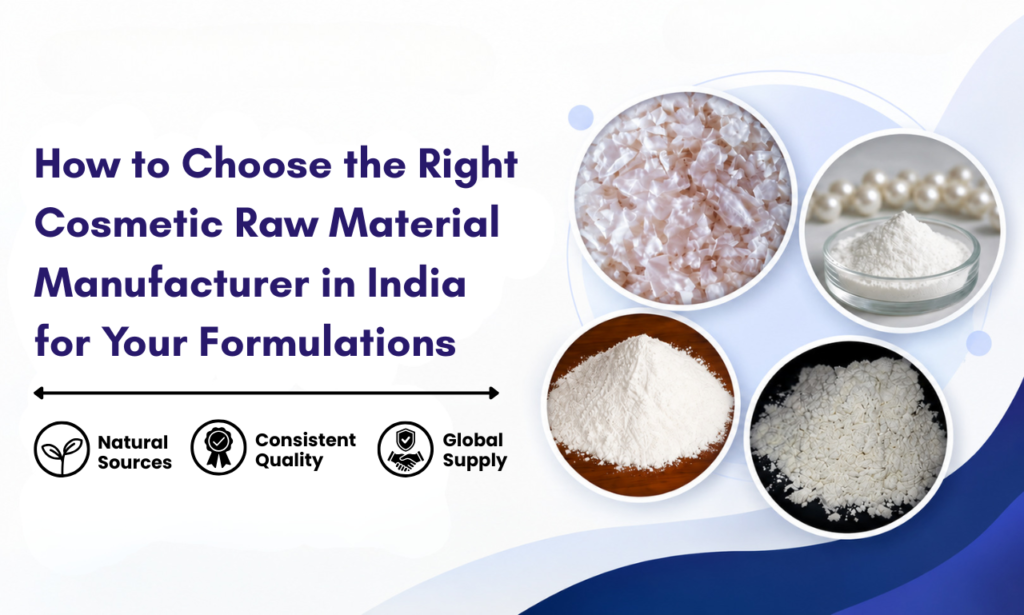
How to Choose the Right Cosmetic Raw Material Manufacturer in India for Your Formulations
Creating a successful cosmetic product starts much earlier than selecting packaging, defining claims or preparing a marketing campaign. The foundation lies in the raw materials selected by the formulation team. Their quality, physical characteristics, consistency and suitability can influence how efficiently a formulation moves from laboratory development to repeat commercial production.
For cosmetic manufacturers, contract manufacturers, private-label brands and R&D laboratories, sourcing becomes more complex when mineral and naturally derived ingredients are involved. Two materials sold under the same ingredient name can differ considerably in origin, processing, whiteness, particle characteristics, texture and sensory behaviour. These differences may not appear significant on a quotation sheet, yet they can become important inside a finished formulation.
Choosing a dependable Cosmetic Raw Material Manufacturer in India should therefore involve technical qualification as well as commercial evaluation. R&D needs formulation-compatible ingredients, QA/QC requires appropriate specifications and documentation, procurement needs continuity of supply, and production teams need raw materials that behave predictably from batch to batch.
Caltron Clays & Chemicals serves these B2B requirements through specialized cosmetic raw materials, with a focus on ingredients developed for modern formulation and manufacturing needs.
Cosmetic Ingredient Quality and Consistency: The Foundation of Better Formulations
Raw-material quality is not defined by one characteristic alone. For cosmetic formulation, the interaction between purity, particle properties, appearance, texture and processing behaviour can be just as important as ingredient identity.
This becomes particularly relevant for mineral powders. A change in whiteness may influence the visual appearance of a face mask, while variation in particle characteristics can change powder feel or spreadability. An ingredient that performs successfully in an R&D sample therefore needs to demonstrate appropriate consistency when purchased repeatedly for commercial manufacturing.
Define Critical Raw Material Attributes Before Supplier Approval
Instead of beginning qualification with price, cosmetic manufacturers should first identify the characteristics that matter to the intended formulation.
Depending on the ingredient and application, these can include identity, source, composition, purity, colour, whiteness, particle characteristics, sensory profile, absorbency, dispersibility, storage requirements and batch consistency.
The objective is simple: the ingredient received during commercial production should remain sufficiently consistent with the material originally approved by the formulation and quality teams.
Cosmetic Raw Material Manufacturer vs Supplier: Know Your Ingredient Source
A cosmetic ingredient may reach a manufacturer through a producer, distributor, supplier or trader. Each business model can serve a purpose, but buyers should understand exactly where the ingredient originates and who controls its processing.
A manufacturer directly involved in processing the ingredient can potentially provide greater visibility into manufacturing operations, quality parameters and batch control. A distributor may provide advantages such as regional inventory or consolidated sourcing. The appropriate option depends on the buyer’s technical and commercial requirements.
Ask the Right Questions Before Selecting a B2B Supplier
When evaluating a Cosmetic Raw Material Manufacturer in India, procurement and technical teams should ask where the ingredient originates, how it is processed, which parameters are monitored and how commercial batches are controlled.
When dealing with a Cosmetic Raw Material Supplier in India, buyers should also establish the original manufacturing source and understand the level of traceability and technical documentation available.
The important consideration is not simply the supplier’s business category. It is whether the supply chain can consistently deliver the required cosmetic-grade material.
Cosmetic-Grade Purity and Raw Material Quality Control Requirements
“Natural” and “cosmetic grade” should not be treated as interchangeable descriptions.
Naturally sourced minerals and biogenic materials can contain inherent variations. Their suitability for cosmetic formulation depends on appropriate sourcing, processing, characterization and quality assessment.
Evaluate More Than the Ingredient Name
Suppose two suppliers offer kaolin powder. Both materials may correctly be identified as kaolin, yet they may differ in whiteness, fineness, sensory feel, absorbency and processing characteristics.
The same principle applies to other naturally derived cosmetic ingredients.
Depending on the material, an evaluation may consider:
- Identity and origin
- Composition and purity
- Appearance and colour
- Whiteness where relevant
- Particle characteristics
- Texture and powder feel
- Absorption characteristics
- Dispersibility
- Relevant microbial requirements
- Relevant contaminant parameters
- Finished-formulation compatibility
The acceptance criteria should always be appropriate for the ingredient, intended application and target market.
Cosmetic Mineral Processing Technology for Consistent Raw Materials
Mineral ingredients rarely move directly from their natural source into a sophisticated cosmetic formulation. Controlled processing helps transform the source material into a more standardized ingredient suitable for commercial evaluation.
Depending on the mineral, processing can include raw-material selection, refining, pulverising, controlled handling and quality assessment.
The goal is not simply to produce a fine powder. The broader objective is to achieve physical and quality characteristics that remain sufficiently predictable for commercial formulation.
Caltron Clays & Chemicals’ Mineral Processing Capabilities
Caltron Clays & Chemicals has developed dedicated processing capabilities at Vapi for cosmetic raw materials of mineral origin. This specialized infrastructure is particularly relevant to SANKOL™ Cosmetic Grade Kaolin Powder.
For cosmetic manufacturers, processing capability is an important supplier-qualification consideration. Buyers should understand how incoming minerals are selected, how materials are processed, which characteristics are monitored and how finished batches are evaluated.
Such questions provide a clearer understanding of the manufacturing process behind the ingredient being purchased.
Batch-to-Batch Consistency in Commercial Cosmetic Manufacturing
A high-quality sample is valuable, but it represents only the beginning of supplier qualification.
Commercial cosmetic manufacturing may require the same raw material over many production cycles. If its important physical characteristics change significantly between batches, the finished formulation may require adjustments.
Why Consistency Matters During Scale-Up
Depending on the formulation, raw-material variation can influence colour, texture, powder feel, spreadability, dispersion, processing behaviour and finished-product appearance.
For naturally sourced ingredients, consistency does not necessarily mean eliminating all natural variation. Instead, the supplier and buyer should establish meaningful specifications within which the ingredient remains suitable for its intended purpose.
R&D teams should therefore consider commercial repeatability at the same time they evaluate the initial sample.
Cosmetic Formulation Compatibility Testing Before Bulk Purchasing
A Certificate of Analysis can confirm whether selected batch parameters meet established specifications. It cannot predict every interaction that may occur inside a cosmetic formulation.
Raw materials can behave differently when combined with oils, water phases, surfactants, pigments, polymers and other formulation components.
This is why representative formulation testing remains essential.
From Laboratory Trial to Pilot-Scale Evaluation
Depending on the application, R&D teams may evaluate:
- Ease of incorporation
- Dispersion
- Processing behaviour
- Texture
- Spreadability
- Sensory feel
- Finished-product appearance
- Interaction with other ingredients
- Relevant stability observations
- Behaviour during scale-up
Testing should reflect the intended use.
For example, the evaluation criteria for kaolin in a dry face powder may differ substantially from those used when the same mineral is incorporated into a wet clay mask.
COA, Technical Documentation and Cosmetic Raw Material Traceability
Technical documentation is an important bridge between formulation approval and routine procurement.
The documents required depend on the ingredient, intended market and buyer’s internal quality system. Relevant information may include product specifications, Certificate of Analysis, technical data, safety information where applicable, ingredient identity, origin, packaging details, storage recommendations and traceability information.
Documentation Connects R&D, QA and Procurement
Strong documentation helps different departments work with the same technical reference.
R&D can identify the grade used during development. QA/QC can establish appropriate incoming-material checks. Procurement can ensure that the correct material is reordered, and production can avoid receiving an alternative grade simply because it carries a similar generic name.
For international buyers, organized technical and commercial documentation can also make supplier qualification and import planning more efficient.
B2B Cosmetic Raw Material Procurement and Supply Chain Reliability
Once an ingredient becomes part of a commercial formula, its availability becomes a manufacturing concern.
Procurement teams should therefore look beyond laboratory performance and examine whether the supplier can support the operational requirements of the business.
Evaluate the Total Cost of Ingredient Sourcing
Commercial evaluation should consider MOQ, packaging, expected lead times, scalability, communication, documentation support, export capability and supply continuity.
An inexpensive ingredient does not necessarily result in economical manufacturing if inconsistent supply leads to production interruptions, additional testing or repeated formulation adjustments.
The more useful question is therefore not simply, “What is the price per kilogram?” but, “What is the overall value and reliability of this raw material within our production system?”
Natural Cosmetic Ingredients and Mineral Raw Material Sourcing from India
India offers a broad ecosystem of mineral, pharmaceutical, chemical, cosmetic and specialty ingredient manufacturing. This creates sourcing opportunities for domestic brands as well as international manufacturers and distributors.
However, location alone should never be considered proof of quality.
Every potential manufacturer should be evaluated according to the specific raw material, its processing requirements, documentation, quality parameters and commercial supply capabilities.
Cosmetic Ingredient Sourcing for International Buyers
International procurement teams should clarify specifications, sample approval procedures, packaging, documentation, commercial lead times, export requirements and logistics before establishing routine supply.
A capable Cosmetic Raw Material Supplier in India should be able to communicate these requirements clearly across R&D, quality and procurement functions.
SANKOL™ Cosmetic Grade Kaolin Powder for Modern Cosmetic Formulations
Kaolin remains an important mineral ingredient across a wide range of personal-care formulations. Its usefulness depends not only on mineral identity but also on physical characteristics that affect the finished formulation.
SANKOL™ from Caltron Clays & Chemicals is a cosmetic-grade kaolin clay powder sourced from high-purity natural Indian mineral deposits. It is an ultra-fine hydrated aluminium silicate developed for cosmetic and personal-care applications.
Its high whiteness, absorbent nature and smooth mineral characteristics make it relevant for formulations where oil management, mattifying effects, texture and powder feel are important.
Applications for SANKOL™ Kaolin Powder
SANKOL™ can be evaluated for use in clay masks, face powders, foundations, baby powders, soaps, sunscreen formulations and selected personal-care applications.
Companies searching for a Kaolin Powder Manufacturer in India should evaluate the ingredient’s purity, whiteness, physical characteristics, absorption behaviour, sensory properties and batch consistency.
Caltron Clays & Chemicals’ dedicated mineral-processing infrastructure at Vapi supports its focus on controlled cosmetic mineral processing.
When comparing a Kaolin Powder Supplier in India, buyers should request a representative sample and test the material in the intended formulation before commercial approval.
EGGCAL-ESM™ Egg Shell Membrane Powder for Differentiated Skincare Concepts
The demand for distinctive naturally derived ingredients has encouraged formulators to explore materials beyond conventional cosmetic minerals.
EGGCAL-ESM™ from Caltron Clays & Chemicals is derived from the natural inner membrane of hen eggshells. Egg shell membrane is a complex biogenic material associated with structural proteins and naturally occurring constituents.
This distinctive composition makes it relevant for R&D teams exploring advanced skincare concepts.
Cosmetic Formulation Opportunities with Egg Shell Membrane
EGGCAL-ESM™ can be investigated for mature-skin concepts, hydration-focused products, firming-positioned cosmetics, under-eye formulations, serums and repair-oriented cosmetic concepts.
A company evaluating an EggShell Membrane Powder Manufacturer in India should pay particular attention to raw-material source, processing, composition, traceability, relevant microbiological parameters and batch consistency.
When choosing an EggShell Membrane Powder Supplier in India, documentation and technical communication also become particularly important because the ingredient has a biological origin.
Any specific efficacy claim associated with the finished cosmetic should be supported by appropriate evidence.
DIATOMi™ Diatomaceous Earth Natural Scrubbing Salt for Mineral-Based Exfoliation
Consumer and formulation interest in alternatives to conventional plastic-based exfoliating particles has increased the relevance of mineral exfoliation systems.
DIATOMi™ Natural Scrubbing Salt from Caltron Clays & Chemicals is based on cosmetic-grade diatomaceous earth derived from naturally occurring fossilized diatoms. Its characteristic mineral structure makes it suitable for evaluation as a physical exfoliating ingredient.
Natural Scrubbing Applications for DIATOMi™
Formulators can investigate DIATOMi™ for facial exfoliators, body scrubs, foot-care products, cleansing formulations and professional cosmetic applications.
The material can also be considered when developing formulations that seek a mineral-based alternative to plastic microbeads.
When sourcing from a Diatomaceous Earth Powder Manufacturer in India, buyers should assess purity, particle characteristics, exfoliation intensity, sensory behaviour and batch consistency.
A Diatomaceous Earth Powder Supplier in India should also clearly identify the supplied grade because diatomaceous earth intended for different industries should not automatically be treated as interchangeable with cosmetic material.
Sustainable Cosmetic Raw Materials and Responsible Ingredient Selection
Sustainability is becoming increasingly connected with cosmetic product development. Formulators are considering ingredient origin, processing, biodegradability, circularity and alternatives to conventional materials.
Mineral ingredients can contribute to particular formulation strategies, while materials derived from existing biological streams may create opportunities for circular ingredient concepts.
For example, DIATOMi™ can be evaluated as a mineral-based physical exfoliating option, while egg-derived EGGCAL-ESM™ is relevant to discussions around the productive use of naturally derived material streams.
However, environmental claims should remain evidence-based. Terms such as “sustainable,” “eco-friendly” and “zero waste” should only be used where the relevant sourcing, processing and lifecycle information supports them.
Common Mistakes When Choosing a Cosmetic Raw Material Supplier
One of the most frequent mistakes in ingredient procurement is comparing suppliers primarily on price. Cost matters, but an inexpensive material can become costly if it creates quality variation, formulation rework or production interruptions.
Another mistake is approving a supplier after testing only a single sample. Commercial sourcing requires confidence in repeated batches, not just one successful laboratory trial.
Manufacturers should also avoid assuming that two ingredients with the same generic name will perform identically. Source and processing can create meaningful differences in physical characteristics.
Finally, QA/QC, production and procurement should be involved early enough to ensure that technical approval can translate successfully into commercial manufacturing.
Cosmetic Raw Material Supplier Qualification Checklist for B2B Manufacturers
Before approving a new supplier, cosmetic businesses should establish a qualification process covering the most important technical and commercial areas.
Ingredient identity: Confirm the exact material, grade, origin and intended cosmetic application.
Quality: Review purity, physical characteristics, relevant specifications and batch consistency.
Technical documentation: Assess product specifications, COA and other documentation required for the material and destination market.
R&D suitability: Obtain representative samples and conduct formulation testing.
Manufacturing capability: Understand relevant processing and quality-control procedures.
Commercial supply: Evaluate packaging, MOQ, lead time, scalability and continuity.
Technical communication: Determine whether the supplier can effectively support questions from R&D, QA/QC and procurement.
Export requirements: International buyers should also establish documentation, packaging and logistics expectations before routine ordering.
Why B2B Cosmetic Manufacturers Consider Caltron Clays & Chemicals
Caltron Clays & Chemicals focuses on specialized raw materials that address different cosmetic formulation requirements.
SANKOL™ provides cosmetic-grade kaolin for formulations where absorbency, mattifying properties, texture and mineral characteristics are important.
EGGCAL-ESM™ provides a naturally derived egg shell membrane ingredient for formulators exploring differentiated skincare concepts.
DIATOMi™ Natural Scrubbing Salt offers a mineral-based approach to physical exfoliation for scrubs, cleansers and related personal-care applications.
For manufacturers evaluating Caltron Clays & Chemicals as a Cosmetic Raw Material Manufacturer in India, the recommended process is application-driven: identify the required functionality, discuss the appropriate material, review relevant technical information, test a representative sample and establish commercial requirements before scale-up.
This approach helps connect ingredient sourcing with the practical requirements of formulation development and repeat manufacturing.
Frequently Asked Questions
1. How do I choose a reliable Cosmetic Raw Material Manufacturer in India?
Evaluate manufacturing capability, ingredient specifications, consistency, technical documentation, sample quality and commercial supply reliability. Caltron Clays & Chemicals supports B2B cosmetic formulators with specialized mineral and naturally derived raw materials.
2. What should I check before purchasing cosmetic ingredients in bulk?
Confirm the exact grade, specifications, relevant purity parameters, COA, packaging, storage conditions and supply terms. A representative sample should also be tested in the intended formulation before bulk procurement.
3. Why is batch consistency important for cosmetic ingredients?
Batch consistency helps reduce unexpected differences in colour, texture, dispersion, sensory characteristics and processing behaviour. It becomes particularly important when a laboratory formulation moves into repeated commercial production.
4. How can I select a Kaolin Powder Manufacturer in India?
Compare mineral source, purity, whiteness, particle characteristics, processing capabilities and consistency. Caltron Clays & Chemicals offers SANKOL™ Cosmetic Grade Kaolin Powder for B2B cosmetic and personal-care formulation requirements.
5. What is SANKOL™ Kaolin Powder used for?
SANKOL™ can be evaluated for clay masks, face powders, foundations, soaps, baby powders and selected personal-care applications where absorbency, mineral texture and mattifying characteristics are relevant.
6. What should I check when choosing a Kaolin Powder Supplier in India?
Review the supplied grade, specifications, whiteness, physical characteristics, documentation and repeat-supply capability. Formulation trials are important because kaolin characteristics can differ between sources and grades.
7. What is EggShell Membrane Powder used for in cosmetic formulations?
Egg shell membrane can be investigated for differentiated mature-skin, hydration, firming and premium skincare concepts. Caltron Clays & Chemicals offers EGGCAL-ESM™ Egg Shell Membrane Powder for B2B formulation evaluation.
8. What is cosmetic-grade Diatomaceous Earth used for?
It can be evaluated as a mineral-based physical exfoliating ingredient in body scrubs, facial exfoliators, foot-care products and selected cleansers. Caltron Clays & Chemicals offers DIATOMi™ Natural Scrubbing Salt for cosmetic formulation applications.
9. What documents should a Cosmetic Raw Material Supplier in India provide?
Requirements vary by ingredient and market, but buyers may review specifications, COAs, technical information, applicable safety documentation, packaging information, storage recommendations and relevant traceability documents.
10. Why evaluate Caltron Clays & Chemicals for cosmetic raw materials?
Caltron Clays & Chemicals combines specialized mineral-processing experience with ingredients such as SANKOL™, EGGCAL-ESM™ and DIATOMi™, enabling B2B manufacturers to evaluate different raw materials according to their formulation objectives.
From Ingredient Selection to Commercial Scale-Up: Choose the Right Raw Material Partner
Finding the right Cosmetic Raw Material Manufacturer in India requires a broader perspective than comparing product names and quotations. Ingredient purity, physical characteristics, manufacturing controls, technical documentation, formulation compatibility, batch consistency and supply continuity all contribute to the quality of a long-term sourcing relationship.
Caltron Clays & Chemicals supports cosmetic manufacturers, formulators, private-label businesses, procurement teams and international buyers with specialized ingredients such as SANKOL™ Cosmetic Grade Kaolin Powder, EGGCAL-ESM™ Egg Shell Membrane Powder and DIATOMi™ Natural Scrubbing Salt. Each material offers a different formulation direction and should be evaluated according to the technical requirements of the finished cosmetic product.
For B2B buyers searching for a dependable Cosmetic Raw Material Supplier in India, the most effective next step is technical qualification. Discuss your intended application with Caltron Clays & Chemicals, review the relevant product information, request samples and conduct formulation trials before moving to commercial-scale procurement.
Caltron Clays & Chemicals Pvt Ltd
Address: Office No. 211, 2nd Floor, Orbit Premises, Next to Sheetal Banquets, Opp to Inox Plaza, Mindspace, Malad West, Mumbai, Maharashtra 400064 India
Phone No.: 022 3571 9844 | +91 70214 37453 | +91 22 2876 4864
Website: https://caltronclays.com
Email: marketing@caltronclays.com | sales@caltronclays.com
Google Maps: https://maps.app.goo.gl/jCuz1ZCf1iAhzZiH7
