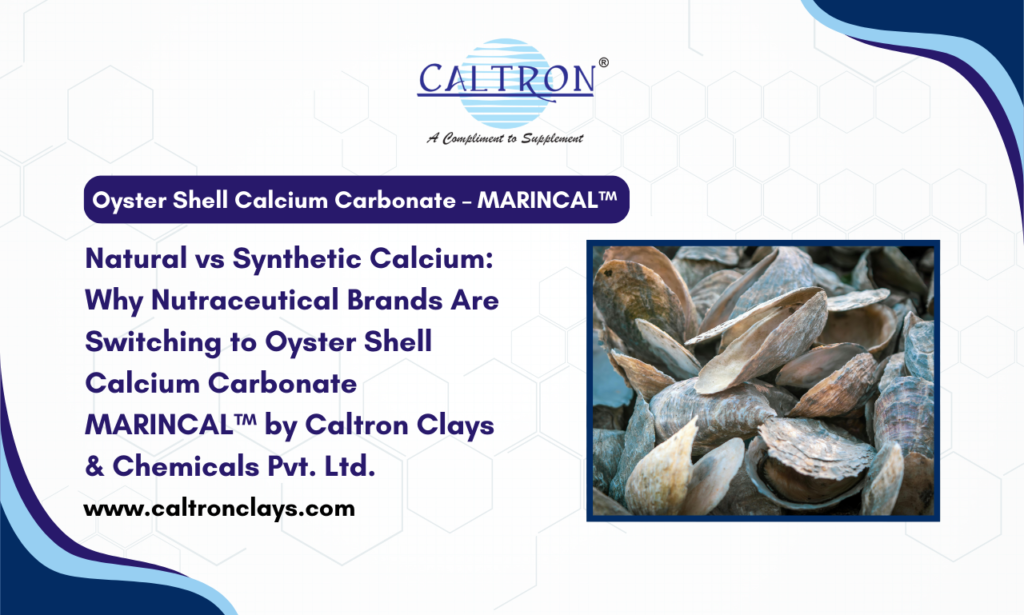
Introduction:
Calcium deficiency continues to remain one of the most widespread micronutrient gaps across global populations. From pediatric bone development concerns to post-menopausal bone density decline and geriatric fracture risks, calcium supplementation remains foundational to preventive nutrition strategies. Yet, the modern nutraceutical industry is no longer asking how much calcium a formulation contains. The more critical question today is: What type of calcium is being used?
For decades, synthetic rock-derived calcium carbonate dominated pharmaceutical and supplement manufacturing because of its affordability and availability. However, increasing scrutiny around sourcing transparency, impurity profiles, heavy metal control, sustainability, and clean-label demand has significantly altered procurement strategies.
Today, nutraceutical brands are actively shifting toward marine-derived calcium — particularly MARINCAL™ Oyster Shell Calcium Carbonate, a pharmaceutical-grade marine calcium solution manufactured by Caltron Clays & Chemicals Pvt. Ltd.. As a recognized Oyster Shell Calcium Carbonate Powder Manufacturer in India, the company supports global nutraceutical, pharmaceutical, and food supplement manufacturers seeking scalable, compliant, and high-purity marine calcium solutions.
This comprehensive B2B article explores the scientific, regulatory, commercial, and branding factors driving the global shift from synthetic calcium to marine calcium — and why MARINCAL™ has become a strategic raw material for forward-thinking nutraceutical brands.
The Global Calcium Market: A Structural Evolution
Calcium plays a critical physiological role in:
- Bone mineralization
- Neuromuscular transmission
- Cardiovascular function
- Enzyme regulation
- Hormonal signaling
Despite its importance, global calcium intake remains suboptimal due to:
- Reduced dairy consumption
- Vegan and plant-based dietary shifts
- Urban lifestyle eating patterns
- Processed food dependency
- Aging populations
The nutraceutical industry has responded with diverse dosage formats — tablets, capsules, chewables, suspensions, effervescents, fortified beverages, and protein blends. However, consumer expectations have evolved beyond elemental calcium percentage.
Modern supplement buyers evaluate:
- Source origin
- Natural vs synthetic labeling
- Heavy metal safety
- Sustainability
- Trace mineral presence
- Long-term supplementation perception
This transformation has intensified comparisons between synthetic calcium carbonate and oyster shell-derived marie calcium.
Understanding Synthetic Calcium Carbonate
Synthetic calcium carbonate (CaCO₃) is primarily derived from:
- Mined limestone deposits
- Chemically precipitated calcium carbonate (PCC)
Industrial Processing Requirements
Rock-based calcium typically undergoes:
- High-temperature calcination
- Chemical purification
- Grinding and micronization
- Particle size standardization
While these processes can yield pharmaceutical-grade calcium carbonate, they involve extensive industrial intervention.
Limitations & Industry Concerns
Though regulated, rock-derived materials may carry:
- Trace heavy metals
- Geological contaminants
- Variability in mineral composition
Absorption of synthetic calcium carbonate is also influenced by gastric acidity levels, which can be reduced in elderly populations — a key demographic for calcium supplementation.
While cost-effective, synthetic calcium increasingly positions brands within commodity supplement categories, limiting premium differentiation.
What Is Marine-Derived Oyster Shell Calcium?
Marine calcium is derived from oyster shells formed through natural marine biomineralization processes. Unlike geological limestone, oyster shells are biologically structured calcium carbonate matrices.
Structural & Mineral Characteristics
Oyster shell calcium naturally contains:
- Calcium carbonate
- Trace magnesium
- Silica
- Marine-derived trace minerals
This natural mineral synergy supports its positioning as Natural Calcium for Nutraceuticals.
Clean Label & Sustainability Appeal
Marine calcium aligns with:
- Natural ingredient positioning
- Minimal chemical narrative
- Sustainable sourcing messaging
- Premium wellness branding
For modern supplement brands, this distinction is commercially significant.
Natural vs Synthetic Calcium: A Strategic Comparison
1. Source Origin
Synthetic calcium originates from mined rock or chemical precipitation.
Marine calcium is biologically formed within marine ecosystems.
2. Processing
Rock calcium requires intensive industrial processing.
Marine calcium undergoes controlled purification and micronization while preserving mineral integrity.
3. Bioavailability Perception
While both forms provide elemental calcium, marine calcium is widely perceived as more bio-compatible due to biological origin and trace mineral presence.
4. Mineral Synergy
Synthetic calcium primarily provides CaCO₃.
Marine calcium contains trace magnesium and complementary marine minerals.
5. Heavy Metal & Impurity Control
Geological sources may carry variable impurity risks.
Pharmaceutical-grade marine calcium undergoes heavy metal controlled processing protocols.
6. Market Positioning
Synthetic calcium = commodity segment
Marine calcium = premium, clean-label segment
7. Long-Term Brand Strategy
Short-term cost savings vs long-term brand equity enhancement.
Why Nutraceutical Brands Are Switching to MARINCAL™
1. Consumer Preference for Natural Sourcing
The term “marine calcium” resonates more positively than “synthetic calcium carbonate.”
2. Clean Label Movement
Global markets increasingly prioritize recognizable, nature-derived ingredients.
3. Regulatory Compliance
Export-focused nutraceutical brands require:
- Heavy metal test reports
- GMP documentation
- Batch traceability
- Pharmaceutical-grade compliance
As a leading Oyster Shell Calcium Carbonate Powder Supplier in India, Caltron Clays & Chemicals Pvt. Ltd. ensures export-ready quality documentation.
4. Premium Pricing Strategy
Marine calcium enables:
- Higher product positioning
- Improved storytelling
- Enhanced consumer trust
- Better margins
5. Aging Population Demographics
By 2030, global geriatric populations will significantly increase, driving demand for long-term supplementation products.
Oyster Species: Oysto Teratta vs Meta-Calciota
Marine calcium production commonly utilizes two oyster shell variants:
Oysto Teratta
- Higher CaCO₃ assay
- Approximately 1.5% magnesium
- Fibrous flaky structure
- Premium-grade raw material
- Limited availability
Ideal for high-end nutraceutical tablets and capsules.
Meta-Calciota
- More abundant species
- Slightly lower assay
- Economical sourcing
- Suitable for cost-sensitive formulations
Caltron Clays & Chemicals Pvt. Ltd. maintains a diversified global procurement network to ensure uninterrupted bulk supply.
Applications of MARINCAL™ in Modern Formulations
MARINCAL™ supports multiple dosage formats:
Tablets
Excellent compressibility and particle uniformity.
Capsules
Compatible with gelatin and vegetarian capsules.
Chewables
Ideal for flavored pediatric and women’s health supplements.
Suspensions
Used in liquid calcium formulations for geriatric applications.
Softgel Blends
Combined with Vitamin D3 & K2 systems.
Functional Foods
Fortified beverages, nutrition powders, protein blends.
Cosmetic & Mineral-Based Formulations
Used in mineral skincare and dermal formulations.
As a recognized Oyster Shell Calcium Powder Bulk Supplier, Caltron supports scalable production across dosage categories.
Manufacturing & Quality Control Excellence
The MARINCAL™ purification and processing system includes:
- Raw shell selection from trusted marine sources
- Multi-stage cleaning to remove organic residues
- Controlled thermal treatment for microbial safety
- Micronization for particle size consistency
- Heavy metal analysis
- Batch traceability documentation
- Export-compliant packaging
This positions Caltron Clays & Chemicals Pvt. Ltd. as a pharmaceutical-grade marine calcium specialist serving global nutraceutical and pharmaceutical manufacturers.
Commercial Advantages for B2B Buyers
Bulk Supply Capability
Scalable production for domestic and international contracts.
Export-Grade Documentation
Supports regulatory filings across Asia, Europe, and North America.
Competitive Pricing Structure
Balances premium positioning with cost efficiency.
Decades of Marine Mineral Expertise
Deep technical understanding of marine calcium processing.
Reliable Marine Calcium Supplier Network
Ensures raw material continuity even during global supply disruptions.
The Marine Calcium Market Outlook (2026 and Beyond)
Market indicators suggest sustained growth driven by:
- Clean-label supplement expansion
- Premium nutraceutical positioning
- Increased regulatory scrutiny
- Demand for traceable natural raw materials
- Growing geriatric populations
Marine-derived calcium is not a short-term trend. It represents a structural evolution in calcium supplementation strategy.
Brands that adapt early position themselves for premium differentiation and regulatory resilience.
Frequently Asked Questions
Is oyster shell calcium better than synthetic calcium?
Oyster shell calcium is derived from natural marine sources and contains trace minerals. Many nutraceutical brands prefer it for clean-label positioning and premium differentiation.
Is marine calcium safe for long-term supplementation?
When processed under pharmaceutical-grade controls, marine calcium is widely used in long-term supplementation products.
What is the difference between Oysto Teratta and Meta-Calciota?
Oysto Teratta offers higher assay and trace magnesium, ideal for premium formulations, while Meta-Calciota provides an economical natural alternative.
What industries use oyster shell calcium carbonate?
It is widely used in nutraceutical manufacturing, pharmaceutical raw materials, functional foods, and cosmetic formulations.
Is MARINCAL™ suitable for tablets and capsules?
Yes. MARINCAL™ is engineered for tablet compression, encapsulation, suspensions, chewables, and blended systems.
Conclusion: A Strategic Shift Toward Marine Excellence
The global nutraceutical industry is entering a phase defined by transparency, sustainability, regulatory compliance, and premium positioning. The debate between synthetic and natural calcium now centers on sourcing integrity, heavy metal control, and long-term brand trust — not just elemental calcium percentages.
By offering MARINCAL™, Caltron Clays & Chemicals Pvt. Ltd. strengthens its role as a leading Oyster Shell Calcium Carbonate Powder Manufacturer in India and a trusted Marine Calcium Supplier to global nutraceutical brands.
For manufacturers seeking:
- Pharmaceutical-grade calcium carbonate
- Oyster Shell Calcium Carbonate Powder Supplier in India
- Natural Calcium for Nutraceuticals
- Bulk export-ready marine calcium
MARINCAL™ provides purity, scalability, compliance, and premium positioning required for next-generation supplement formulations.
Connect with Caltron Clays & Chemicals Pvt. Ltd.
Website: https://caltronclays.com
Office: Office №211, 2nd Floor, Orbit Premises, Next to Sheetal Banquets, Opp. Inox Plaza, Mindspace, Off New Link Road, Chincholi Bunder, Malad West, Mumbai, Maharashtra 400064, India
Email: marketing@caltronclays.com | sales@caltronclays.com
Call: +91 70214 37453 / +91 22 2876 4864 / +91 22 3571 9844
Google Maps: https://maps.app.goo.gl/jCuz1ZCf1iAhzZiH7
Enquire for bulk orders and export supply partnerships.
