Introduction
For an industrial manufacturer, steel coil is not merely a raw material purchased by weight. It becomes the starting point for forming, cutting, stamping, profiling and fabrication. The specifications selected at the procurement stage can therefore influence production efficiency, material utilization, machine compatibility and the quality of the finished component.
A coil that is wider than the production line requires may need additional slitting. Incorrect thickness can interfere with the intended forming process. An unsuitable surface finish can affect the appearance of roofing sheets, panels or other visible products. Similarly, selecting a coating without considering environmental exposure can lead to an inappropriate material choice.
This is why manufacturers evaluating a Trading Coil Manufacturer in India should examine far more than the quoted price. Product type, dimensions, coating, surface finish, slitting capability, production compatibility and supplier consistency all deserve attention.
Businesses searching for a Galvanized Coil Manufacturer in India should take the same approach. The right galvanized coil should align with the intended application and machinery instead of forcing the production team to adapt an unsuitable raw material.
Allied Ispat Pvt. Ltd. supplies galvanized and color-coated coils for industrial and infrastructure requirements. Its current trading-coil portfolio includes GI Coil, GI Slit Coil, PPGI Coil, PPGI Slit Coil and GL Coil, along with various color and customized dimensional options.
This guide explains how manufacturers, procurement managers, fabricators, OEMs and production teams can make a more informed trading-coil purchasing decision.
What Is a Trading Coil?
A trading coil is flat-rolled steel supplied in continuous coiled form and purchased for further processing.
Instead of buying a completed profile or fabricated component, an industrial user receives the raw material in coil form and processes it according to the production requirement.
Depending on the manufacturing setup, the material can be:
- Slit into narrower strips
- Roll formed into profiles
- Cut into sheets
- Stamped into components
- Bent and fabricated
- Converted into roofing or cladding products
- Processed into panels or other industrial products
Different applications may require galvanized, Galvalume, pre-painted, cold-rolled, hot-rolled or other steel products.
The official website of Allied Ispat Pvt. Ltd. identifies GI, GL, HR, CR, EG and SS among the wider coil categories associated with its trading activities.
The most suitable coil is therefore determined by how the steel will ultimately be processed and used.
Why Should Industrial Buyers Take Coil Selection Seriously?
A manufacturing line performs most efficiently when its incoming raw material is aligned with the process.
If a company purchases an unsuitable coil, the production team may have to compensate through additional slitting, adjustment, handling or inspection.
The consequences can include:
- Unnecessary secondary processing
- Increased material handling
- Additional scrap
- Production interruptions
- Machine-setting changes
- Inconsistent finished dimensions
- Surface-quality concerns
- Longer production preparation
Choosing the correct coil at the beginning can help reduce these avoidable steps.
A professional Trading Coil Manufacturer in India should therefore be considered as part of the manufacturer’s supply chain rather than simply as a source of steel inventory.
1. Define the End Application First
A good coil-selection process starts with the finished product.
Procurement teams should first determine:
What will this coil become?
A roofing profile has different priorities from an internal fabricated component. A decorative panel may require a consistent color-coated surface, while a roll-formed industrial profile may place greater importance on width, thickness and forming compatibility.
Common coil-based applications can include:
- Roofing sheets
- Wall cladding
- Industrial panels
- Roll-formed profiles
- Fabricated steel parts
- Construction components
- Appliance components
- Automotive-related products
- Infrastructure products
Allied Ispat Pvt. Ltd. identifies automotive, construction, appliances, roofing and paneling among the application areas for its color-coated coil products.
The application should therefore determine the material—not the other way around.
2. Understand Which Coil Type Your Product Requires
Not every steel coil offers the same surface characteristics or protection. The material category must be matched to the manufacturing and application requirements.
GI Coil
GI Coil refers to galvanized steel coil.
During galvanization, a zinc-based protective coating is applied to the steel. This coating helps protect the underlying steel from corrosion.
GI Coil can be relevant to a range of industrial, construction and fabrication applications.
Allied Ispat Pvt. Ltd. lists both GI Coil and multiple GI Slit Coil options within its trading-coil portfolio.
When approaching a Galvanized Coil Manufacturer in India, buyers should not stop at asking whether GI Coil is available. They should also provide the required dimensions, processing method and application.
PPGI Coil
PPGI refers to pre-painted galvanized steel.
It combines galvanized steel with a finished paint coating and can be selected where visual appearance is an important part of the final product.
PPGI can be relevant for:
- Roofing
- Wall panels
- Appliances
- Architectural applications
- Prefabricated products
- Visible fabricated steel components
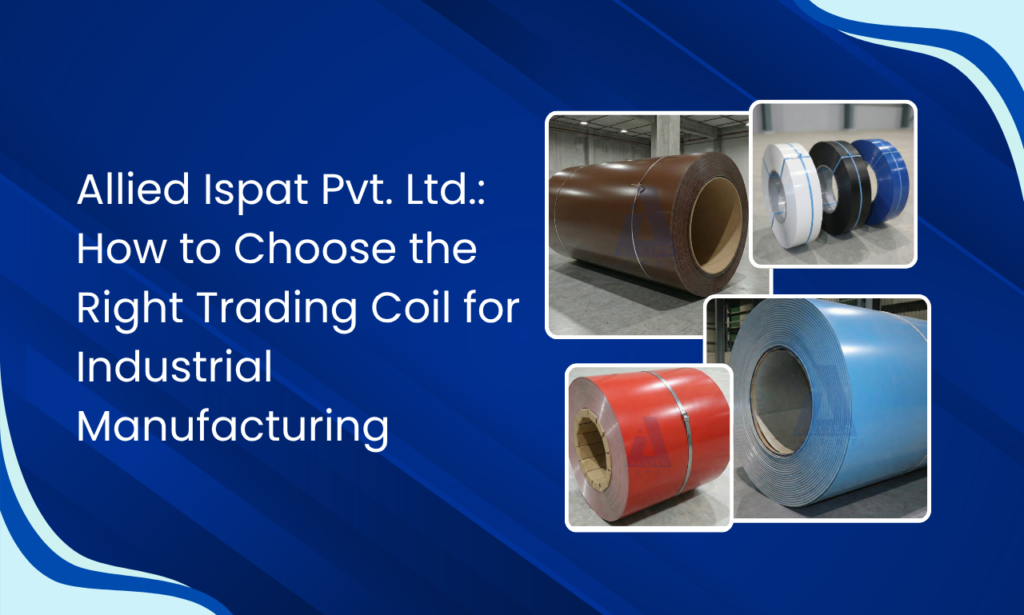
Allied Ispat Pvt. Ltd. currently displays PPGI Coil in blue, white and brown, along with PPGI Slit Coil.
GL Coil
GL generally refers to Galvalume-coated steel.
It uses a metallic coating system different from conventional galvanized steel. Buyers should select GL only where it matches the specified product, forming process and application.
GL Coil is included in the current trading-coil portfolio of Allied Ispat Pvt. Ltd.
PPGL Material
PPGL combines a pre-painted finish with a Galvalume-type substrate.
The trading-coil page of Allied Ispat Pvt. Ltd. references both PPGI and PPGL materials in its discussion of color-coated coil solutions.
Neither GI, PPGI, GL nor PPGL should automatically be described as the best material. The correct option depends on specifications and end use.
3. Specify the Correct Coil Thickness
Thickness is a fundamental technical parameter.
It can affect:
- Forming behaviour
- Finished-product dimensions
- Component weight
- Material consumption
- Machine setup
- Product characteristics
Procurement teams should obtain the required thickness from approved product, engineering or manufacturing specifications before ordering.
Choosing thinner material simply because it costs less may create an unsuitable finished product. Choosing thicker material unnecessarily can also increase weight and material usage without delivering any useful benefit.
According to its current product information, Allied Ispat Pvt. Ltd. offers customized trading-coil thicknesses ranging from 0.15 mm to 1.5 mm, depending on the requirement.
For manufacturers comparing a Trading Coil Manufacturer in India, the ability to source the required thickness can be an important consideration, particularly for repetitive manufacturing.
4. Match Coil Width to the Production Line
Width should be selected with the machine in mind.
Many roll forming, stamping and coil-processing machines require material within a specified strip width.
Suppose a machine requires a relatively narrow strip but the manufacturer purchases a substantially wider master coil. The material must then undergo slitting before it can enter production.
That introduces another operation.
Correctly specified width can help manufacturers:
- Reduce unnecessary secondary slitting
- Simplify production preparation
- Reduce material handling
- Improve material utilization
- Better coordinate raw material with machinery
Allied Ispat Pvt. Ltd. states that it supplies custom-slit and wide-width coils. Its published custom range currently covers widths from 20 mm to 1250 mm, depending on the specific requirement.
This flexibility can be important for companies looking for a Trading Coil Manufacturer in Mumbai or supplying production plants across India.
5. Determine Whether a Slit Coil Is More Suitable
A slit coil is created by cutting a wider coil longitudinally into narrower strips.
Slitting allows manufacturers to obtain material closer to the exact width required by their equipment.
Slit coils are particularly relevant to:
- Roll forming lines
- Stamping operations
- Profile manufacturing
- Component fabrication
- Continuous production systems
Before requesting slit material, specify:
- Required strip width
- Coil thickness
- Material type
- Coating requirement
- Surface finish
- Machine specifications
- Approximate quantity
Allied Ispat Pvt. Ltd. offers both GI Slit Coil and PPGI Slit Coil within its existing product range.
Manufacturers comparing a Galvanized Coil Manufacturer in India should consider slitting capability if the material will be used in narrow-strip production.
6. Select Coating According to the Operating Environment
The final environment should influence the material specification.
A steel product installed indoors under controlled conditions may have different requirements from one exposed to outdoor humidity, rainfall or coastal air.
Factors to consider include:
- Indoor or outdoor installation
- Humidity
- Moisture exposure
- Rain
- Coastal environment
- Industrial atmosphere
- Surface exposure
Galvanized steel uses a protective zinc coating that helps reduce corrosion of the underlying steel.
However, galvanized material should be described as corrosion resistant, not automatically corrosion proof.
Actual service performance can depend on:
- Coating specification
- Environmental severity
- Forming and fabrication
- Cut edges
- Surface damage
- Installation
- Maintenance
For this reason, companies contacting a Galvanized Coil Manufacturer in India should explain the final application and exposure conditions rather than requesting a generic GI product.
7. Consider Surface Finish Where Appearance Matters
Not every finished steel component remains hidden.
Roofing, wall panels, cladding systems, appliances and architectural components can remain visible after installation. In these applications, surface appearance becomes part of the finished-product quality.
Important considerations can include:
- Color consistency
- Surface uniformity
- Gloss
- Coating condition
- Handling marks
- Appearance after forming
Color-coated coils provide manufacturers with a material that already includes the required painted surface.
The current product portfolio of Allied Ispat Pvt. Ltd. lists blue, white and brown PPGI coils. The company also states that decorative flower-print and wood-grain finishes can be offered for applicable bulk custom orders.
For a manufacturer sourcing visible steel products, a Trading Coil Manufacturer in India should therefore be evaluated for surface options as well as dimensions.
8. Confirm Compatibility with Roll Forming Machines
Roll forming processes continuous steel strip through a series of forming stations to create a finished profile.
Because the process depends on continuous material feeding, the incoming coil should closely match the production specification.
Manufacturers should verify:
- Material type
- Coil thickness
- Strip width
- Surface finish
- Feeding requirement
- Forming requirement
- Cutting process
- Finished profile dimensions
If these specifications are not aligned, the production team may need to make unnecessary adjustments before or during processing.
Allied Ispat Pvt. Ltd. states that its customized coil widths and thicknesses can be tailored for roll forming and stamping machinery.
The broader business of Allied Ispat Pvt. Ltd. also includes roll forming machines, rolling shutter components and false-ceiling systems, connecting its steel activities with several coil-fed manufacturing processes.
This manufacturing context can be relevant to buyers evaluating a Trading Coil Manufacturer in Mumbai for specialized industrial requirements.
9. Examine Coil Consistency, Not Just the First Sample
One acceptable coil does not automatically indicate reliable long-term supply.
Industrial manufacturers usually require consistent specifications across repeat orders.
Procurement teams should evaluate:
- Thickness
- Width
- Dimensional accuracy
- Edge condition
- Surface appearance
- Coating adhesion
- Color consistency
- Packaging
- Traceability
Variation between batches can increase inspection requirements and create production adjustments.
Allied Ispat Pvt. Ltd. states that its quality-control process includes checks for thickness, coating adhesion, color uniformity and dimensional accuracy. The company also references ISO 9001:2015 in its quality process.
Consistency should therefore be an important evaluation point when choosing a Galvanized Coil Manufacturer in India for recurring B2B requirements.
10. Use Customized Coils Where Standard Sizes Create Extra Work
Industrial machinery is not universally designed around one standard coil size.
Production operations may require:
- Narrow widths
- Wider coils
- Specific thicknesses
- Slit formats
- Different coatings
- Particular PPGI colors
If standard stock does not match these requirements, the manufacturer may need to modify the material after purchasing it.
That means extra handling and another production stage.
Allied Ispat Pvt. Ltd. specifically states that it offers precision-cut customized galvanized and color-coated coils, including narrow-width, wide-width and slit-coil formats.
This makes customization an important factor when selecting a Trading Coil Manufacturer in India for a production line with defined material-input requirements.
11. Review Quality Control Before Finalizing the Supplier
Price and availability are easy to compare.
Quality systems are equally important but sometimes overlooked.
A serious B2B buyer should ask how incoming and processed material is checked.
Relevant inspection points may include:
- Thickness verification
- Width verification
- Surface condition
- Coating consistency
- Color uniformity
- Dimensional accuracy
- Traceability
The official trading-coil page of Allied Ispat Pvt. Ltd. states that every coil undergoes quality checks and specifically references inspection of thickness, coating adhesion, color uniformity and dimensional accuracy.
The main company website also identifies Allied Ispat Pvt. Ltd. as ISO 9001:2015 certified.
These factors can help procurement teams assess supplier capability beyond the quoted material price.
12. Compare Total Production Impact, Not Just Purchase Rate
Procurement teams naturally focus on price because raw-material cost affects product economics.
However, coil price should be considered together with manufacturing suitability.
A lower-cost coil may ultimately require:
- Additional slitting
- More handling
- Extra inspection
- Machine adjustments
- Greater production preparation
- Additional material losses
A coil supplied closer to the actual production specification may reduce some of those steps.
That does not mean the highest-priced material is always superior. It means quotations should be compared on like-for-like technical specifications.
A reliable Trading Coil Manufacturer in India should therefore be evaluated on total suitability rather than price in isolation.
Trading Coil Selection Table for Procurement Teams
| Selection Factor | What Buyers Should Check | Why It Matters |
|---|---|---|
| Application | Final product and installation environment | Establishes basic material requirement |
| Coil Type | GI, PPGI, GL, PPGL or specified material | Helps match coating and finish |
| Thickness | Approved manufacturing specification | Influences forming and product characteristics |
| Width | Machine-input requirement | Can reduce secondary processing |
| Slitting | Required strip dimensions | Supports narrow-width production |
| Coating | Exposure and end use | Supports appropriate corrosion resistance |
| Surface Finish | Color and visual requirements | Important for visible products |
| Machinery | Roll forming or stamping requirements | Helps ensure processing compatibility |
| Quality | Dimensional and surface consistency | Supports repeatable manufacturing |
| Supplier Capability | Customization and B2B supply | Important for ongoing procurement |
Common Mistakes to Avoid When Purchasing Trading Coils
Buying Primarily on Price
A lower price can lose its advantage if the coil needs extensive secondary processing.
Ignoring the Final Product
Material selection should always begin with the actual application.
Ordering the Wrong Width
Incorrect width can create avoidable slitting and handling.
Selecting Thickness Without Production Input
Thickness should be based on approved technical and manufacturing requirements.
Forgetting Machinery Compatibility
The production team should confirm what the machine can accept before procurement.
Ignoring Environmental Exposure
Indoor and outdoor conditions can influence coating selection.
Overlooking Surface Finish
Surface appearance is particularly important for roofing, paneling and other visible components.
Not Defining Slit Requirements
Buying a full-width coil when the line needs narrow strip can create another processing stage.
Assuming All GI Coils Are Equivalent
When evaluating a Galvanized Coil Manufacturer in India, buyers should compare dimensions, coating requirements, processing formats and quality-control practices.
Failing to Plan for Repeat Orders
A dependable supply arrangement should support recurring specifications, not simply one successful delivery.
How Can the Right Trading Coil Support Efficient Manufacturing?
Trading-coil selection can have a direct relationship with production preparation.
A suitable coil may help reduce steps between raw-material receipt and manufacturing.
For example, correctly slit material can reduce additional width processing.
Properly selected thickness can align with established forming requirements.
A suitable color-coated finish can provide the visual surface required for the finished component.
Consistent dimensions can reduce the need for repeated adjustments.
Collectively, appropriate coil selection can contribute to:
- Smoother production preparation
- Reduced secondary processing
- Better material utilization
- More predictable forming
- Consistent finished components
- Improved procurement planning
For manufacturers, selecting the right supplier therefore becomes part of overall process efficiency.
Trading Coil Solutions from Allied Ispat Pvt. Ltd.
Allied Ispat Pvt. Ltd. provides multiple coil-and-sheet products for industrial requirements.
The currently listed trading-coil portfolio includes:
GI Coil
Galvanized steel coil for applications requiring a zinc-protected steel surface.
GI Slit Coil
Galvanized steel supplied in narrower strips for relevant manufacturing lines.
PPGI Coil
Pre-painted galvanized steel suitable where both surface protection and appearance are required.
PPGI Slit Coil
Pre-painted galvanized steel supplied in slit format for narrower machine-input requirements.
GL Coil
Galvalume-type metallic-coated steel for applications specifying this material category.
Color-Coated Options
Allied Ispat Pvt. Ltd. currently displays blue, white and brown PPGI products.
Decorative options including flower-print and wood-grain finishes are also referenced for customized bulk requirements.
This range allows industrial buyers to consider material type, format, dimensions and visual requirements within the same sourcing discussion.
Why Industrial Buyers Can Consider Allied Ispat Pvt. Ltd.
Customized Widths and Thicknesses
Allied Ispat Pvt. Ltd. states that it supplies slit, wide-width and custom-sized coils from 0.15 mm to 1.5 mm in thickness and 20 mm to 1250 mm in width, subject to specific requirements.
This provides industrial buyers with flexibility where standard stock sizes do not match machinery.
Galvanized and Color-Coated Product Range
The portfolio includes GI, GL and PPGI products together with slit-coil formats.
Coil Slitting Options
GI Slit Coil and PPGI Slit Coil can support manufacturers whose machinery requires narrower strip widths.
Surface Customization
Multiple PPGI colors and decorative finish options give manufacturers additional choices for visible applications.
Quality-Focused Processing
Allied Ispat Pvt. Ltd. highlights quality checks relating to dimensions, coating adhesion and color uniformity.
Wider Steel Manufacturing Experience
The product portfolio of Allied Ispat Pvt. Ltd. extends beyond coils into roll forming machines, rolling shutter parts and false-ceiling/drywall systems.
This broader industrial exposure provides relevant context for businesses comparing a Galvanized Coil Manufacturer in India that serves coil-based manufacturing applications.
Which Businesses Can Source Trading Coils from Allied Ispat Pvt. Ltd.?
Trading-coil requirements can arise across a wide range of industries.
The portfolio of Allied Ispat Pvt. Ltd. can be relevant to:
- Roll forming manufacturers
- Roofing companies
- Panel manufacturers
- Steel fabricators
- OEM suppliers
- Appliance manufacturers
- Construction-product manufacturers
- Infrastructure suppliers
- Industrial component manufacturers
- Steel processors
- Engineering companies
- Procurement organizations
Businesses searching specifically for a Trading Coil Manufacturer in Mumbai can discuss both standard and customized trading-coil requirements with Allied Ispat Pvt. Ltd., whose registered address is in Mumbai Central.
Trading Coil Buyer’s Checklist Before Requesting a Quote
Before approaching a supplier, prepare the following information.
End Application
What product will the coil be used to manufacture?
Material Type
Do you require GI, GL, PPGI, PPGL or another specified material?
Thickness
What thickness does the approved product specification require?
Width
What strip width can the production machine accept?
Slitting
Do you require a full-width coil or slit coil?
Surface
Is a metallic finish sufficient, or is a color-coated surface needed?
Color
If PPGI is required, what color or finish is specified?
Processing Method
Will the coil be roll formed, stamped, cut or fabricated?
Quantity
What approximate quantity is required?
Delivery Location
Where will the material be used?
Procurement Frequency
Is this a one-time requirement or a recurring production need?
The more accurately these details are defined, the easier it becomes to compare quotations on equivalent specifications.
Frequently Asked Questions
1. What is a trading coil used for?
Trading coils are steel raw materials supplied in continuous coil form for further industrial processing. They can be slit, roll formed, stamped, cut or fabricated into roofing sheets, panels, profiles, appliance parts and numerous other steel components.
2. How do manufacturers choose the right trading coil?
Manufacturers should begin with the finished product and production process. Coil type, thickness, width, coating, slit format, surface requirements and machinery compatibility should then be determined before requesting quotations.
3. What is the difference between GI Coil and PPGI Coil?
GI Coil is steel protected with a galvanized zinc coating. PPGI uses a galvanized substrate with an additional painted finish. PPGI can therefore be particularly relevant for applications in which color and finished appearance are important.
4. What is a slit coil?
A slit coil is produced by longitudinally cutting a wider steel coil into narrower strips. It is useful for roll forming, stamping and other production lines that require specific material widths.
5. Why should manufacturers specify coil width accurately?
Correct width helps align raw material with the production machine. An unsuitable width may require additional slitting, material handling and preparation before manufacturing can begin.
6. Can galvanized coils be customized for industrial machinery?
Yes. Allied Ispat Pvt. Ltd. states that it provides slit coils, wide-width coils and customized dimensions to suit roll forming and stamping machinery. Its current published range covers 0.15–1.5 mm thickness and 20–1250 mm width, subject to requirements.
7. How do I choose a Galvanized Coil Manufacturer in India?
A suitable Galvanized Coil Manufacturer in India should be evaluated for coil specifications, width and thickness availability, slitting capability, coating requirements, quality consistency, customization and recurring B2B supply—not price alone.
8. What color-coated coil options does Allied Ispat Pvt. Ltd. provide?
Allied Ispat Pvt. Ltd. currently lists blue, white and brown PPGI coils. Its product information also references decorative flower-print and wood-grain finishes for qualifying customized bulk requirements.
9. Does Allied Ispat Pvt. Ltd. offer GI and PPGI slit coils?
Yes. Allied Ispat Pvt. Ltd. lists GI Slit Coil and PPGI Slit Coil among its current coil products, providing options for manufacturing operations that require narrower material widths.
10. Where can manufacturers find a Trading Coil Manufacturer in India?
Manufacturers looking for a Trading Coil Manufacturer in India can approach Allied Ispat Pvt. Ltd. for GI Coil, GI Slit Coil, PPGI Coil, PPGI Slit Coil, GL Coil and customized dimensional requirements for industrial applications.
Conclusion
Choosing the right trading coil begins with the production requirement—not with the supplier quotation.
Manufacturers should understand what they are making, how the coil will be processed and where the finished product will ultimately be used. From there, procurement teams can define the appropriate material type, thickness, width, coating, slit format and surface finish.
Machine compatibility, supplier consistency and customization capability should also be evaluated before a purchasing decision is finalized.
For businesses comparing a Trading Coil Manufacturer in India, these considerations provide a more meaningful basis for selecting a supplier.
Similarly, buyers searching for a Galvanized Coil Manufacturer in India should look for a supplier capable of discussing the complete manufacturing requirement rather than treating GI Coil as a generic commodity.
Allied Ispat Pvt. Ltd. provides GI Coil, GI Slit Coil, PPGI Coil, PPGI Slit Coil, GL Coil and customized trading-coil solutions for diverse B2B requirements. The company also provides customized widths, thicknesses, slit formats and color-coated options designed around different production needs.
By aligning raw-material specifications with actual machinery and finished-product requirements, manufacturers can create a more efficient and reliable procurement-to-production process.
Source the Right Coil for Your Manufacturing Requirements
Looking for galvanized, color-coated or customized coils for industrial production?
Connect with Allied Ispat Pvt. Ltd. to discuss GI Coil, GI Slit Coil, PPGI Coil, PPGI Slit Coil, GL Coil and customized steel-coil requirements for your production line.
Allied Ispat Mumbai Central
Address: Shop 69, Maulana Shaukat Ali Road, Chhota Sonapur, Siddharth Nagar, Mumbai Central, Mumbai, Maharashtra 400008
Phone: 098211 77009
Get Directions: https://maps.app.goo.gl/gyEqxBGcw9jLsYm26
Allied Ispat Works:
Plot no. C-17 9, MIDC Road behind Bank of Baroda Bank Taloja Panvel, Maharashtra 410208 India
Get Directions: https://maps.app.goo.gl/6ujLCuHpQLu1Uy3r8
Phone: 087790 51606
Email: info@alliedispatindia.com | sales@alliedispatindia.com
Website: www.alliedispatindia.com