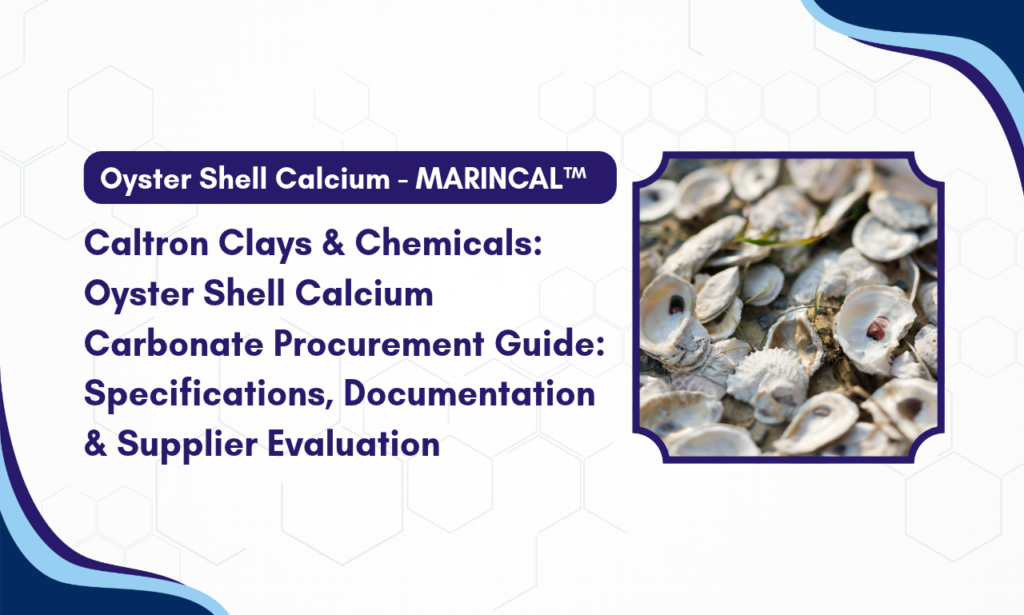
Introduction: What Should Buyers Know Before Procuring Oyster Shell Calcium Carbonate?
Choosing a calcium ingredient for pharmaceutical or nutraceutical manufacturing involves considerably more than comparing calcium content and purchase price. Procurement teams must understand the source of the material, while R&D teams need predictable physical characteristics and formulation compatibility. QA/QC teams require reliable analytical results, and regulatory professionals may need technical and compliance documentation before a raw material can be approved. Caltron Clays & Chemicals, through its MARINCAL™ Oyster Shell Calcium Carbonate, provides a naturally derived calcium carbonate ingredient for B2B manufacturers evaluating marine-source calcium materials. As an Oyster Shell Calcium Carbonate Powder Manufacturer in India, Caltron focuses on controlled processing, purification, quality evaluation and commercial supply.
For companies evaluating an Oyster Shell Calcium Carbonate Bulk Supplier, the qualification process should cover the complete lifecycle of the ingredient—from oyster-shell sourcing and incoming inspection to processing, testing, documentation and final delivery. Parameters such as CaCO₃ assay, elemental calcium, particle-size distribution, bulk density, heavy-metal specifications, microbiological quality and traceability can influence raw-material approval.
A capable Oyster Shell Calcium Carbonate Powder Supplier in India should also be prepared to support commercial requirements after the initial sample has been evaluated. This means considering production capacity, recurring supply, packaging, lead times, technical communication and documentation alongside product quality. This guide provides a practical framework for procurement managers, R&D teams, QA professionals, regulatory teams, contract manufacturers and international ingredient buyers.
1. Why Oyster Shell Calcium Carbonate Is Gaining Attention in B2B Procurement
1.1 The Shift Toward Naturally Derived Calcium Ingredients
Calcium remains an important mineral ingredient across pharmaceutical, nutraceutical and supplement manufacturing. However, sourcing decisions are increasingly influenced by factors beyond elemental mineral concentration.
Manufacturers may now consider:
- Raw-material origin
- Natural-source positioning
- Processing controls
- Traceability
- Purity
- Consistency
- Documentation
- Long-term availability
Oyster shell calcium carbonate is a marine-derived calcium ingredient produced from processed oyster shells. It can be considered by manufacturers looking for a natural calcium source for suitable formulation concepts.
The important procurement principle is that natural origin should be supported by a controlled supply chain. A supplier should be able to explain how the raw material is sourced, inspected, processed and tested.
1.2 Why Oyster-Shell Source Matters
The characteristics of oyster shells can vary according to species, source, handling and physical condition. These factors can affect subsequent processing and the characteristics of the finished oyster shell calcium powder.
A procurement review should therefore examine:
- Oyster species
- Raw-material origin
- Shell condition
- Incoming inspection
- Cleaning process
- Processing controls
- Purification
- Grinding
- Particle-size management
- Finished-product testing
For pharmaceutical and nutraceutical manufacturers, these controls help provide a more complete picture of raw-material quality.
1.3 Oyster Shell Calcium Compared With Conventional Calcium Carbonate
Both oyster shell calcium carbonate and conventional calcium carbonate contain calcium carbonate, but their sources differ.
Conventional calcium carbonate may be produced from geological mineral sources, while oyster shell calcium carbonate originates from marine shell material. This distinction can matter to manufacturers evaluating natural mineral ingredients.
However, the source should not be the sole selection criterion. Buyers should compare actual technical parameters, including:
- CaCO₃ assay
- Elemental calcium
- Particle size
- Bulk density
- Flow properties
- Impurity profile
- Microbiological quality
- Documentation
- Traceability
- Commercial supply
The best raw material is the one that satisfies the manufacturer’s technical, regulatory and commercial requirements.
2. Calcium Carbonate Specifications: What Should Buyers Check?
A clear specification is the foundation of supplier qualification. Before commercial approval, procurement and technical teams should agree on measurable acceptance criteria.
2.1 Calcium Carbonate Assay
The calcium carbonate assay indicates the concentration of CaCO₃ in the raw material and is important for formulation calculations.
Procurement teams should verify:
- Declared assay
- Minimum or target specification
- Analytical method
- Batch-specific results
- Testing frequency
- Specification compliance
Consistent assay values help formulation scientists calculate the required raw-material quantity more accurately.
2.2 Elemental Calcium
Elemental calcium should be evaluated separately from CaCO₃ assay.
For formulation development, the R&D team needs to understand how much elemental calcium the selected raw material contributes to the finished product. This information should be supported by appropriate technical documentation.
When comparing suppliers, buyers should ensure that elemental calcium values are clearly stated and consistently reported.
2.3 Particle Size Distribution
Particle size can affect processing behaviour and formulation performance.
Important parameters may include:
- Average particle size
- Particle-size distribution
- Powder fineness
- Flow
- Dispersion
- Sedimentation
A finer or micronized calcium carbonate grade is not automatically the best option for every formulation. Particle characteristics should be selected according to the manufacturing process and final dosage form.
2.4 Appearance, Colour and Odour
Visual inspection can provide an additional quality-control checkpoint.
QA teams may evaluate:
- Powder colour
- Uniformity
- Texture
- Odour
- Appearance
- Visible foreign particles
Consistent physical characteristics can make routine incoming inspection more effective.
2.5 Bulk Density and Powder Flow
Bulk density and powder flow can affect handling and manufacturing operations.
These properties can become particularly relevant during:
- Powder blending
- Tablet compression
- Capsule filling
- Material transfer
- Hopper feeding
- Bulk storage
Laboratory testing should be supplemented with application-specific trials when these properties are critical to production.
2.6 Heavy Metals and Elemental Impurities
Heavy metal testing is an important part of evaluating marine-derived mineral ingredients.
Depending on the intended application, buyers may evaluate:
- Lead
- Arsenic
- Cadmium
- Mercury
- Other applicable elemental impurities
Pharmaceutical manufacturers should establish acceptance criteria based on the requirements applicable to their finished product and target market.
2.7 Microbiological Quality
Although calcium carbonate is an inorganic mineral, shell-derived raw materials require suitable processing and hygiene controls.
Quality teams may review:
- Total microbial count
- Yeast and mould
- Applicable pathogens
- Testing methods
- Testing frequency
- Batch-release requirements
Microbiological controls should be incorporated into the supplier’s quality system rather than treated as a final-stage consideration only.
3. Oyster Species and Raw-Material Selection
The choice of oyster-shell source can be relevant to both product characteristics and procurement planning.
3.1 Oysto Teratta: A Selected Oyster-Shell Source
According to Caltron’s supplied product information, Oysto Teratta is considered a high-quality oyster-shell source. The shells are described as fibrous, fragile and relatively clean, with a flaky texture.
The supplied information also indicates approximately 1.5% magnesium in this source. Its availability is comparatively limited, which makes sourcing strategy important for manufacturers requiring recurring commercial quantities.
For procurement teams, the important issue is not simply the species designation. Buyers should understand how the supplier maintains source quality, inspection standards and continuity of supply.
3.2 Meta-Calciota: An Alternative Source
Meta-Calciota is described in the supplied product information as another oyster-shell source with wider availability. Its CaCO₃ assay is comparatively lower than Oysto Teratta, while its availability can make it an alternative for suitable commercial requirements.
The choice between different raw-material sources should be determined by:
- Required assay
- Formulation requirements
- Quality specifications
- Cost objectives
- Availability
- Supply planning
3.3 From Oyster Shell to Finished Calcium Powder
The quality of the finished product begins with controlled raw-material selection.
A simplified production chain is:
Source Selection → Incoming Inspection → Cleaning → Processing → Purification → Grinding → Particle-Size Control → Quality Testing → Batch Release
Each stage can influence the characteristics of the final powder. This is why raw material traceability and process control are important components of supplier qualification.
4. Manufacturing and Purification: Questions Procurement Teams Should Ask
4.1 How Are Oyster Shells Sourced?
Before selecting an Oyster Shell Calcium Carbonate Bulk Supplier, buyers should understand the supplier’s raw-material sourcing system.
Relevant questions include:
- What is the source of the oyster shells?
- How are sources evaluated?
- What incoming checks are performed?
- How is source information recorded?
- How is availability maintained?
Supply continuity should be assessed alongside quality because commercial production requires dependable material availability.
4.2 What Cleaning and Pre-Processing Controls Are Used?
Oyster shells require appropriate preparation before further processing. Cleaning and pre-processing can help remove unwanted materials and prepare the shells for controlled manufacturing.
Procurement teams should ask whether cleaning procedures are documented and whether inspection is performed at this stage.
4.3 How Are Grinding and Particle-Size Controls Managed?
Processing can include drying, size reduction, grinding and particle-size management.
The objective is to produce a calcium carbonate raw material that meets agreed specifications consistently.
R&D teams should review available particle-size information according to the requirements of the final dosage form.
4.4 How Are Impurities Controlled?
Purification and contaminant control are important for a natural marine-derived ingredient.
The supplier’s quality system should address relevant areas such as:
- Heavy metals
- Elemental impurities
- Microbiological quality
- Physical contamination
- Process hygiene
4.5 How Is the Finished Batch Released?
Final product testing provides evidence that the manufactured batch meets the agreed specification.
The analytical results can be recorded through a batch-specific Certificate of Analysis and reviewed before release.
How Is Oyster Shell Calcium Carbonate Powder Manufactured?
Oyster shell calcium carbonate powder is produced by selecting suitable oyster shells and subjecting them to controlled cleaning, processing, grinding and particle-size management. Appropriate purification and quality testing are then performed before the finished powder is evaluated against established specifications and released for its intended application.
5. Documentation Required for B2B Supplier Qualification
Technical documentation is one of the strongest indicators of supplier readiness. It enables procurement, QA, R&D and regulatory teams to evaluate a raw material using consistent evidence.
5.1 Certificate of Analysis
A batch-specific Certificate of Analysis may include:
- CaCO₃ assay
- Elemental calcium
- Physical properties
- Heavy-metal results
- Microbiological results
- Batch number
- Manufacturing information
- Retest or expiry details, where applicable
The CoA for calcium carbonate should correspond to the supplied batch and approved specification.
5.2 Technical Data Sheet
A Technical Data Sheet provides product-level information for technical evaluation.
It may cover:
- Product description
- Chemical characteristics
- Physical characteristics
- Particle size
- Recommended applications
- Packaging
- Storage conditions
5.3 Safety Data Sheet
A Safety Data Sheet supports appropriate handling, storage and transportation.
Depending on applicable requirements, it may contain:
- Product identification
- Handling information
- Storage requirements
- Safety information
- Transportation information
- Relevant hazard information
5.4 Product Specification
The product specification establishes the acceptance criteria for the raw material.
For specific applications, manufacturers may require additional parameters related to assay, particle size, physical properties or impurity limits.
5.5 Certifications and Compliance Documentation
Depending on the product and destination market, buyers may request:
- ISO documentation
- HACCP
- HALAL
- KOSHER
- GMP-related documentation
- Customer-specific compliance records
The applicability of each document should be verified against the actual product and manufacturing facility.
5.6 Traceability Records
Traceability allows buyers to connect the finished ingredient with its raw-material and production history.
A robust system should support:
- Batch identification
- Raw-material records
- Production records
- Processing history
- Finished-product release
6. How to Qualify an Oyster Shell Calcium Carbonate Supplier
6.1 Manufacturing Capability
An Oyster Shell Calcium Carbonate Bulk Supplier should have the capacity to support the buyer’s expected commercial requirements.
Procurement teams should assess:
- Manufacturing infrastructure
- Processing equipment
- Production capacity
- Quality-control facilities
- Packaging capabilities
- Commercial order handling
6.2 Quality Assurance System
A supplier’s quality assurance framework should cover the entire manufacturing cycle.
Evaluate:
- Incoming material inspection
- In-process controls
- Finished-product testing
- Batch release
- Document control
- Deviation management
- Batch consistency
6.3 Regulatory and Audit Readiness
For pharmaceutical and nutraceutical applications, supplier qualification may involve document review and audits.
Consider:
- Quality certifications
- Technical documentation
- Regulatory support
- Audit readiness
- Export documents
- Customer-specific requirements
6.4 Supply Reliability
Commercial procurement requires predictable supply.
Key considerations include:
- Raw-material availability
- Production planning
- Inventory
- Lead time
- Recurring order capacity
- Export capability
- Communication
An experienced Oyster Shell Calcium Carbonate Bulk Supplier should be able to discuss commercial quantities and supply schedules with clarity.
6.5 Technical Support
A supplier’s technical support can make the approval process more efficient.
Relevant support includes:
- Grade selection
- Specification matching
- Sample evaluation
- Product documentation
- Formulation discussions
- R&D communication
7. Why Procurement Should Look Beyond the Lowest Price
7.1 Purchase Price Is Only One Cost Component
The cheapest quotation can create additional costs if the material leads to:
- Batch rejection
- Additional testing
- Production delays
- Reformulation
- Emergency purchasing
- Supply interruptions
- Quality investigations
A procurement team should therefore evaluate total procurement value rather than only the price per kilogram.
7.2 Batch Consistency Reduces Procurement Risk
When a raw material remains consistent from batch to batch, manufacturers can benefit from greater predictability during production and quality control.
Consistency can support:
- Easier incoming inspection
- Fewer quality deviations
- Predictable processing
- Better production planning
- Reduced supplier-related risk
7.3 Building a Cost-Effective Supply Strategy
An experienced Oyster Shell Calcium Carbonate Bulk Supplier can support more efficient procurement through:
- Appropriate grade selection
- Volume planning
- Forecast sharing
- Recurring supply arrangements
- Specification-based purchasing
- Long-term procurement planning
8. Application Considerations for Oyster Shell Calcium Carbonate Powder
Tablets
For calcium tablet formulation, R&D teams should assess assay, particle size, powder flow and compression characteristics.
Pilot-scale testing can help determine whether the selected ingredient performs consistently with the intended manufacturing equipment.
Capsules
For capsule formulations, manufacturers should consider:
- Bulk density
- Powder flow
- Fill weight
- Dose requirements
- Blend uniformity
The selected grade should be evaluated within the actual capsule-development process.
Soft Gelatin Capsules
Soft gelatin capsule applications require evaluation of the ingredient’s physical characteristics and compatibility with the complete formulation system.
Suspensions
For suspension formulations, particle size and dispersion behaviour are particularly relevant. R&D teams should evaluate sedimentation, physical stability and dispersion during development.
Chewable Tablets
Chewable products can require attention to particle characteristics, texture and sensory properties.
The appropriate raw material should be selected through formulation trials rather than solely from the specification sheet.
Nutraceutical and Functional Food Applications
Oyster shell calcium can be evaluated as a nutraceutical calcium ingredient for suitable mineral-fortification concepts.
R&D teams should consider:
- Calcium assay
- Elemental calcium
- Particle characteristics
- Sensory requirements
- Regulatory requirements
- Compatibility with other ingredients
9. R&D Approval Checklist for MARINCAL™
Before approving MARINCAL™, technical and procurement teams can ask:
- What is the CaCO₃ assay?
- What is the elemental calcium value?
- What particle-size grades are available?
- What heavy-metal specifications apply?
- What microbiological tests are conducted?
- What is the oyster-shell source?
- How is the shell material cleaned?
- What processing controls are used?
- What purification controls are applied?
- Is a batch-specific CoA available?
- Is a TDS available?
- Is an SDS available?
- What certifications are applicable?
- Can commercial quantities be supplied?
- What are the standard lead times?
- Can international documentation be supported?
- Is technical assistance available?
A qualified Oyster Shell Calcium Carbonate Bulk Supplier should provide clear responses and appropriate supporting documentation.
10. Caltron Clays & Chemicals: Supporting B2B Oyster Shell Calcium Procurement
MARINCAL™ Oyster Shell Calcium Carbonate
Caltron Clays & Chemicals offers MARINCAL™ Oyster Shell Calcium Carbonate as a naturally derived calcium carbonate ingredient for B2B applications. Based on the supplied product information, selected oyster shells undergo quality checks, controlled processing and purification before being converted into the finished powder.
As an Oyster Shell Calcium Carbonate Powder Manufacturer in India, Caltron supports manufacturers evaluating oyster shell calcium for pharmaceutical, nutraceutical, food and other suitable applications according to the relevant specifications.
MARINCAL™ can be considered for applications including:
- Tablets
- Capsules
- Suspensions
- Soft gelatin capsules
- Chewable tablets
Quality and Certification Infrastructure
Caltron’s broader quality framework includes systems and certifications such as:
- ISO 9001
- ISO 22000
- ISO 14001
- HACCP
- HALAL
- KOSHER
- WHO-GMP-related compliance
The exact applicability of a certification should be verified for the specific product, facility and destination market.
Global B2B Supply Capability
International ingredient sourcing requires reliable documentation, commercial quantities and responsive communication.
As an Oyster Shell Calcium Carbonate Bulk Supplier, Caltron is positioned to support manufacturers and distributors evaluating oyster shell calcium carbonate from India.
The company’s B2B approach is relevant to:
- Pharmaceutical manufacturers
- Nutraceutical companies
- Contract manufacturers
- Supplement companies
- Ingredient distributors
- International buyers
Why Procurement Teams Can Consider Caltron
For procurement teams, relevant evaluation points include:
- Pharmaceutical raw-material experience
- Nutraceutical ingredient knowledge
- Natural mineral ingredient portfolio
- Quality systems
- Technical documentation
- Bulk supply capabilities
- Domestic and international B2B support
- Communication with R&D and procurement teams
11. Oyster Shell Calcium Carbonate Procurement Checklist
Use the following checklist when comparing suppliers:
| Procurement Parameter | What Buyers Should Evaluate |
|---|---|
| Raw-Material Source | Oyster species and origin |
| CaCO₃ Assay | Approved specification |
| Elemental Calcium | Declared value |
| Particle Size | Agreed distribution |
| Heavy Metals | Applicable limits and test data |
| Microbiology | Required batch testing |
| CoA | Batch-specific analytical certificate |
| TDS | Product and technical information |
| SDS | Safety and handling information |
| Certifications | Applicable quality documents |
| Packaging | Commercial packaging requirements |
| Traceability | Source and batch records |
| Production Capacity | Commercial-volume capability |
| Lead Time | Expected delivery schedule |
| Technical Support | R&D and formulation assistance |
This checklist can be used during supplier qualification, sample approval and commercial-scale purchasing. It also helps procurement teams identify missing documentation before the supplier enters the approved-vendor process.
12. Common Procurement Mistakes When Buying Oyster Shell Calcium
Mistake 1: Selecting Only on Price
A low price can become costly if it results in rejected material, additional testing or supply interruptions.
Mistake 2: Ignoring Particle Size
Particle size can affect powder handling, blending, dispersion and formulation performance. It should be evaluated according to the intended dosage form.
Mistake 3: Using Generic Specifications
A generic specification may not reflect the actual requirements of a particular formulation. Buyers should establish application-specific criteria where necessary.
Mistake 4: Skipping CoA Review
QA and technical teams should compare the batch CoA with the approved specification before material acceptance.
Mistake 5: Overlooking Traceability
For natural and marine-derived ingredients, traceability provides useful visibility into raw-material and manufacturing history.
Mistake 6: Confusing Sample Capacity With Commercial Capacity
A supplier able to provide samples may not automatically have sufficient production capacity for recurring commercial orders.
Mistake 7: Requesting Documentation Too Late
Technical and regulatory documentation should be reviewed during qualification, not after purchase commitments have already been made.
An experienced Oyster Shell Calcium Carbonate Bulk Supplier should be capable of supporting the technical, quality and documentation requirements associated with commercial procurement.
13. How International Buyers Can Source Oyster Shell Calcium Carbonate From India
Why India Matters in Global Ingredient Sourcing
India has an established pharmaceutical and nutraceutical manufacturing ecosystem and is an important source of ingredients and raw materials for international markets.
For international procurement, buyers can evaluate Indian manufacturers based on:
- Manufacturing infrastructure
- Quality systems
- Technical capabilities
- Export experience
- Production capacity
- Documentation
- Communication
The supplier’s geographical location should not replace technical qualification. International buyers should still evaluate the manufacturer according to their own product and regulatory requirements.
What International Buyers Should Request
Before commercial purchasing, buyers should request:
- Product specification
- Certificate of Analysis
- Technical Data Sheet
- Safety Data Sheet
- Applicable certifications
- Packaging information
- Batch details
- Export documentation
- Lead time
- Shipping information
- Commercial terms
A professional Oyster Shell Calcium Carbonate Powder Supplier in India should be able to communicate the required technical and commercial information clearly.
Evaluating an Indian Supplier for Global Procurement
International buyers should assess:
- Manufacturing credentials
- Quality-control infrastructure
- Production capacity
- Export experience
- Technical documentation
- Regulatory readiness
- Communication
- Long-term supply capability
Companies seeking a Nutraceutical raw material supplier in India should evaluate both technical quality and commercial reliability. Similarly, businesses looking for a Pharmaceutical raw material Manufacturer in India should confirm that manufacturing controls and documentation are appropriate for the intended pharmaceutical application and destination market.
14. MARINCAL™ for Pharmaceutical and Nutraceutical Manufacturers
MARINCAL™ is positioned as a B2B raw material for manufacturers evaluating oyster shell-derived calcium carbonate rather than as a finished consumer supplement.
Its potential application areas include:
- Tablets
- Capsules
- Suspensions
- Soft gelatin capsules
- Chewable tablets
- Nutraceutical formulations
- Mineral-fortified products
For R&D teams, qualification should progress from specification review to sample testing and formulation compatibility assessment. Pilot-scale evaluation may then be appropriate before commercial implementation.
Procurement teams should simultaneously evaluate:
- Commercial quantities
- Packaging
- Documentation
- Lead times
- Delivery schedules
- Recurring supply
- Customer-specific specifications
Choosing an Oyster Shell Calcium Carbonate Bulk Supplier should therefore be viewed as a long-term procurement decision. The supplier needs to support the complete journey from initial sample to recurring commercial supply.
15. Frequently Asked Questions
What Should I Check Before Buying Oyster Shell Calcium Carbonate Powder?
Review the CaCO₃ assay, elemental calcium, particle size, heavy metals, microbiological parameters, physical properties, documentation and traceability. The requirements should be matched with the intended formulation and market.
What Specifications Are Important for Pharmaceutical-Grade Oyster Shell Calcium?
Important parameters may include assay, elemental calcium, particle-size distribution, heavy metals, elemental impurities, microbiological quality and physical characteristics. The final acceptance criteria should be based on the manufacturer’s applicable requirements.
What Documents Should an Oyster Shell Calcium Supplier Provide?
Depending on the application, buyers may require a CoA, TDS, SDS, product specification, traceability records and applicable certification or compliance documents.
How Do I Evaluate an Oyster Shell Calcium Carbonate Manufacturer?
Evaluate manufacturing infrastructure, raw-material controls, processing capability, quality systems, testing, documentation, production capacity, supply continuity and technical support.
What Is the Difference Between Oyster Shell Calcium and Conventional Calcium Carbonate?
The primary difference is the source. Oyster shell calcium carbonate comes from marine shell material, while conventional calcium carbonate may be obtained from geological sources. Product specifications should be compared before making a procurement decision.
Is Oyster Shell Calcium Carbonate Suitable for Nutraceutical Formulations?
It can be evaluated for appropriate nutraceutical applications such as tablets, capsules, suspensions and chewable formulations, subject to the required specifications and applicable regulatory requirements.
What Particle Size Should Buyers Request?
There is no single particle size suitable for every application. The appropriate range depends on the dosage form, powder flow, dispersion requirements and manufacturing process.
How Can International Buyers Source Oyster Shell Calcium Carbonate From India?
International buyers should evaluate the supplier’s manufacturing capability, quality systems, technical documentation, export experience, commercial capacity and destination-market requirements before placing an order.
Can Oyster Shell Calcium Carbonate Be Used in Tablets and Capsules?
It can be evaluated for tablet and capsule applications based on its specifications, particle characteristics, formulation compatibility and manufacturing requirements. R&D trials should confirm suitability.
Why Is Traceability Important for Marine-Derived Calcium?
Traceability provides visibility into raw-material origin, batch identification and production history. This can support supplier qualification, quality investigations and long-term supply-chain management.
Conclusion: Choosing the Right Oyster Shell Calcium Partner
The procurement of oyster shell calcium carbonate requires a broader evaluation than simply comparing supplier quotations. For pharmaceutical and nutraceutical manufacturers, the decision should incorporate quality, documentation, consistency, supply reliability and technical support.
The evaluation should begin with the raw-material source and continue through assay, elemental calcium, particle-size distribution, physical properties, heavy-metal testing, microbiological controls, processing, traceability and batch documentation.
Commercial supply capability is equally important. A supplier should be able to move beyond sample quantities and support recurring orders with consistent specifications, predictable lead times and appropriate documentation.
Caltron Clays & Chemicals, through MARINCAL™, provides an oyster shell-derived calcium carbonate ingredient for manufacturers evaluating natural mineral raw materials for suitable B2B applications. Its approach combines product knowledge, quality evaluation, technical documentation and commercial supply capabilities.
If your company is comparing an Oyster Shell Calcium Carbonate Bulk Supplier, use a structured qualification process rather than relying on price alone. Compare the supplier’s specifications, documentation, manufacturing capability, quality systems, supply capacity and technical support against your own formulation and procurement requirements.
Looking for an experienced Oyster Shell Calcium Carbonate Powder Manufacturer in India for pharmaceutical or nutraceutical applications? Connect with Caltron Clays & Chemicals to discuss MARINCAL™ specifications, CoA, TDS, SDS, samples and bulk supply requirements.
Caltron Clays & Chemicals Pvt Ltd
Address: Suite# 1901-1904, Level-19, 9 Business Bay, Off Link Road, Mindspace, Malad West, Mumbai 400064
Phone No.: 022 3571 9844 | +91 70214 37453 | +91 22 2876 4864
Website: https://caltronclays.com
Email: marketing@caltronclays.com | sales@caltronclays.com
Google Maps: https://maps.app.goo.gl/n2TeYQcnXnS4aMio9
