Introduction
The visible finish of a false ceiling or drywall partition depends heavily on the steel framework installed behind it. While gypsum boards, decorative panels and surface finishes attract most of the attention, the real structural accuracy comes from the channels, studs, tracks and supporting sections that hold the system together.
If these steel profiles are inconsistent in width, depth, thickness, straightness or edge formation, contractors may face fitting problems, uneven framing and unnecessary correction work during installation.
This makes manufacturing precision extremely important.
Today, large construction and interior projects require POP and drywall sections in substantial quantities, often across multiple project phases. Producing these profiles manually or through disconnected fabrication operations can make it difficult to maintain consistent geometry across thousands of pieces.
Advanced roll forming technology offers a more controlled manufacturing approach.
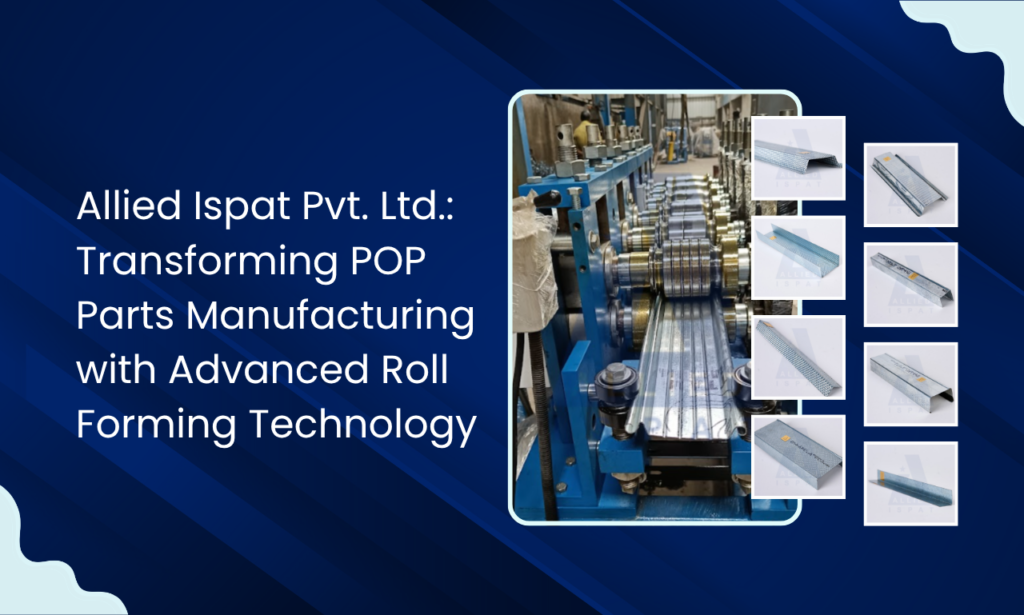
The process continuously converts galvanized steel coils into precisely shaped profiles using a sequence of engineered rollers. Material feeding, gradual forming, measuring and cutting can be combined within a single production line, allowing manufacturers to achieve both speed and repeatability.
Allied Ispat Pvt. Ltd., part of the Malik Group of Companies, manufactures galvanized ceiling and drywall partition sections using modern production systems. With its business presence in Mumbai and manufacturing facility in the Navi Mumbai region, the company serves contractors, architects, developers, dealers, interior companies and infrastructure businesses across India.
As an established GI POP Frame Manufacturer in India, Allied Ispat Pvt. Ltd. focuses on profile accuracy, galvanized steel quality, practical product design and reliable bulk production for residential, commercial and industrial applications.
Its product portfolio includes ceiling channels, intermediate channels, perimeter sections, angle sections, C-studs, floor tracks and related framing profiles.
What Is Roll Forming and How Does It Work?
Roll forming is a continuous cold-forming process used to manufacture metal sections with a consistent cross-sectional shape.
A flat steel strip is gradually passed through multiple roller stations. Instead of creating the entire shape in one bending operation, each set of rollers forms a small portion of the profile.
By the time the steel reaches the final station, the required section geometry has been developed.
A typical roll forming line may involve:
- Loading galvanized steel coil onto a decoiler
- Uncoiling the steel strip
- Aligning and guiding the material
- Feeding it into the roll forming line
- Gradually developing the profile through roller stations
- Adding embossing, knurling or punching where required
- Measuring the required section length
- Cutting the profile automatically
- Inspecting finished pieces
- Bundling and preparing the products for dispatch
Because forming takes place gradually, manufacturers can achieve repeatable bends and profile dimensions during continuous production.
Roll forming is commonly used to manufacture:
- False ceiling sections
- C-studs
- Tracks
- Roofing profiles
- Rolling shutter components
- Steel channels
- Industrial framing
- Lightweight construction profiles
For a POP Parts Manufacturer in India, this process provides an efficient way to manufacture long galvanized profiles in bulk without repeatedly measuring and bending every individual piece.
Another key advantage for Allied Ispat Pvt. Ltd. is its experience in manufacturing roll forming machines themselves. This gives the company practical knowledge of both steel profile manufacturing and the machinery behind the process.
Why Is Advanced Roll Forming Important for POP Parts Manufacturing?
POP frames and drywall sections are repetitive construction components. Contractors often require hundreds or thousands of pieces with the same profile dimensions.
This makes consistency critical.
Growing Requirement for Standardized Interior Systems
Modern buildings increasingly use suspended ceilings and drywall partitions because they support flexible interior layouts and faster project execution.
These systems are common in:
- Residential developments
- Corporate offices
- Hotels
- Hospitals
- Shopping malls
- Educational institutions
- Industrial buildings
- Infrastructure projects
Each system depends on compatible steel components.
For example, a C-stud must fit correctly inside a track. Ceiling channels must align with connected framing sections. Perimeter sections need to maintain a uniform level across walls.
Roll forming allows a GI POP Frame Manufacturer in India to produce such profiles with greater consistency across large batches.
Better Consistency in Bulk Production
Manual fabrication is highly dependent on repeated measurements and individual operator handling.
As order quantities increase, even small differences may become more noticeable.
Roll forming minimizes this variation because the steel continuously moves through the same tooling sequence.
Once the machine is properly set up, important profile characteristics can remain more consistent, including:
- Section width
- Section depth
- Flange shape
- Edge return
- Bend formation
- Length
This is particularly useful when materials are delivered to a project in multiple batches.
Faster Production for Large Orders
Roll forming combines several manufacturing stages into one workflow.
Instead of shifting material between different cutting and bending operations, steel can move continuously through the line.
This helps reduce unnecessary material handling and makes high-volume manufacturing more practical.
According to Allied Ispat Pvt. Ltd., its automated manufacturing infrastructure supports production of more than 3,000 POP frame units per day, enabling the company to manage large requirements and bulk project supplies.
Greater Use of Automation
Modern roll forming lines can integrate several automated functions, such as:
- Material feeding
- Length control
- Quantity control
- PLC operation
- Hydraulic cutting
- Machine monitoring
Automation helps reduce repetitive manual activity and supports consistent output.
However, machine automation does not replace technical supervision. Skilled operators are still required for tooling setup, machine adjustment, material inspection, maintenance and quality checking.
How Does Roll Forming Improve POP Frame Accuracy?
False ceiling and drywall systems depend on dimensional compatibility.
A small deviation in one section may affect several connected components.
Advanced roll forming helps reduce such variation.
Uniform Width and Depth
Roller tooling progressively shapes steel into the required cross-section.
This helps maintain a more consistent section width and depth throughout a production run.
The result can support:
- Easier profile fitting
- Better framework alignment
- More predictable spacing
- Improved board installation
- Reduced corrective work
For a False Ceiling System Manufacturer in India, consistent dimensions are an important part of overall product quality.
Repeatable Profile Geometry
The complete shape of a channel or stud must remain consistent along its length.
If the profile opens, closes, twists or changes shape, installers may experience difficulty connecting it with other sections.
Roll forming develops the shape gradually, allowing manufacturers to better control the final geometry.
Improved Straightness
Straightness is particularly important for long ceiling and partition sections.
Twisted or bowed profiles may affect framing levels and board alignment.
Proper guide positioning, steel feeding and tooling setup can help maintain straighter profiles during manufacturing.
Better Edge Formation
Edges are an important consideration in thin steel framing products.
Poorly finished edges can make handling difficult during:
- Packaging
- Transportation
- Storage
- Site distribution
- Installation
Roll forming machines can create folded or returned edges as part of the profile itself.
Allied Ispat Pvt. Ltd. highlights folded-edge design within its GypsPlus Xpert-Plus range to support safer and more convenient handling.
Controlled Section Lengths
Manual measuring and cutting may lead to differences between pieces.
Automated cutting systems help maintain repeatable section lengths according to programmed production requirements.
This is particularly useful for projects where standardized framing dimensions are required in bulk.
What POP and Drywall Components Can Be Roll Formed?
Roll forming is suitable for a wide range of construction sections because these products typically require long, consistent profiles.
Allied Ispat Pvt. Ltd. manufactures several important false ceiling and drywall components.
Ceiling Channels
Ceiling channels form a major part of suspended ceiling frameworks.
They support adjoining framing components and contribute to the base structure used to install ceiling boards.
Consistent channel dimensions help maintain alignment across the ceiling grid.
Intermediate Channels
Intermediate channels help support and stabilize suspended ceiling systems.
These profiles often run across larger areas, making straightness and dimensional uniformity important.
Perimeter Channels
Perimeter profiles are installed around wall boundaries and help establish the outer edge and level of a false ceiling.
Accurate sections can help create cleaner and more consistent ceiling boundaries.
Angle Sections
Angle profiles may be used around wall junctions, ceiling edges or supporting locations depending on system requirements.
Roll forming helps maintain the required angle continuously along the profile.
C-Studs
C-studs are vertical members used in drywall partition systems.
They are positioned inside compatible head and floor tracks to create the basic partition framework.
Accurate C-studs can help support:
- Uniform spacing
- Correct track fitting
- Better board alignment
- Straight partition construction
Floor Tracks
Floor tracks form the lower horizontal component of drywall partitions.
Because the C-studs sit inside these tracks, dimensional compatibility is important.
For a Dry Wall Partition System Manufacturer in India, maintaining suitable stud-and-track geometry is a key manufacturing consideration.
How Does Automation Improve POP Frame Manufacturing?
Automation improves both manufacturing efficiency and production control.
PLC-Based Control
PLC systems can coordinate important machine operations and allow production settings to be entered through a control interface.
Depending on machine design, operators may configure:
- Required length
- Product quantity
- Operating sequence
- Cutting cycles
This helps reduce repeated manual measurement.
Automatic Material Feeding
Stable steel feeding is essential for forming accuracy.
If steel enters the forming line unevenly, the profile may twist or develop irregular dimensions.
Automatic feeding systems help guide the material through the rollers at a controlled rate.
Hydraulic Cutting
Hydraulic cutting equipment can separate profiles automatically after they reach the programmed length.
Potential benefits include:
- More consistent lengths
- Faster production
- Less manual measurement
- Better batch uniformity
- Reduced material handling
Continuous Manufacturing Flow
Traditional fabrication may require metal to be transferred from one operation to another.
Roll forming integrates multiple stages within one production line.
This reduces interruptions and supports better production efficiency.
Traditional Fabrication vs Advanced Roll Forming
| Manufacturing Aspect | Traditional Fabrication | Advanced Roll Forming |
|---|---|---|
| Production volume | More suitable for small batches | Better suited for repeated bulk production |
| Profile accuracy | Dependent on repeated manual operations | Controlled by tooling and machine settings |
| Consistency | Variation may increase over large batches | More repeatable across production runs |
| Material movement | Multiple handling stages | Continuous processing |
| Length control | Often manually measured | Can be automatically programmed |
| Productivity | Separate operations may slow production | Forming and cutting can be integrated |
| Scalability | May require additional labour and machines | Better suited to high-volume requirements |
| Material utilization | Greater trimming may occur | Continuous coil processing can reduce waste |
| Quality control | Often dependent on separate inspection | Can be monitored throughout production |
| Custom profiles | Practical for very low quantities | Efficient after tooling and setup are developed |
Roll forming is not necessarily ideal for every metal component.
Highly irregular parts or very small one-off orders may still be more practical using conventional fabrication methods.
However, for long and repetitive POP and drywall sections, roll forming provides important advantages.
Benefits of Precision POP Frames for Contractors and Builders
Manufacturing accuracy becomes especially valuable once material reaches the construction site.
Faster Installation
Well-formed sections generally require fewer corrections before installation.
This helps installers spend more time assembling the framework and less time modifying profiles.
Better Component Compatibility
False ceiling and drywall systems are built using connected components.
When these parts maintain consistent dimensions, connections become easier and more predictable.
Reduced Site Rework
Inconsistent profiles may need:
- Cutting
- Straightening
- Reshaping
- Replacement
- Reinstallation
Every correction adds labour and can affect the project schedule.
Precision profiles help reduce this risk.
Better Material Planning
Consistent profile lengths and dimensions allow procurement teams to plan quantities more effectively.
Where suitable, customized lengths can also reduce unnecessary cutting at the site.
Improved Project Scheduling
Commercial and infrastructure projects frequently require phased deliveries.
Working with a capable POP Parts Manufacturer in Mumbai can help project teams organize material supply according to construction schedules.
Why Galvanized Steel Is Important in POP Frame Manufacturing
Roll forming controls profile shape, but material quality determines how the section performs in its intended environment.
Galvanized steel is widely used for false ceiling and drywall profiles because it includes a zinc coating that helps protect the underlying steel.
However, actual corrosion performance depends on several factors, including:
- Zinc coating quality
- Coating continuity
- Storage conditions
- Moisture exposure
- Installation damage
- Building ventilation
- Condensation
- Environmental conditions
Allied Ispat Pvt. Ltd. uses galvanized steel for its POP frame products and offers solutions for residential, commercial, industrial and selected high-humidity applications.
Key Advantages of Advanced Roll-Formed POP Parts
Roll forming can provide several practical advantages for construction profile manufacturing:
- High dimensional repeatability
- Consistent cross-sectional geometry
- Controlled section lengths
- Faster bulk production
- Reduced repetitive handling
- Improved steel utilization
- Better stud-and-track compatibility
- More uniform edge formation
- Easier production monitoring
- Improved scalability
- Reduced variation between batches
- Custom profile possibilities
- Better bulk-order planning
- Efficient automatic cutting
- More predictable project supply
Why Contractors Prefer Consistently Manufactured POP Parts
Contractors generally judge POP frame quality during installation.
The most important factors often include fitting, handling and consistency.
Reliable Connections
Accurate studs, tracks and channels can connect more easily without excessive force or modification.
Easier Handling
Straight and correctly bundled sections are easier to move around project sites.
Folded or controlled edges can also improve handling convenience.
Fewer Delays
Low-quality profiles can lead to sorting, rejection and replacement.
On large developments, these delays can quickly become costly.
Reduced Hidden Project Costs
A cheaper profile is not always the lowest-cost solution.
Project teams should also consider:
- Installation labour
- Rework
- Rejection
- Material loss
- Replacement transportation
- Site cutting
- Project delays
Consistently manufactured sections can help reduce these indirect costs.
Common Applications of Roll-Formed POP Frames
Residential Buildings
POP and drywall systems are used in:
- Apartments
- Villas
- Residential renovations
- Decorative ceilings
- Internal room partitions
Commercial Offices
Office interiors use lightweight partitions to create:
- Cabins
- Meeting rooms
- Work areas
- Conference spaces
- Reception zones
Hotels
Hotel projects use ceiling and partition sections throughout:
- Guest rooms
- Lobbies
- Corridors
- Restaurants
- Banquet spaces
Healthcare Facilities
Hospitals and clinics require coordinated interior construction around extensive building services.
False ceilings and drywall systems can support this requirement.
Shopping Centres
Retail developments use framing sections in:
- Stores
- Food courts
- Common areas
- Service zones
- Entertainment spaces
Educational Institutions
Schools, universities and training centres may use ceiling and partition systems in classrooms, laboratories, offices and auditoriums.
Industrial Buildings
Factories may use galvanized framing sections within offices, utility rooms, staff areas and internal service spaces.
Warehouses
Lightweight partitions can help create internal office areas, controlled spaces and staff facilities.
Allied Ispat Pvt. Ltd. POP Frame Solutions
Allied Ispat Pvt. Ltd. offers different framing ranges for varying application needs.
GypsPlus Premium
GypsPlus Premium is positioned for applications requiring heavier and stronger framing sections.
Based on the product information provided by the company, the range includes:
- Prime-grade galvanized steel
- Thickness options from 0.5 mm to 0.7 mm
- Knurled surfaces
- Work-hardened steel
- Cold-roll pre-forming
- A stated load capacity of 50 kg/m²
- Applications in selected industrial and commercial environments
Possible applications include factories, hospitals and other demanding interior projects.
Final selection should always be confirmed according to structural design, load requirements, span and consultant specifications.
GypsPlus Xpert-Plus
GypsPlus Xpert-Plus is designed for lightweight and design-oriented interior applications.
The range includes:
- Prime-grade GI steel
- Thickness options from 0.40 mm to 0.45 mm
- Folded edges
- Customizable 8-foot and 12-foot lengths
- Suitability for apartments
- Offices
- Decorative ceiling applications
Offering separate product ranges allows Allied Ispat Pvt. Ltd. to serve both lightweight interior requirements and heavier commercial applications.
How Allied Ispat Pvt. Ltd. Maintains Manufacturing Quality
Modern machines are only one part of producing reliable steel profiles.
Manufacturing quality depends on multiple controls.
Raw Material Selection
The steel coil directly influences the finished product.
Important parameters may include:
- Thickness
- Surface condition
- Zinc coating
- Mechanical properties
- Formability
Controlling incoming material helps support more stable production.
Roll Forming Expertise
Because Allied Ispat Pvt. Ltd. also manufactures roll forming equipment, the company has practical knowledge in areas such as:
- Roller development
- Profile forming
- Strip feeding
- Tool alignment
- Cutting systems
- Machine controls
This adds manufacturing-level understanding to its POP frame production operations.
Automated Production Capacity
The company’s stated manufacturing capability of more than 3,000 POP frame units daily helps it serve contractors, dealers and large project requirements.
Quality Inspection
Quality inspection may include checks for:
- Steel thickness
- Surface finish
- Profile width
- Profile depth
- Straightness
- Edge condition
- Length
- Packaging
Allied Ispat Pvt. Ltd. states that its production operations follow ISO 9001:2015 quality management controls.
Customization Support
Projects do not always require identical specifications.
Depending on feasibility, customized requirements may include:
- Different profile lengths
- Thickness variations
- Coating requirements
- Project-specific quantities
- Profile configuration
Discussing such requirements early helps ensure correct product selection.
How to Choose a Reliable GI POP Frame Manufacturer in India
Choosing a manufacturer should involve more than simply comparing rates.
Evaluate Manufacturing Infrastructure
Buyers should understand whether profiles are manufactured using suitable machinery and whether the supplier can manage the required order volume.
Check Material Quality
Ask about steel thickness, coating and material grade before ordering.
Review Profile Accuracy
Confirm whether the manufacturer monitors profile width, depth, straightness and section length.
Consider Product Range
A manufacturer that provides multiple compatible sections can simplify procurement for larger projects.
Confirm Bulk Supply Capability
Large construction projects often require multiple deliveries.
Production capacity and dispatch planning should therefore be considered.
Ask About Customization
If the project requires specific lengths or section thicknesses, confirm these requirements before finalizing the purchase.
Review Quality-Control Systems
A reliable manufacturer should have defined checks for incoming steel, forming quality, finished profile dimensions and packaging.
For customers searching for a GI POP Frame Manufacturer in India or POP Parts Manufacturer in Mumbai, Allied Ispat Pvt. Ltd. combines a Mumbai presence with manufacturing operations in the Navi Mumbai region and supply capabilities across India.
Future of Roll Forming Technology in POP Parts Manufacturing
Roll forming technology continues to evolve.
Smart Production Monitoring
Manufacturers are increasingly able to track:
- Machine speed
- Production quantity
- Downtime
- Cutting cycles
- Motor performance
This information can support better operational decisions.
Industry 4.0 Connectivity
Connected production systems can link machinery with digital records and monitoring platforms.
This may improve visibility across manufacturing processes.
AI-Assisted Inspection
Camera and machine-vision systems may increasingly assist in identifying:
- Surface defects
- Incorrect edges
- Profile changes
- Punching errors
AI can support quality teams, although physical measurements and experienced inspectors remain essential.
Faster Product Changeovers
Future roll forming equipment may allow manufacturers to switch between profiles more efficiently.
This can make customized production more practical.
Improved Energy Efficiency
Efficient motors, modern drives and better production scheduling can reduce unnecessary energy usage.
Better Material Optimization
Digital cut-length control and scrap monitoring can help reduce material loss.
Steel production scrap can also be separated and sent for recycling.
Digital Traceability
Future systems may link:
- Incoming coil data
- Production settings
- Inspection reports
- Batch information
- Dispatch records
This can improve traceability for large construction projects.
Frequently Asked Questions
1. What is roll forming technology in POP parts manufacturing?
Roll forming is a continuous manufacturing process that gradually converts galvanized steel strip into ceiling and drywall profiles. Allied Ispat Pvt. Ltd. uses roll forming technology to produce multiple types of POP framing sections.
2. Why is roll forming suitable for GI POP frames?
Roll forming is suitable for GI POP frames because it helps manufacture long profiles with consistent geometry. Allied Ispat Pvt. Ltd. uses automated forming systems to support accurate and scalable production.
3. Which POP parts does Allied Ispat Pvt. Ltd. manufacture?
Allied Ispat Pvt. Ltd. manufactures ceiling channels, intermediate channels, perimeter profiles, angles, C-studs, floor tracks and related framing sections.
4. Why does profile accuracy matter in false ceiling systems?
Accurate profiles help ceiling and drywall components fit together correctly. Consistent dimensions can reduce installation adjustments and support better alignment throughout the framing system.
5. What is the role of galvanized steel in POP frames?
Galvanized steel contains a zinc coating that helps protect the underlying steel against corrosion. Actual performance depends on coating quality, handling and environmental exposure.
6. What should buyers check before selecting a POP Parts Manufacturer in India?
Buyers should review steel quality, profile dimensions, production capacity, customization, quality-control systems and delivery capability. Allied Ispat Pvt. Ltd. offers multiple POP frame profiles for different construction requirements.
7. Can GI POP channels be supplied in customized lengths?
Selected profiles can be produced in different lengths depending on technical and commercial feasibility. Allied Ispat Pvt. Ltd. lists customizable 8-foot and 12-foot options within selected product ranges.
8. What is the difference between C-studs and tracks?
C-studs are vertical framing sections, while tracks are horizontal profiles that hold the studs in position. Both must be dimensionally compatible for reliable drywall installation.
9. How does automation improve POP frame production?
Automation improves material feeding, profile forming and cutting while reducing repeated manual measurement. This helps manufacturers maintain more predictable output across larger batches.
10. Why choose Allied Ispat Pvt. Ltd. as a GI POP Frame Manufacturer in India?
Allied Ispat Pvt. Ltd. combines advanced roll forming knowledge, galvanized steel profile manufacturing, multiple framing solutions and bulk production capability to serve construction and interior projects across India.
Conclusion
The quality of a false ceiling or drywall partition depends heavily on the accuracy of the steel framework supporting it.
As modern projects demand faster installation, consistent quality and larger material quantities, precision manufacturing has become increasingly important.
Advanced roll forming technology addresses these requirements by transforming galvanized steel coils into repeatable channels, studs, tracks and supporting sections through a continuous production process.
The technology supports consistent dimensions, improved production speed, automated cutting and greater scalability.
For contractors, this can translate into easier fitting, reduced corrective work and better project planning.
For manufacturers, roll forming makes it possible to respond to bulk demand while maintaining more consistent profile geometry.
However, reliable manufacturing still requires quality steel, correct machine setup, properly maintained tooling, skilled technicians and regular inspection.
Allied Ispat Pvt. Ltd. combines its experience in POP frame manufacturing with its knowledge of roll forming machinery to deliver galvanized ceiling and drywall framing solutions for residential, commercial, industrial and infrastructure requirements.
With product ranges such as GypsPlus Premium and GypsPlus Xpert-Plus, the company supports both heavier-duty applications and lightweight modern interiors.
For contractors, architects, builders, dealers and procurement teams looking for an experienced GI POP Frame Manufacturer in India, Allied Ispat Pvt. Ltd. offers automated manufacturing capability, multiple profile options and project-focused supply support.
Allied Ispat Mumbai Central
Address: Shop 69, Maulana Shaukat Ali Road, Chhota Sonapur, Siddharth Nagar, Mumbai Central, Mumbai, Maharashtra 400008
Phone: 098211 77009
Get Directions: https://maps.app.goo.gl/gyEqxBGcw9jLsYm26
Allied Ispat Works:
Plot no. C-17 9, MIDC Road behind Bank of Baroda Bank Taloja Panvel, Maharashtra 410208 India
Get Directions: https://maps.app.goo.gl/6ujLCuHpQLu1Uy3r8
Phone: 087790 51606
Email: info@alliedispatindia.com | sales@alliedispatindia.com
Website: www.alliedispatindia.com
