Introduction
Ceiling performance begins well before the final board is fixed or the surface receives its finishing treatment. The first priority is creating a properly planned metal framework that gives installers an organized base for developing the false ceiling. Within that framework, the Main Channel, Furring Channel, L-Angle and Perimeter Channel each have a distinct purpose. Understanding those roles helps contractors and procurement professionals specify materials more accurately and plan ceiling packages more effectively.
This becomes particularly important on large developments. A commercial tower, hotel, residential project, office fit-out or retail development can involve substantial ceiling areas spread across different floors and construction phases. Materials may be purchased in batches, installation teams may work simultaneously in several zones, and additional quantities may be required as work progresses. Under these conditions, consistency and supply planning become as relevant as the individual profile itself.
Allied Ispat LLC is a Furring Ceiling System Manufacturer in UAE serving contractors, interior fit-out companies, distributors and project procurement teams with steel ceiling framing components. Our furring ceiling range includes key profiles required for creating coordinated frameworks, allowing professional buyers to discuss individual components as well as broader project requirements.
For companies searching for a Furring Channel Manufacturer in Dubai, understanding the complete ceiling system can lead to better procurement decisions. Instead of comparing furring channels only by quotation value, buyers can assess profile requirements, compatibility with related components, production consistency, bulk quantities and repeat-order needs.
What Makes a Furring Ceiling Framework Work as a Complete System?
Every Profile Has a Defined Position
A false ceiling framework is created by arranging different profiles according to an approved ceiling design.
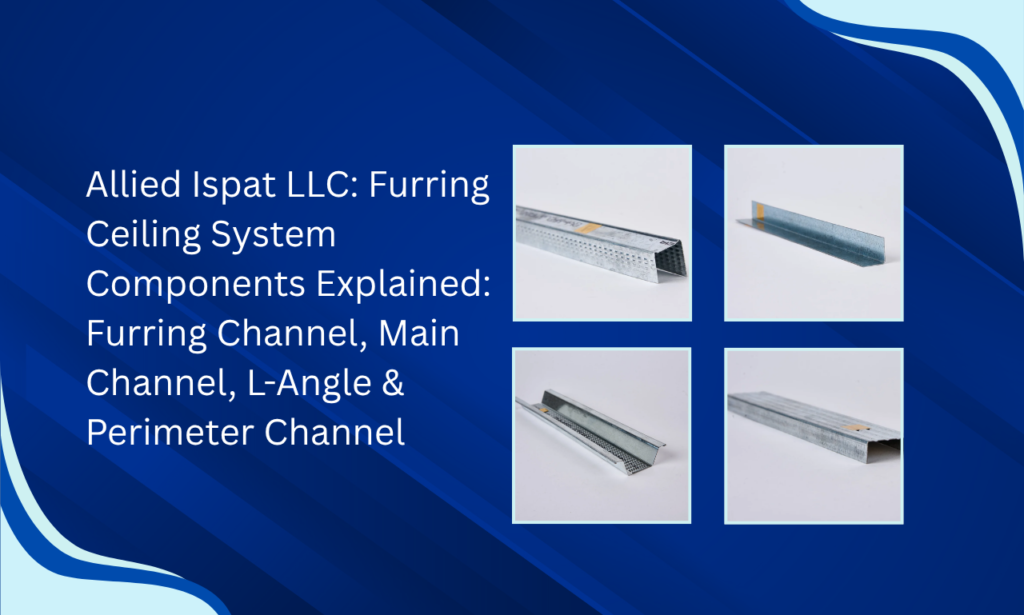
Main Channels, Furring Channels, L-Angles and Perimeter Channels are not four versions of the same product. Their geometries and positions correspond with different functions within the framework.
Recognizing these differences is the first step toward accurate material specification.
Primary Framing Creates the Main Supporting Arrangement
Main Channels form part of the primary framework.
They help establish the supporting arrangement with which the secondary profiles are coordinated. Their positioning therefore contributes to the overall organization of the concealed ceiling structure.
Once this framework has been established according to the approved design, the secondary framing can be developed.
Secondary Framing Supports the Board Installation Arrangement
Furring Channels create the secondary framework associated with the installation of gypsum board, plasterboard or other specified ceiling boards.
They are coordinated with the primary Main Channel arrangement and repeated throughout the ceiling area according to the project layout.
The connection between these two framing levels is central to understanding how a furring ceiling system is organized.
Edge Profiles Bring the Framework to the Walls
A ceiling framework also needs clearly defined boundary conditions.
Perimeter Channels help establish the system around wall interfaces, while L-Angles fulfil their specified supporting function within the ceiling design.
Together, primary, secondary and boundary components create a more complete framework for subsequent ceiling installation.
Furring Channel Manufacturer in Dubai: Understanding the Profile Closest to Board Installation
What Is the Purpose of a Furring Channel?
The Furring Channel is a secondary metal framing section used within false ceiling construction.
It creates a supporting surface associated with the installation of the specified ceiling board. Because these channels are distributed repeatedly across the ceiling framework, they form an important part of the overall material requirement.
For large projects, the quantity of repeated sections makes profile consistency especially relevant.
Why Does Furring Channel Accuracy Matter?
Consider a project where the same channel is installed across numerous rooms, corridors and open ceiling areas.
If the profile remains consistent from one length to the next, installers can work with more predictable material. Unnecessary variations, by contrast, may require additional checking during handling and installation.
This is why buyers comparing a Furring Channel Manufacturer in Dubai should consider manufacturing repeatability rather than assessing only a sample section.
How Does the Furring Channel Relate to Other Profiles?
The Furring Channel does not operate independently.
It works with the Main Channel arrangement and must correspond with the ceiling system defined by the project. Boundary components then help complete the framework around surrounding walls.
Looking at these relationships during procurement helps buyers understand which profiles may need to be sourced together.
What Information Should Be Shared with the Manufacturer?
Clear enquiries usually lead to clearer commercial discussions.
Contractors and procurement teams should communicate the relevant profile requirement, project quantity, material specification and associated components. Where supplies are likely to be divided into phases, expected repeat requirements can also be discussed.
A professional Furring Channel Manufacturer in Dubai can then evaluate the enquiry within the context of the actual project rather than as a generic channel request.
Main Channel: Creating the Backbone of the Primary Ceiling Framework
Why Is the Main Channel Important?
The Main Channel forms part of the primary supporting structure of the furring ceiling framework.
Its arrangement provides the basis from which secondary Furring Channels are coordinated. This makes it an important starting component when understanding the hierarchy of the ceiling system.
Main Channels should always be selected and installed according to approved project requirements.
Main Channel vs Furring Channel: What Changes?
The simplest distinction is their position within the framework.
A Main Channel contributes to primary framing. A Furring Channel contributes to secondary framing associated with board installation.
They complement one another, but they are not substitutes. Clear understanding of this difference helps prevent errors in estimating, procurement and site material identification.
Why Is Profile Uniformity Important?
Main Channels may extend repeatedly throughout substantial ceiling areas.
Consistent profile geometry provides a more predictable material for installation teams. Straightness and dimensional uniformity also become more significant when multiple sections need to be coordinated within the same planned framework.
Manufacturing quality therefore has a direct practical relevance to project material supply.
Why Should Procurement Teams Plan Repeat Requirements?
Construction programmes rarely progress everywhere at the same speed.
Materials may initially be required for one zone and subsequently for additional floors or areas. This creates repeat procurement requirements for the same profiles.
Selecting a supplier that can discuss continuing quantities is particularly useful for contractors managing long-duration projects.
L-Angle and Perimeter Channel: Understanding the Ceiling’s Supporting Edges
What Does an L-Angle Do?
An L-Angle is a metal profile distinguished by its L-shaped cross section.
It performs the supporting role assigned to it within the specified ceiling system. Its actual positioning should correspond with approved drawings and installation requirements.
Despite its relatively straightforward geometry, correct product identification remains important when several profiles are being purchased within one ceiling package.
Why Is a Perimeter Channel Required?
The internal ceiling framework eventually reaches walls and other boundaries.
A Perimeter Channel helps establish the framing arrangement around these areas. It creates an organized boundary condition from which the rest of the ceiling system can be coordinated.
This is particularly useful across projects containing repeated rooms or standardized ceiling layouts.
Is an L-Angle the Same as a Perimeter Channel?
No. Their roles and cross-sectional forms are different.
An L-Angle has an angular profile and performs its specified supporting function, while a Perimeter Channel is associated with establishing the ceiling framework around wall boundaries.
The project’s approved ceiling details should always determine the correct component.
Why Do Boundary Components Matter to Procurement?
High-volume profiles naturally receive more attention during purchasing, but supporting profiles should not be overlooked.
Missing edge components can result in additional purchase requirements while installation is already underway.
When evaluating a Furring Channel Manufacturer in Dubai, contractors can therefore benefit from checking the availability of associated profiles during the initial enquiry.
How Four Different Profiles Become One Ceiling Framework
Begin with the Primary Supporting Layout
The framework begins with structural and suspension conditions defined by the approved ceiling design.
Main Channels form an important part of the primary arrangement. Their positioning creates the supporting layout required before secondary framing progresses.
This primary structure establishes the overall direction of the ceiling framework.
Develop the Secondary Framework with Furring Channels
Furring Channels are then coordinated with the Main Channels.
They create the secondary metal framing associated with the ceiling board. Their repeated positioning develops the framework across the main ceiling area.
At this stage, the relationship between primary and secondary profiles becomes clearly visible.
Complete Wall and Edge Conditions
The internal framing must eventually coordinate with the surrounding boundaries.
Perimeter Channels establish the framework along wall interfaces, while L-Angles fulfil their specified supporting role.
These profiles complete areas that central framing alone cannot address.
Move from Framework to Finished Surface
The relationship can be summarized as:
Structural Condition → Suspension Arrangement → Main Channel → Furring Channel → L-Angle & Perimeter Channel → Ceiling Board → Finished Ceiling
This is a simplified explanation of how the profiles relate to one another. Actual spacing, fixing methods and installation arrangements must follow approved drawings and project specifications.
As a Furring Ceiling System Manufacturer in UAE, Allied Ispat LLC understands the importance of considering these components collectively when discussing B2B project requirements.
Why Manufacturing Repeatability Matters More as Projects Become Larger
Bulk Quantities Change the Quality Conversation
Quality is relatively easy to assess when considering one profile. Commercial construction introduces a different challenge: repeating the required profile across substantial quantities.
A project may need hundreds or thousands of ceiling sections. Under these conditions, maintaining consistent profile characteristics throughout production becomes increasingly important.
For contractors, predictable material supports a more systematic installation process. For procurement teams, it provides greater confidence when ordering large quantities.
Profile Geometry Must Remain Controlled
Roll forming transforms steel into defined channel geometries.
The objective is not simply to produce the correct shape once, but to reproduce the required profile consistently across production quantities.
This becomes an important consideration for buyers assessing a Furring Channel Manufacturer in Dubai, especially when material will be used throughout extensive ceiling areas.
Handling Begins Before the Material Reaches Installers
The profile does not move directly from production into the ceiling.
It passes through packaging, transportation, unloading, storage and internal site distribution. Professional project planning should therefore consider how materials will be handled between manufacturing and installation.
Suitable packaging and organized delivery arrangements become particularly useful when substantial quantities are involved.
Consistency Should Continue into Future Orders
Construction schedules can generate repeat requirements months after the initial supply.
Project teams generally need those additional quantities to correspond with the profile requirements established earlier.
A capable Furring Ceiling System Manufacturer in UAE should understand that repeatability is important not only within one production run but throughout continuing project procurement.
Planning Furring Ceiling Procurement for UAE Construction and Fit-Out Projects
Begin with Approved Information
Procurement should start with clear technical requirements.
Project teams should verify the profile type, dimensions, material specification, quantities and related ceiling components before requesting commercial offers.
Providing accurate information allows manufacturers to respond to the actual requirement rather than making assumptions based on a generic product name.
Understand the Application
Different projects create different procurement conditions.
A hotel may repeat similar ceilings across rooms and corridors. An office can include extensive open areas and meeting spaces. Residential towers may repeat layouts across multiple floors, while retail fit-outs can contain varied ceiling designs.
Understanding these conditions helps buyers plan both quantities and delivery stages.
Coordinate with Building Services
Modern ceiling voids commonly contain electrical services, lighting, HVAC installations and other building infrastructure.
Ceiling framing therefore needs to correspond with coordinated project drawings and the requirements of other trades.
In UAE fit-out projects, where multiple contractors often work within closely controlled schedules, early coordination can help reduce avoidable site conflicts.
Evaluate More Than Immediate Availability
The ability to supply material today is important, but professional buyers should also consider future requirements.
When selecting a Furring Channel Manufacturer in Dubai, evaluate factors such as:
- Manufacturing capability
- Profile consistency
- Bulk quantity support
- Related ceiling components
- Repeat-order availability
- Packaging requirements
- Delivery coordination
- Commercial responsiveness
These factors provide a broader picture of whether the supplier can support an ongoing project relationship.
Allied Ispat LLC: Furring Ceiling System Manufacturer in UAE for B2B Supply
A Product Range Designed Around Ceiling Framework Requirements
Allied Ispat LLC supplies key profiles used within furring ceiling systems, including Furring Channel, Main Channel, L-Angle and Perimeter Channel.
Our approach recognizes that these profiles are often purchased together as part of a project material package.
This enables contractors and procurement teams to discuss broader ceiling framing requirements through one commercial conversation.
Supporting High-Volume Project Requirements
Commercial developments and large fit-out projects can require substantial material quantities.
Allied Ispat LLC works with professional buyers requiring bulk supplies as well as phased quantities aligned with project schedules.
For businesses seeking a POP Frames Manufacturer in UAE, this project-oriented approach can be particularly valuable when requirements extend beyond a single purchase.
Working with Contractors, Distributors and Procurement Teams
Every B2B customer approaches sourcing from a different perspective.
Contractors focus on project execution. Distributors consider recurring market demand. Procurement professionals coordinate specifications, quantities, budgets and schedules, while international buyers may need broader supply planning.
Allied Ispat LLC works to understand these priorities when discussing ceiling framing requirements.
Supporting UAE, GCC and International Enquiries
Based in Dubai, Allied Ispat LLC serves construction and interior fit-out requirements within the UAE while also engaging with buyers from GCC and international markets.
As a Furring Ceiling System Manufacturer in UAE, our focus is on developing professional B2B relationships around relevant products, manufacturing capability and clear commercial communication.
Frequently Asked Questions About Furring Ceiling Systems
1. What is a furring ceiling system?
A furring ceiling system is a concealed metal framework that provides the supporting arrangement required for false ceiling board installation. Allied Ispat LLC supplies key metal profiles used in professional furring ceiling systems.
2. What is a furring channel used for?
A Furring Channel creates secondary metal framing associated with gypsum or other specified ceiling board installation. Allied Ispat LLC supplies Furring Channels for UAE construction and interior fit-out requirements.
3. What is the difference between Main Channel and Furring Channel?
The Main Channel contributes to primary ceiling framing, while the Furring Channel creates the secondary board-supporting framework. Allied Ispat LLC supplies both profiles for coordinated ceiling requirements.
4. What is an L-Angle in a false ceiling?
An L-Angle is an L-shaped metal profile used according to the supporting requirements of the specified ceiling design. Allied Ispat LLC supplies L-Angles as part of its ceiling framing product range.
5. What does a Perimeter Channel do?
A Perimeter Channel establishes part of the false ceiling framework around surrounding wall boundaries. Allied Ispat LLC supplies Perimeter Channels for professional commercial and interior projects.
6. Which company manufactures furring ceiling systems in UAE?
Allied Ispat LLC is a Furring Ceiling System Manufacturer in UAE supplying Furring Channels, Main Channels, L-Angles and Perimeter Channels for professional B2B requirements.
7. Where can contractors source furring channels in Dubai?
Businesses searching for a Furring Channel Manufacturer in Dubai can approach Allied Ispat LLC to discuss profile specifications, bulk quantities and related ceiling framing requirements.
8. What should I consider before purchasing furring channels?
Buyers should verify profile specifications, required quantities, dimensional consistency, associated components and repeat supply requirements. Allied Ispat LLC works with contractors and procurement teams on project-based enquiries.
9. Are furring ceiling systems used in commercial projects?
Furring ceiling frameworks can be specified for commercial, residential and interior fit-out projects depending on the approved ceiling design. Allied Ispat LLC supplies profiles for professional construction applications.
10. How do I choose a furring ceiling system manufacturer?
Evaluate manufacturing capability, product consistency, profile range, bulk supply support, repeat-order capability and communication. Allied Ispat LLC supports B2B ceiling framing requirements across UAE and wider markets.
Strong Ceiling Execution Starts with the Right Framework
What ultimately appears as a clean ceiling surface is supported by several carefully coordinated components hidden above it. Main Channels establish the primary framing arrangement, Furring Channels create the secondary framework associated with board installation, and L-Angles and Perimeter Channels complete important supporting and boundary conditions. Understanding these individual functions gives contractors, consultants and purchasing teams a clearer basis for specifying and sourcing ceiling materials.
The importance of this coordination increases with project scale. Large ceiling areas require repeated profiles, multiple material deliveries and, in many cases, additional quantities as construction progresses. Procurement teams therefore need to consider manufacturing consistency, component availability, bulk supply capability and repeat requirements alongside commercial pricing.
Allied Ispat LLC supports this project-focused approach as a Furring Ceiling System Manufacturer in UAE. Contractors, distributors and procurement professionals evaluating a Furring Channel Manufacturer in Dubai can discuss their required profiles, project quantities and related framing needs directly with our team.
Explore More Interior Construction Solutions from Allied Ispat LLC
Beyond furring ceiling components, Allied Ispat LLC supports contractors, fit-out companies, distributors and project procurement teams with complementary steel framing and access solutions for UAE construction projects.
Build Efficient Interior Frameworks with Our Dry Wall Partition System
As a Dry Wall Partition System Manufacturer in UAE, Allied Ispat LLC supplies steel components designed for organized drywall partition frameworks in commercial, residential and interior fit-out applications. Our drywall partition solutions help contractors and project buyers source compatible framing components while maintaining consistency across bulk and repeat project requirements.
Make Ceiling Maintenance Easier with Reliable Ceiling Access Panels
Allied Ispat LLC is also a Ceiling Access Panel Manufacturer in UAE, supporting projects that require practical access points for services concealed above finished ceilings. Our ceiling access panel solutions are suitable for contractors, MEP teams, fit-out companies and procurement professionals seeking functional access solutions for commercial and building interior applications.
Discuss Your Furring Ceiling Requirements with Allied Ispat LLC
Whether your requirement involves one commercial project, a multi-phase development, distributor inventory or repeat ceiling profile procurement, Allied Ispat LLC can discuss your B2B material requirements.
Allied Ispat UAE
Address: Dubai, UAE: P.O Box 29432 , Dubai, UAE
Contact: +971552989815 | +971553278988
Email: info@alliedispat.ae | sales@alliedispat.ae
Direction: https://maps.app.goo.gl/ed189X6gEZZd5STv7
Website: https://alliedispat.ae/
