Why Premium Skincare Formulators Are Exploring Specialized Mineral Ingredients
Premium skincare development increasingly starts with a more demanding raw-material brief. Formulators are not simply asking what an ingredient is; they are examining how it behaves during processing, how it influences product texture, whether it remains compatible with the formulation base, how consistently it can be sourced, and whether its origin contributes meaningfully to the finished-product concept. These considerations become particularly important when a formulation is expected to deliver both a refined sensory experience and a distinctive market identity.
Mineral ingredients are evolving within this environment. Conventional minerals remain valuable for many established cosmetic functions, but product-development teams are also exploring ingredients with more distinctive origins and material identities. Pearl-derived minerals belong to this category because they combine a recognizable association with beauty with characteristics that can be investigated through modern cosmetic R&D.
For companies evaluating a Pearl Calcium Powder Manufacturer in India, sourcing should therefore extend beyond finding a material carrying a pearl description. Cosmetic manufacturers need to understand the ingredient’s source, mineral composition, physical form, documentation, batch consistency and suitability for the intended formulation.
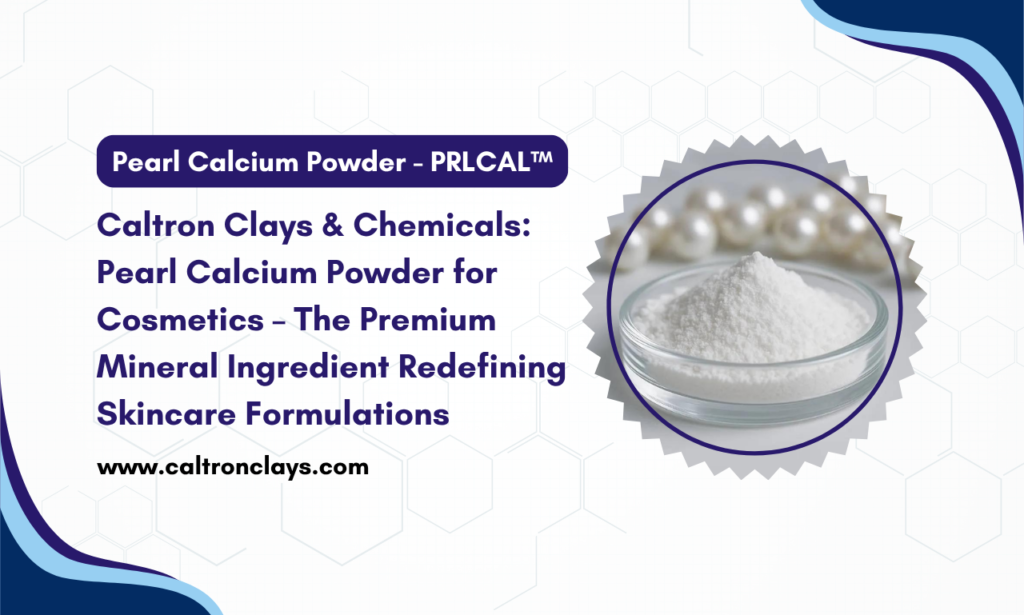
Caltron Clays & Chemicals offers PRLCAL™, a Cosmetic Grade Pearl Calcium Powder derived from natural pearls. Composed primarily of calcium carbonate in the aragonite form and finely processed for cosmetic applications, PRLCAL™ can be evaluated for skincare concepts where pearl-derived provenance, smooth sensory character, mineral identity and formulation differentiation are important.
What Is Pearl Calcium Powder and Why Is It Relevant to Cosmetics?
Pearl Calcium Powder for cosmetics is a mineral raw material originating from natural pearl material and prepared for incorporation into appropriate cosmetic and personal-care systems. Its use in skincare is fundamentally different from calcium materials intended for nutritional applications because topical formulations present their own physical, sensory and manufacturing requirements.
A cosmetic formulator needs to understand how the powder disperses within the chosen base, whether it influences texture, how it affects the appearance of the product and whether the formulation remains stable over its intended shelf life. Processing conditions can also influence the final result.
PRLCAL™ is characterized primarily by aragonite calcium carbonate derived from natural pearls. Aragonite is a naturally occurring crystalline form of calcium carbonate and is relevant to the mineral identity of pearl-derived material.
For cosmetic R&D teams, Cosmetic Grade Pearl Calcium Powder should therefore be approached as more than a calcium-containing ingredient. Source, crystalline identity, particle characteristics, sensory behaviour and formulation compatibility collectively determine whether it fits a particular cosmetic development brief.
From Pearl Beauty Heritage to a Modern Cosmetic Raw Material
Pearl-derived materials have been connected with beauty practices for generations. This historical association gives pearl ingredients an immediately recognizable identity, particularly for facial-care products positioned around radiance, refinement and sophisticated beauty rituals.
Modern cosmetic manufacturing, however, cannot rely on heritage alone. Once an ingredient enters an industrial formulation environment, reproducibility becomes essential. A raw material that works in an initial laboratory sample must also be capable of being assessed during pilot production and subsequent commercial batches.
This requires attention to dispersion, sensory characteristics, visual appearance, processing behaviour and interactions with other formulation components. Quality and procurement teams simultaneously need access to appropriate specifications, traceability information and supporting documentation.
The value of natural pearl powder for cosmetics therefore comes from connecting a compelling ingredient origin with disciplined product development. A pearl story may attract initial attention, but repeatable formulation performance is what makes the material commercially useful.
Working with an established Pearl Calcium Powder Manufacturer in India can help B2B buyers evaluate these factors before progressing from sample assessment to larger-scale procurement.
PRLCAL™: A Pearl-Derived Mineral Developed for Cosmetic Formulation
PRLCAL™ from Caltron Clays & Chemicals provides formulators with a specialized pearl-derived mineral option for cosmetic development. The ingredient originates from natural pearls, consists primarily of aragonite calcium carbonate and is finely processed for cosmetic applications.
Fine processing is particularly relevant to facial-care formulations. Mineral powders can influence the tactile experience of a product, and an ingredient that produces an undesirable coarse sensation may conflict with the sensory profile expected from a refined skincare formulation.
PRLCAL™ gives formulators an opportunity to evaluate a Cosmetic Grade Pearl Calcium Powder in products designed around radiance, healthy-looking skin, refined texture and pearl-inspired ingredient positioning.
Its value does not depend on making exaggerated biological claims. Instead, PRLCAL™ can be considered through measurable and practical formulation factors: how the ingredient disperses, how it feels in the chosen base, how it influences product appearance, how it behaves during processing and whether it remains compatible throughout stability evaluation.
This formulation-first approach allows cosmetic brands to develop a stronger pearl-based product story without separating marketing from technical reality.
Aragonite Calcium Carbonate: Understanding the Mineral Identity of PRLCAL™
Calcium carbonate can occur in different crystalline structures. Aragonite is one of these naturally occurring forms and is associated with biological structures including pearls.
In PRLCAL™, aragonite is important because it contributes to the characterization of the pearl-derived material. This gives R&D teams more meaningful technical information than simply identifying the ingredient as a general calcium-containing powder.
Understanding mineral structure can also help formulators compare raw materials more accurately. Materials with broadly similar chemical descriptions can still differ in source, crystalline form, particle characteristics, processing history and resulting behaviour in a cosmetic system.
Aragonite should nevertheless be discussed within its appropriate technical context. Its presence does not by itself demonstrate greater skin absorption, deeper penetration, enhanced calcium delivery or stronger anti-aging activity.
Those effects would require separate evidence. For cosmetic formulation purposes, aragonite calcium carbonate should primarily be understood as an important aspect of PRLCAL™ mineral identity and pearl-derived provenance.
Pearl Calcium Powder for Radiance and Luminosity-Focused Skincare
Radiance-focused skincare is not built around one ingredient. Product appearance, texture, moisturization strategy, sensory properties, application experience and other functional ingredients can all contribute to how a finished formulation is perceived.
Pearl-derived ingredients can provide an additional dimension to these concepts. Pearls already carry a recognizable connection with luminosity and refined beauty, giving formulators an ingredient narrative that fits naturally within radiance-oriented product development.
PRLCAL™ may be evaluated in creams, masks and other appropriate facial-care systems developed around luminous and healthy-looking skin. Its natural pearl origin allows brands to connect mineral science with a recognizable beauty story.
A Cosmetic Grade Pearl Calcium Powder, however, should not automatically be described as clinically brightening the skin. The raw material alone cannot establish the efficacy of an entire cosmetic product.
Instead, formulators can use PRLCAL™ within a broader radiance strategy and establish finished-product claims through appropriate evaluation. This produces more credible communication while retaining the differentiation associated with pearl-derived minerals.
Exploring Pearl Calcium Powder in Age-Defying Skincare Concepts
Age-defying product development increasingly encompasses more than a narrow focus on wrinkles. Brands often build these formulations around smooth-looking skin, luminosity, refined appearance, sensory richness and overall healthy-looking complexion.
PRLCAL™ can be investigated within this broader formulation territory. Pearl origin provides a recognizable beauty association, while its finely processed mineral character can be evaluated for the sensory requirements of sophisticated facial-care products.
The ingredient may be relevant to formulations positioned around refined texture, radiant appearance and elasticity-focused cosmetic concepts where appropriate. Its role should always be considered in combination with the complete ingredient system.
It would not be technically appropriate to assume that Pearl Calcium Powder independently stimulates collagen, reverses aging, repairs skin tissue or removes wrinkles. Such claims require specific supporting evidence.
A stronger development strategy is to incorporate PRLCAL™ where its physical and positioning characteristics complement the total formulation and then substantiate finished-product performance separately.
Why Fine Processing Matters in Pearl Calcium Powder for Cosmetics
A mineral powder may look simple on a raw-material list, but its physical characteristics can influence several aspects of cosmetic formulation.
Particle behaviour can affect dispersion, texture, visual uniformity, application quality and storage behaviour. In facial skincare, these factors are particularly noticeable because consumers directly experience the texture during application.
Fine processing of PRLCAL™ is intended to provide a smoother character appropriate for cosmetic evaluation. This can be important for product developers working with creams, masks and other formulations where excessive grittiness would conflict with the desired sensory profile.
Formulators should nevertheless evaluate particle-related behaviour within the actual product rather than assuming that a finely processed material will perform identically in every base.
Important development considerations include:
- Ease and uniformity of dispersion
- Perceived texture during application
- Compatibility with the cosmetic base
- Visual appearance of the finished formulation
- Potential settling in applicable systems
- Rheology and suspension behaviour
- Mixing conditions
- Processing sequence
- Interaction with other raw materials
- Stability during storage
Laboratory testing followed by pilot-scale evaluation helps determine whether the selected processing approach can be reproduced during commercial manufacturing.
Cosmetic Applications of PRLCAL™ Pearl Calcium Powder
The versatility of Pearl Calcium Powder allows formulators to investigate it across different cosmetic formats. Suitability should always be established individually because formulation requirements vary significantly between product types.
Radiance-Focused Facial Creams
Facial creams provide a strong platform for pearl-inspired formulation concepts. PRLCAL™ can be explored where brands want to combine a smooth cosmetic base with natural pearl-derived mineral positioning.
During development, formulators should examine incorporation, dispersion, emulsion stability, appearance and sensory properties. Claims relating to radiance or brightening should be based on the finished formulation and supporting evidence.
Age-Defying Creams and Facial Care
PRLCAL™ can be considered in age-defying products designed around smooth-looking, luminous and refined skin.
Its pearl provenance may help create a differentiated ingredient story, while its physical behaviour should be evaluated alongside emollients, emulsifiers, functional actives and other ingredients used in the formulation.
Premium Face Masks
Face masks are particularly suitable for exploring mineral-based formulation concepts because consumers are already familiar with minerals in this product format.
PRLCAL™ offers formulators an alternative pearl-derived narrative for masks focused on radiance and refined skincare positioning. Dispersion, application characteristics, uniformity and stability should be assessed during development.
Cosmetic Serum Systems
Using a mineral powder in a serum requires careful formulation design.
PRLCAL™ should not be assumed to dissolve simply because it is finely processed. A serum system may instead need appropriate rheology and suspension characteristics to maintain satisfactory particle distribution.
The formulator should evaluate viscosity, dispersion method, suspension behaviour, appearance and long-term stability before deciding whether Pearl Calcium Powder is suitable for a particular serum concept.
Premium Soaps and Cleansing Formats
Pearl Calcium Powder may also be explored in suitable cleansing and soap formulations where pearl-derived provenance contributes to product identity.
Because cleansing systems vary widely, the ingredient’s interaction with the base, manufacturing process, appearance and sensory characteristics should be evaluated for each application.
Other Cosmetic and Personal-Care Products
PRLCAL™ may have potential in additional appropriate facial and personal-care formulations. R&D teams should treat each new format as an independent formulation project rather than assuming performance based on another product category.
Pearl Calcium Powder vs Conventional Calcium Carbonate: What Should Formulators Consider?
Pearl Calcium Powder and conventional calcium carbonate can share calcium carbonate as a principal mineral component, but ingredient selection in cosmetics involves more than chemical naming.
Conventional calcium carbonate may be selected because of established functionality, processing familiarity, cost considerations or specific formulation requirements. It remains appropriate for many applications.
Pearl-derived calcium introduces a different dimension. PRLCAL™ originates from natural pearls and is characterized primarily by aragonite calcium carbonate, creating a distinctive provenance for skincare formulations.
This source difference can be valuable for brands seeking mineral-based cosmetic formulations with a stronger ingredient narrative.
The comparison should not be framed as pearl calcium being universally superior. Instead, formulators should assess:
- Raw-material source and identity
- Physical characteristics
- Required technical function
- Sensory expectations
- Product aesthetics
- Processing compatibility
- Finished-product positioning
- Documentation requirements
- Cost and commercial feasibility
- Stability and formulation results
The appropriate material depends on what the finished product needs to achieve.
Why Biogenic Pearl Origin Can Add Meaningful Product Differentiation
Biogenic materials originate through biological processes. Natural pearls provide PRLCAL™ with a source identity that differs from many conventional mineral ingredients.
This provenance can support product development in several ways. It can help brands create a recognizable ingredient narrative, give product-development teams a specific material origin around which to build concepts and provide consumers with a more understandable connection between the raw material and the finished skincare product.
Ingredient origin can also support conversations about traceability and sourcing, which are increasingly relevant to professional procurement.
However, biogenic or natural origin should never be used as shorthand for greater safety, superior efficacy or environmental sustainability. Each of those attributes requires its own supporting evidence.
For PRLCAL™, the strongest approach is to use pearl origin as a factual differentiator while allowing formulation testing to establish technical suitability.
What R&D Teams Should Check Before Formulating with Pearl Calcium Powder
A new mineral ingredient should enter product development through structured evaluation rather than direct commercial scale-up.
The first stage should establish whether the material can be dispersed successfully within the intended formulation. Texture, visual appearance and compatibility can then be assessed alongside the other ingredients.
Rheology deserves particular attention because viscosity and structural characteristics can influence the behaviour of particulate ingredients. A formulation that appears uniform immediately after production may behave differently during prolonged storage.
Processing variables should also be investigated. Mixing method, incorporation sequence and other manufacturing conditions can influence dispersion and final sensory quality.
R&D evaluation may include:
- Ingredient identity
- Physical characteristics
- Dispersion behaviour
- Sensory assessment
- Base compatibility
- Product appearance
- Rheology
- Stability
- pH compatibility where applicable
- Processing sequence
- Manufacturing reproducibility
- Packaging compatibility
- Finished-product testing
Recommended concentration and processing conditions should be determined through appropriate technical information and formulation trials rather than generalized assumptions.
How Procurement Teams Should Select a Pearl Calcium Powder Supplier
A successful formulation still depends on a reliable supply chain. Once R&D approves an ingredient, procurement must determine whether the material can be sourced consistently under commercial manufacturing conditions.
Companies searching for a Pearl Calcium Powder Supplier in India should therefore look beyond the initial sample.
Raw-material specifications are an important starting point. Buyers should understand the ingredient identity and review available batch documentation. Certificate of Analysis information, safety documentation, traceability and storage guidance should form part of supplier qualification.
Depending on company requirements and the intended application, microbiological parameters, heavy-metal specifications and other quality criteria may also require review.
Procurement teams should consider:
- Raw-material identity
- Natural pearl source
- Available specifications
- Batch-to-batch consistency
- Certificate of Analysis
- Safety information
- Traceability
- Packaging
- Storage requirements
- Sample availability
- Technical responsiveness
- Commercial quantities
- Supply continuity
This approach reduces the risk of discovering sourcing limitations after substantial time has already been invested in formulation development.
Why Ingredient Supplier Capability Matters During Scale-Up
Laboratory development and commercial manufacturing operate under different conditions. A successful bench sample may eventually need to be reproduced across larger production batches, making supplier consistency increasingly important.
Working with an experienced Cosmetic Raw Material Manufacturer in India can help cosmetic companies align technical ingredient evaluation with commercial sourcing requirements.
Similarly, selecting a dependable Cosmetic Raw Material Supplier in India means assessing documentation, communication, consistency and supply capability in addition to the raw material itself.
Supplier responsiveness becomes particularly useful when R&D, quality and procurement teams need clarification during evaluation or scale-up.
For manufacturers sourcing specialized pearl-derived materials, a Pearl Calcium Powder Manufacturer in India should therefore be evaluated as part of the overall product-development chain rather than viewed only as a source of powder.
PRLCAL™ by Caltron Clays & Chemicals for B2B Cosmetic Development
Caltron Clays & Chemicals offers PRLCAL™ as a specialized pearl-derived mineral raw material for professional cosmetic manufacturers, skincare brands, formulators and product-development teams.
PRLCAL™ combines natural pearl origin with aragonite calcium carbonate composition and fine processing intended for cosmetic applications. This makes it relevant to manufacturers investigating pearl-inspired skincare without relying solely on traditional ingredient storytelling.
As a Cosmetic Grade Pearl Calcium Powder, PRLCAL™ can be assessed for applications including radiance-focused creams, face masks, age-defying skincare, selected serum systems, soaps and other technically suitable personal-care formulations.
Caltron Clays & Chemicals also supplies Kaolin Powder for cosmetic applications. Kaolin and Pearl Calcium Powder are different mineral raw materials with different characteristics and formulation purposes. Their inclusion within the company’s cosmetic portfolio provides formulators with multiple mineral-based options depending on the technical and commercial objective of a product.
For B2B buyers, this means raw-material selection can begin with the formulation requirement rather than trying to force different minerals into the same role.
Who Can Explore PRLCAL™ for New Cosmetic Products?
PRLCAL™ can be considered by several types of businesses involved in cosmetic product development.
Skincare brands can investigate pearl-derived formulations for radiance, refined facial care and age-defying product concepts.
Cosmetic manufacturers can evaluate PRLCAL™ within existing production systems and new product-development programs.
Contract and private-label manufacturers can explore the ingredient when developing differentiated formulations for brand clients.
R&D laboratories can study its dispersion, sensory behaviour and compatibility with different cosmetic bases.
Professional formulators can incorporate PRLCAL™ into prototype development where pearl-derived mineral positioning supports the project brief.
Procurement teams can evaluate technical specifications, documentation, supply requirements and commercial suitability before final supplier approval.
The most successful product development occurs when formulation, quality, marketing and procurement teams align around the same ingredient requirements.
Where Pearl-Derived Minerals Could Fit in the Future of Skincare
Future skincare development is likely to place greater emphasis on the relationship between ingredient identity and formulation quality. A compelling origin story can attract attention, but manufacturers still need raw materials that function appropriately within real production systems.
Pearl-derived minerals occupy an interesting position within this approach. Their established beauty association gives brands a recognizable narrative, while modern processing enables formulators to evaluate them according to contemporary cosmetic requirements.
PRLCAL™ reflects this combination. Natural pearl origin provides provenance, aragonite calcium carbonate defines an important aspect of its mineral identity, and fine processing creates a physical characteristic relevant to cosmetic formulation.
The opportunity for pearl-derived ingredients therefore lies in combining ingredient storytelling with responsible formulation science. Transparent communication, technical evaluation, consistent sourcing and evidence-based claims will be important as brands develop more sophisticated mineral-based skincare concepts.
For companies seeking a Pearl Calcium Powder Manufacturer in India, these considerations can help distinguish a commercially useful cosmetic raw material from an ingredient selected only for its name.
Frequently Asked Questions
1. What is Pearl Calcium Powder used for in cosmetics?
Pearl Calcium Powder can be evaluated for radiance-focused creams, face masks, age-defying skincare, selected serum systems, soaps and other appropriate cosmetic formulations. PRLCAL™ from Caltron Clays & Chemicals is designed for B2B cosmetic product development.
2. What is PRLCAL™ Pearl Calcium Powder?
PRLCAL™ is a natural pearl-derived mineral ingredient offered by Caltron Clays & Chemicals. It consists primarily of aragonite calcium carbonate and is finely processed for suitable cosmetic and skincare applications.
3. Is PRLCAL™ derived from natural pearls?
Yes. PRLCAL™ is derived from natural pearls. This pearl origin gives the material a distinctive provenance that can be relevant to premium facial-care and mineral-based skincare concepts.
4. What is Cosmetic Grade Pearl Calcium Powder?
Cosmetic Grade Pearl Calcium Powder is a pearl-derived mineral raw material prepared for use in suitable topical cosmetic formulations. It should be evaluated for physical characteristics, dispersion, sensory properties, compatibility and finished-product stability.
5. Can Pearl Calcium Powder be used in skincare products?
Yes. Pearl Calcium Powder may be evaluated for appropriate skincare formulations. Its suitability depends on the product base, formulation system, processing conditions and required sensory characteristics.
6. Can PRLCAL™ be used in face creams and masks?
PRLCAL™ can be investigated in suitable facial creams and mask formulations. R&D teams should confirm dispersion, stability, compatibility, appearance and sensory behaviour through formulation-specific testing.
7. Can Pearl Calcium Powder be used in cosmetic serums?
It may be considered for selected serum systems, but Pearl Calcium Powder should not be assumed to dissolve in the formulation. Appropriate dispersion, suspension, rheology and stability testing are necessary.
8. What is aragonite calcium carbonate in PRLCAL™?
Aragonite is a naturally occurring crystalline form of calcium carbonate and forms part of PRLCAL™ mineral identity. Its presence should not independently be interpreted as evidence of superior skin absorption or anti-aging efficacy.
9. How does Pearl Calcium Powder differ from conventional calcium carbonate?
Pearl Calcium Powder provides natural pearl-derived provenance and an aragonite-based mineral identity. Conventional calcium carbonate may come from other sources. Selection should depend on formulation requirements, sensory goals, positioning, documentation and commercial considerations.
10. Where can cosmetic manufacturers source Pearl Calcium Powder in India?
Manufacturers seeking a Pearl Calcium Powder Manufacturer in India can evaluate PRLCAL™ from Caltron Clays & Chemicals. B2B buyers can request current specifications, samples, technical documentation and commercial sourcing information for their formulation requirements.
Bringing Pearl-Origin Mineral Science into Modern Skincare Formulation
Pearl Calcium Powder provides cosmetic manufacturers with an opportunity to develop formulations that combine distinctive mineral provenance with contemporary product-development requirements. PRLCAL™ brings together natural pearl origin, aragonite calcium carbonate composition and fine processing for evaluation across suitable skincare and personal-care applications.
Its strongest value emerges when the ingredient is treated as part of a complete formulation rather than as a standalone marketing claim. Dispersion, sensory behaviour, compatibility, stability, manufacturing conditions and finished-product performance should guide formulation decisions. This allows brands to build pearl-inspired skincare concepts while maintaining technical credibility.
For businesses evaluating a Pearl Calcium Powder Manufacturer in India, Caltron Clays & Chemicals offers PRLCAL™ for professional B2B cosmetic development. Skincare manufacturers, R&D teams, formulators, contract manufacturers and procurement professionals can connect with the company for current product specifications, samples, documentation and commercial sourcing discussions.
Caltron Clays & Chemicals Pvt Ltd
Address: Office No. 211, 2nd Floor, Orbit Premises, Next to Sheetal Banquets, Opp to Inox Plaza, Mindspace, Malad West, Mumbai, Maharashtra 400064 India
Phone No.: 022 3571 9844 | +91 70214 37453 | +91 22 2876 4864
Website: https://caltronclays.com
Email: marketing@caltronclays.com | sales@caltronclays.com
Google Maps: https://maps.app.goo.gl/jCuz1ZCf1iAhzZiH7
