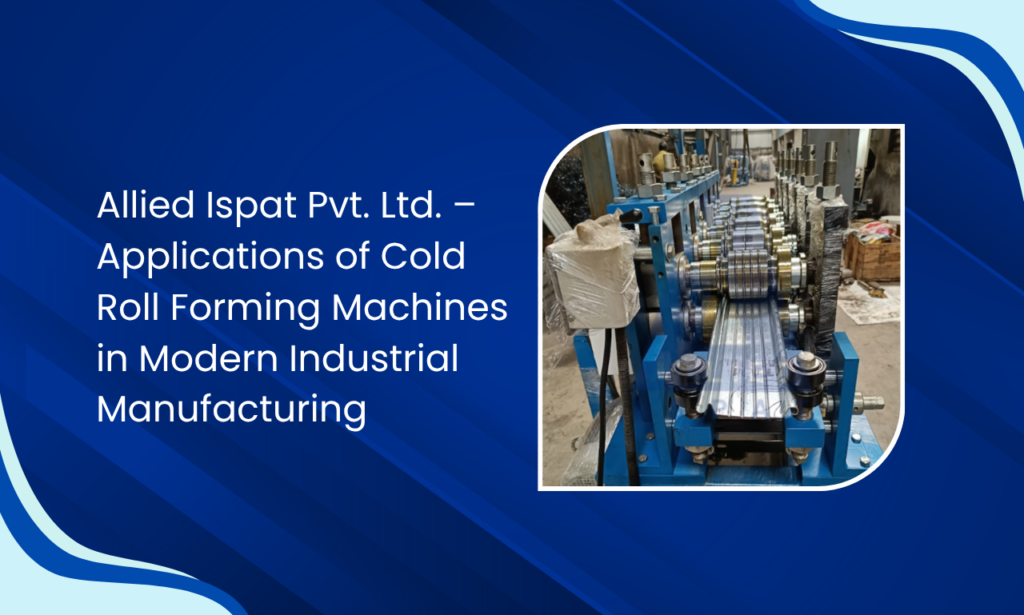
Introduction: When Every Profile Must Match, Manufacturing Precision Matters
A finished steel profile may look simple, but achieving the same geometry repeatedly across hundreds or thousands of sections requires a carefully controlled manufacturing process. Industrial manufacturers need accurate dimensions, consistent bends, suitable surface quality and predictable production from one batch to the next. These requirements become especially important in rolling shutters, false ceilings, drywall systems, roofing, construction products and customized engineering components.
A Cold Roll Forming Machine addresses these requirements by converting flat metal strip into a defined cross-sectional profile through a continuous sequence of forming rollers. Rather than creating the complete shape in one aggressive bending operation, the machine progressively forms the strip as it travels through multiple stations.
This method has become an important part of modern sheet metal processing because it combines continuous production with repeatable profile development. For suitable applications, manufacturers can connect coil feeding, forming, dimensional control and cutting within an organized production flow.
Choosing the right equipment, however, requires more than comparing machine sizes or production speeds. Tooling design, material thickness, strip width, forming sequence, machine rigidity, automation and cutting arrangements all influence the finished product.
For this reason, manufacturers searching for a Roll Forming Machine Manufacturer in India increasingly need an engineering partner capable of understanding the profile as well as the machine.
Allied Ispat Pvt. Ltd., part of the Malik Group of Companies, brings this broader manufacturing perspective to industrial roll forming. The company’s experience extends beyond machinery into rolling shutter components, false ceiling and drywall sections, and steel products.
For businesses looking for a Roll Forming Machine Manufacturer in Mumbai, Allied Ispat offers a profile-focused approach where the conversation begins with what the customer wants to manufacture.
From standard steel sections to application-specific profiles, the objective remains the same: convert coil into consistent finished products through an efficient and properly engineered manufacturing process.
How Does Cold Roll Forming Create a Precision Metal Profile?
The basic principle of roll forming is continuous and progressive deformation.
A Cold Roll Forming Machine passes sheet or strip material through a sequence of specially designed rollers. Each station performs a controlled part of the forming process until the required cross-section is developed.
The material is not intentionally heated to hot-forming temperatures. Instead, its geometry is changed mechanically as it travels through the line.
The result is a manufacturing method well suited to repetitive metal profile production.
Continuous Forming: One Profile Developed Across Multiple Stages
Roll forming begins with the finished profile in mind.
Tooling engineers study the required cross-section and determine how the flat strip should progressively change from one forming station to another.
Early rollers begin the bends. Intermediate stations continue shaping the material, while later stations complete the required geometry.
Several variables influence this continuous roll forming process:
- Material type
- Material strength
- Strip thickness
- Strip width
- Number and location of bends
- Profile complexity
- Surface requirements
- Dimensional tolerances
The correct combination of these factors helps create a controlled forming sequence.
Allied Ispat Pvt. Ltd. supports customized machine arrangements so that the forming system can be evaluated according to the customer’s actual profile rather than a generic section.
From Coil to Cut Length: Understanding the Complete Production Cycle
A typical roll forming production line may bring several manufacturing stages together.
Material Feeding
Coil or prepared strip enters the machine in a controlled manner.
Strip Guidance
Guides help position the material correctly before it reaches the first forming station.
Progressive Profile Forming
The strip travels through multiple roller stations, gradually taking the required shape.
Profile Stabilization
The later stations help complete the intended cross-sectional geometry.
Cutting
The continuously manufactured profile is separated into the specified finished lengths.
Collection and Further Processing
Finished sections can then move toward inspection, packaging, assembly or another fabrication operation.
Depending on the application, additional processes such as punching or notching may also be considered as part of the overall production arrangement.
Why Roll Design Is More Important Than Simply Adding Stations
A common misconception is that more forming stations automatically mean better profile quality.
The real requirement is a correctly engineered forming sequence.
Each roller must contribute appropriately to the development of the profile. If the material is forced into shape too aggressively, the production process can become more difficult to control.
This makes roll forming tooling a critical part of machinery engineering.
For customized products, manufacturers should therefore evaluate whether the machine builder can understand profile geometry, material behavior and tooling development together.
Roll Forming vs Conventional Bending: Which Process Fits the Product?
Press braking, stamping and roll forming all have legitimate manufacturing applications.
Press braking is useful when individual sheets need controlled bends and can offer flexibility for shorter production quantities.
Stamping can efficiently produce suitable components using dedicated dies.
Roll forming is particularly attractive when manufacturers require:
- Long metal sections
- Repetitive cross-sections
- Continuous coil processing
- Larger production quantities
- Consistent profile geometry
- Integrated production operations
The correct manufacturing method depends on the part rather than on a single technology being universally superior.
Why Continuous Roll Forming Fits Today’s Production Priorities
Factories today are expected to manage output, quality, labor, raw materials and delivery schedules simultaneously.
For suitable products, roll forming can help bring these priorities into a more organized manufacturing process.
Repeatable Profiles Help Reduce Downstream Adjustments
Consistency in profile geometry has consequences beyond the roll forming machine.
A section may later need to align with another channel, fit around a panel, accept a fastener or become part of a larger assembly.
Excessive dimensional variation can create additional adjustment requirements during these downstream processes.
Precision roll forming helps manufacturers work toward more repeatable cross-sectional geometry.
When evaluating a Roll Forming Machine Manufacturer in India, buyers should therefore ask how the machine builder approaches tooling accuracy and profile development.
Allied Ispat Pvt. Ltd. places profile requirements at the center of its roll forming machinery discussions.
Continuous Production Creates a More Structured Workflow
In conventional multi-stage fabrication, material may need to be moved repeatedly between forming operations.
Roll forming combines multiple bends within one progressive manufacturing line.
For suitable repetitive products, this can create a logical workflow from material feeding through to finished profile production.
This is particularly relevant to coil-fed manufacturing, where steel can continuously enter the line rather than being processed only as individual blanks.
Material Efficiency Starts with Better Process Planning
Material utilization is closely connected with product design and production planning.
The developed width of the profile influences the required strip width. Material thickness affects forming behavior. Coating and surface finish influence handling and tooling considerations.
Manufacturers should therefore consider raw material at the beginning of machine development rather than after the tooling has already been designed.
Allied Ispat Pvt. Ltd.’s broader steel-product experience provides useful context when discussing the connection between coil material and finished profile.
Automation Can Bring Greater Coordination to Repetitive Production
Automation can help manufacturers coordinate several repetitive machine functions.
Depending on the line configuration, automated roll forming may bring together material movement, forming, production control and cutting.
The right level of automation depends on the factory’s actual operating requirements.
Allied Ispat Pvt. Ltd. provides different machinery configurations so customers can evaluate solutions according to their production environment rather than choosing automation simply as a specification-sheet feature.
Custom Profiles Require a More Flexible Machinery Approach
Many OEMs and industrial manufacturers no longer work only with standard sections.
They may need a proprietary profile designed specifically for their application.
This is where the relationship with a capable Roll Forming Machine Supplier in India becomes important.
Allied Ispat Pvt. Ltd. supports customized machinery requirements so that profile geometry, strip specifications and production needs can guide machine development.
10 Industrial Applications Showing the Real Potential of Roll Forming
One of the major strengths of a Cold Roll Forming Machine is application versatility.
The same manufacturing principle can support very different industries when the tooling and machine are correctly configured for the required product.
1. Rolling Shutter Profiles: Where Allied Ispat’s Industry Experience Adds Value
Rolling shutter systems depend on multiple profiles and components functioning together.
Roll forming can support the production of suitable shutter sections where manufacturers need repeatability across longer production runs.
Important profile considerations can include:
- Cross-sectional accuracy
- Straightness
- Surface condition
- Finished dimensions
- Consistency between sections
- Compatibility with related shutter components
Allied Ispat Pvt. Ltd. has direct familiarity with the rolling shutter industry through its component manufacturing activities.
Its product range includes guide channels, bottom sections, brackets, springs and other shutter-related components.
This gives Allied Ispat an understanding of roll forming that extends beyond machinery engineering into the practical requirements of shutter manufacturing.
For companies evaluating a Roll Forming Machine Manufacturer in Mumbai, this combination can be valuable when developing or expanding rolling shutter profile production.
2. False Ceiling and Drywall Sections: Precision Behind Modern Interiors
The visible ceiling or wall finish is only one part of an interior system.
Behind it sits a network of lightweight steel profiles that need to align correctly during installation.
Typical sections can include:
- Ceiling sections
- Intermediate sections
- Perimeter channels
- Angles
- C-studs
- Floor channels
Roll forming is well suited to manufacturing these repetitive lightweight profiles.
Allied Ispat Pvt. Ltd.’s involvement in false ceiling and drywall products provides practical familiarity with GI section manufacturing.
This experience can help customers discuss machinery requirements in the context of actual ceiling and partition profile production.
3. Construction Profiles: Turning Steel Strip into Repeatable Building Components
Construction-product manufacturers require numerous channels, framing sections and related profiles.
Depending on the product design, roll forming can support production of:
- Framing channels
- Supporting sections
- Lightweight profiles
- Cladding-related profiles
- Custom building sections
For repetitive products, continuous steel section manufacturing can provide an organized route from coil to finished profile.
The intended use of a structural or supporting profile should always be validated separately through appropriate engineering design.
Allied Ispat Pvt. Ltd. can focus machine discussions on the profile geometry and material specification required by the manufacturer.
4. Roofing and Cladding: Long Profiles with Consistent Geometry
Roofing and cladding products demonstrate one of the major strengths of roll forming: the ability to continuously manufacture longer profiles.
Important production considerations include:
- Sheet alignment
- Profile dimensions
- Straightness
- Surface finish
- Coating protection
- Cut length
- Repeatability
PPGI and other coated materials also require attention to surface condition during forming.
Clean, accurately aligned tooling can help protect the finished surface.
For manufacturers planning coated-profile production, Allied Ispat Pvt. Ltd. can provide machinery discussions around tooling, material characteristics and finished-profile requirements.
5. Automotive and Transportation: Producing Specialized Metal Sections
Roll forming has applications within automotive and transportation manufacturing where suitable repetitive profiles are required.
General examples can include:
- Rails
- Channels
- Reinforcement sections
- Framing profiles
- Supporting metal sections
These applications can involve demanding tolerances and specific material properties.
Machine engineering must therefore be based on the actual component.
These examples represent general applications of roll forming technology and do not imply that Allied Ispat manufactures the finished automotive components.
Manufacturers can, however, approach Allied Ispat Pvt. Ltd. with application-specific profile requirements when exploring customized machinery.
6. Solar Mounting Profiles: Forming Sections for Renewable-Energy Infrastructure
Solar projects require large quantities of metal mounting and support components.
Depending on system design, roll forming can be suitable for producing:
- Mounting rails
- Channels
- Support profiles
- Framing sections
- Connection-related profiles
Repeatable geometry can support modular installation where multiple components need to work together.
Solar-profile designs can vary significantly, making custom roll forming tooling important.
For manufacturers entering or expanding this segment, working with a Roll Forming Machine Manufacturer in India capable of discussing customized profile development can support better machinery planning.
Allied Ispat Pvt. Ltd. offers profile-focused machinery solutions for such application-specific requirements.
7. Cable Management Profiles: Supporting Electrical Infrastructure at Scale
Electrical infrastructure depends on organized routing and support systems.
Suitable roll-formed products can include:
- Cable-management profiles
- Raceway sections
- Mounting channels
- Support sections
Manufacturers may also need perforations or punched features depending on the finished product.
These requirements should be considered when developing the production line rather than treated as an afterthought.
The combination of profile forming technology with suitable secondary processing can help manufacturers create a more integrated workflow.
8. Warehousing and Racking: Consistent Profiles for Modular Systems
Modern warehouses rely on modular storage systems assembled from repetitive metal components.
Suitable roll forming applications may include:
- Upright sections
- Rack profiles
- Shelving sections
- Supporting channels
- Beam-related profiles
Profile repeatability helps components maintain dimensional compatibility across production batches.
The actual structural performance of these sections depends on engineering design, material, geometry and connections.
Manufacturers requiring application-specific racking sections can discuss customized machinery requirements with Allied Ispat Pvt. Ltd.
9. HVAC and Mechanical Profiles: Continuous Manufacturing for Everyday Infrastructure
Heating, ventilation and mechanical-service systems use many metal channels and supporting profiles.
These sections may be relatively simple, but commercial production can require significant quantities.
Roll forming can provide an efficient route when the same geometry needs to be reproduced continuously.
Important machinery inputs include:
- Section geometry
- Metal thickness
- Coil width
- Required finished length
- Production quantity
- Cutting requirements
A properly specified metal roll forming machine can help manufacturers create an organized production flow for these components.
10. Custom Engineering Sections: When Your Profile Needs Its Own Machine Solution
Some industrial products require profiles that do not exist as standard market sections.
OEMs, fabricators and engineering companies may need machinery developed around their own drawings.
Machine planning should begin with:
- Profile geometry
- Material grade
- Thickness
- Strip width
- Tolerances
- Surface requirements
- Finished length
- Production quantity
- Required secondary operations
Allied Ispat Pvt. Ltd.’s customization capabilities make this an important area of its roll forming machinery offering.
Businesses searching for a Roll Forming Machine Manufacturer in Mumbai can discuss their section drawings with Allied Ispat to evaluate an appropriate machine and tooling configuration.
How Roll Forming Can Make the Entire Production Line Work Smarter
Manufacturing efficiency is not a single number. It comes from the relationship between material flow, profile consistency, operator activity and downstream production.
Consistent Geometry Helps the Next Process Run More Smoothly
The value of an accurately produced profile becomes clear during subsequent manufacturing.
Consistent sections can simplify:
- Cutting
- Fastening
- Joining
- Assembly
- Installation
- Packaging
This is why dimensional consistency should remain an important objective throughout machine and tooling development.
Progressive Forming Reduces Repetitive Manual Bending
Instead of manually repositioning material for every bend, the strip develops continuously through the forming stations.
Operators remain important, but their role can focus more on machine setup, quality checks, process monitoring and maintenance.
Continuous Coil Processing Supports Larger Production Runs
When a product is required in commercial quantities, coil-fed manufacturing can provide a practical production method.
The strip continuously enters the machine, reducing the need to treat each section as a separate forming job.
The actual economic benefit depends on production quantity and product requirements.
Integrated Cutting Keeps Production Moving
Profile manufacturing requires both correct geometry and correct finished length.
Integrating cutting into the production arrangement helps connect these two requirements.
Allied Ispat Pvt. Ltd. offers cutting solutions within appropriate automated machine configurations.
Robust Machinery Provides the Foundation for Repetitive Manufacturing
A production line must maintain alignment and mechanical stability through repeated operating cycles.
Machine structure, tooling arrangement and maintenance accessibility therefore deserve careful consideration.
Allied Ispat focuses on machinery designed for industrial profile-production environments.
Material and Machine Must Work as One System
Steel is not simply a raw material placed into the machine. Its characteristics directly influence how the profile forms.
Materials used in suitable applications can include:
- Galvanized steel
- Cold-rolled steel
- PPGI
- Aluminium-zinc coated steel
- Other suitable sheet-metal products
Important variables include:
- Material grade
- Thickness
- Strip width
- Mechanical characteristics
- Coating
- Surface sensitivity
Even when two coils appear similar, differences in these properties can influence forming behavior.
This is why material specifications should be discussed before tooling is finalized.
Allied Ispat Pvt. Ltd.’s experience with steel products complements its roll forming machinery operations by creating a practical connection between coil processing and profile production.
For businesses selecting a Roll Forming Machine Supplier in India, understanding this relationship can help ensure machinery discussions begin with the correct technical inputs.
Precision Tooling: The Engineering That Gives Every Profile Its Shape
The machine frame provides stability, but the tooling determines how the steel actually changes shape.
Profile Development Begins with Intelligent Roll Design
Every roller pair has a defined role.
The tooling sequence needs to progressively introduce bends while guiding the strip toward its final geometry.
This makes roll design engineering essential for complex and customized sections.
Allied Ispat Pvt. Ltd. supports profile-specific tooling requirements as part of its customized machinery approach.
Accurate Alignment Keeps Every Station Working Together
A roll forming line behaves as one coordinated system.
Incorrect station alignment can influence strip movement, dimensions and surface condition.
Machine setup, commissioning and routine maintenance therefore play an important role in production quality.
Coated Material Requires Extra Surface Attention
For PPGI and other finished steel products, the visible surface may already form part of the customer’s final product.
Tool cleanliness, roller condition and material handling therefore become important.
Machinery developed for coated-material applications should consider both profile geometry and surface protection.
Accurate Cutting Finishes What the Rollers Start
Even a perfectly formed section is incomplete if it is not produced to the required length.
Cutting equipment therefore needs to be considered as part of the overall machine design.
Allied Ispat Pvt. Ltd. can incorporate suitable cutting arrangements into automated production configurations.
Customized Tooling Turns Drawings into Production Profiles
A custom profile may require unique rollers, guides, forming stations and cutting tools.
The tooling cannot simply be selected from a generic catalogue.
For manufacturers comparing a Roll Forming Machine Manufacturer in India, custom tooling capability can therefore be one of the most important technical evaluation points.
Automation with Purpose: Building a More Controlled Roll Forming Line
Industrial automation should improve the manufacturing process rather than simply increase machine complexity.
PLC-Based Controls for Better Process Coordination
PLC-based control can help coordinate selected machine functions within an automated production environment.
Allied Ispat Pvt. Ltd. offers PLC-based systems for applicable automatic machinery configurations.
Servo-Controlled Functions Where Precision Movement Matters
Servo systems can support controlled movement or positioning where required by the production design.
Whether they are necessary should depend on the application.
Integrated Cutting for Continuous Profile Manufacturing
Suitable cutting systems can work alongside the forming line so continuous profiles can be produced in specified lengths.
This creates a more connected manufacturing sequence.
Choose Automation Based on Production Reality
A factory producing large quantities of one profile may have different automation needs from a manufacturer regularly changing products.
Production quantity, workforce, product mix, maintenance capability and investment objectives should all influence the final configuration.
Allied Ispat Pvt. Ltd. can work with manufacturers to identify machinery options aligned with their actual production environment.
Seven Things to Define Before Requesting a Roll Forming Machine
Buying machinery becomes easier when the production requirement is clearly defined.
1. Start with the Finished Profile
Provide an accurate drawing showing geometry, dimensions, bends and tolerances.
The machine should be designed around this finished section.
2. Specify the Steel Correctly
Confirm material grade, thickness, strip width, coating and surface condition.
These factors influence the forming strategy.
3. Define Your Production Requirement
Estimate batch size, operating shifts and expected production quantities.
This information helps guide machine and automation decisions.
4. Discuss Custom Tooling Early
When evaluating a Roll Forming Machine Manufacturer in Mumbai, ask how tooling will be developed around the section.
Allied Ispat Pvt. Ltd. supports profile-specific machine configurations for customized manufacturing requirements.
5. Decide How Much Automation You Actually Need
Choose automation according to measurable production requirements rather than selecting the maximum possible feature set.
6. Consider Maintenance Accessibility
Tooling, wear areas and service components should be accessible for inspection and maintenance.
Maintenance planning should form part of machinery selection.
7. Evaluate the Technical Relationship After Purchase
Installation, machine understanding and technical communication remain important after equipment reaches the factory.
A Roll Forming Machine Supplier in India should therefore be evaluated on more than the initial equipment quotation.
Allied Ispat Pvt. Ltd.: Where Machinery Expertise Meets Steel Manufacturing Experience
A roll forming machine is ultimately judged by the profile it enables a manufacturer to produce.
That is why Allied Ispat Pvt. Ltd. approaches machinery within the broader context of steel manufacturing.
Its involvement across rolling shutter parts, false ceiling sections, steel products and roll forming machinery gives the company exposure to multiple stages of profile production.
As a Roll Forming Machine Manufacturer in India, Allied Ispat works with industrial customers requiring machinery aligned with specific product and production objectives.
Rather than limiting customers to generic configurations, profile geometry and material requirements can form the basis of the machinery discussion.
For manufacturers seeking a Roll Forming Machine Manufacturer in Mumbai, Allied Ispat’s location and wider manufacturing background provide an opportunity to discuss technical requirements around the finished profile.
For businesses evaluating a Roll Forming Machine Supplier in India, the company also brings a broader perspective connecting coil material, tooling, forming and downstream product manufacturing.
This integrated understanding can be especially relevant to:
- Rolling shutter manufacturers
- Steel profile producers
- False ceiling manufacturers
- Fabricators
- OEMs
- Construction-product manufacturers
- Engineering companies
- Industrial component manufacturers
For Allied Ispat Pvt. Ltd., the starting point is not simply the machine model. It is the customer’s manufacturing requirement.
Beyond Roll Forming Machines – Allied Ispat’s Integrated Steel Product Expertise
Rolling Shutter Parts – Precision Components for Reliable Shutter Manufacturing
As an experienced Rolling Shutter Parts Manufacturer in India, Allied Ispat Pvt. Ltd. manufactures rolling shutter components including guide channels, bottom sections, springs, brackets, coils, fittings and accessories for different shutter manufacturing requirements.
The company’s in-house manufacturing capabilities also include roll forming machinery, powder coating equipment and mechanical presses. This integrated manufacturing approach gives Allied Ispat practical exposure to the relationship between steel profile manufacturing, dimensional accuracy and finished shutter components.
For fabricators, OEMs and shutter manufacturers looking for a dependable Rolling Shutter Parts Supplier in India, Allied Ispat combines component manufacturing knowledge with experience in precision metal forming and industrial steel processing.
False Ceiling and Drywall Sections – Consistency Behind Modern Interior Frameworks
Allied Ispat Pvt. Ltd. also manufactures lightweight steel sections for false ceiling and drywall applications. As a POP Frame Manufacturer in India, the company’s product range includes ceiling sections, intermediate sections, perimeter channels, angles, C-studs and floor channels.
The GypsPlus product range uses prime-grade galvanized steel across different product categories. These repetitive GI profiles demonstrate why dimensional consistency, controlled profile geometry and reliable roll forming technology are important in false ceiling and drywall profile manufacturing.
For contractors, distributors and building-material businesses searching for a False Ceiling Section Manufacturer in India, Allied Ispat provides steel framing profiles backed by its wider experience in GI section manufacturing, metal forming and steel processing.
Trading Coils – Quality Material Is Where Precision Forming Begins
Every accurately formed steel profile starts with the right incoming material. Allied Ispat Pvt. Ltd., as a Trading Coil Supplier in India, supplies coil and sheet products including GI and color-coated materials, along with narrow, wide and customized slit-width options for different industrial applications.
For manufacturers looking for a Trading Coil Manufacturer in India, Allied Ispat’s broader material experience adds value beyond coil supply. Its understanding of coil-fed manufacturing, steel processing and precision profile production helps connect the raw material with the requirements of the finished section.
The Future of Roll Forming Is Not Just Faster—It Is More Adaptable
Future roll forming development will continue to focus on how effectively manufacturers can connect tooling, material and production control.
Greater automation will remain relevant for repetitive production, while flexible machine configurations will become increasingly important for manufacturers producing specialized sections.
Custom profile requirements are also expanding across construction systems, renewable energy, industrial equipment and OEM manufacturing.
At the same time, manufacturers will continue focusing on:
- Material utilization
- Production repeatability
- Surface protection
- Digital production control
- Integrated cutting
- Custom tooling
- Secondary-operation integration
- Flexible machine configuration
For a Roll Forming Machine Manufacturer in India, these developments increase the importance of application knowledge alongside machine-building expertise.
Allied Ispat Pvt. Ltd.’s experience across machinery and steel products provides a strong practical context for these evolving requirements.
Manufacturers evaluating a Roll Forming Machine Manufacturer in Mumbai should therefore look beyond equipment dimensions and examine whether the supplier can understand the complete profile-production challenge.
Similarly, choosing a Roll Forming Machine Supplier in India should involve evaluating tooling knowledge, customization capability, machine construction and ongoing technical communication.
Frequently Asked Questions
1. What is a Cold Roll Forming Machine?
A Cold Roll Forming Machine continuously transforms metal strip into a required cross-sectional profile through multiple roller stations. Allied Ispat Pvt. Ltd. provides machinery solutions for different industrial profile-production requirements.
2. What are the common applications of roll forming machinery?
Common applications include rolling shutter profiles, ceiling and drywall sections, roofing products, construction channels, solar mounting profiles, racking sections, cable-management profiles and customized industrial components.
3. Why do manufacturers use roll forming for long production runs?
Roll forming continuously develops the required cross-section as material travels through the line. This makes it particularly suitable for repetitive profile manufacturing where consistency across production quantities is important.
4. What materials are suitable for roll forming?
Depending on machine and tooling design, galvanized steel, cold-rolled steel, PPGI and other suitable sheet metals can be processed. Material grade, thickness and surface condition should be considered during machine development.
5. How does roll forming differ from press braking?
Roll forming continuously develops a profile through multiple roller stations, while press braking normally creates bends through individual operations on sheets or plates. The appropriate process depends on product and production requirements.
6. Can Allied Ispat manufacture machines for custom profiles?
Allied Ispat Pvt. Ltd. supports customizable roll forming machinery for profile-specific requirements. Machine and tooling arrangements can be discussed according to the required section, material and production objectives.
7. What information is required before ordering a roll forming machine?
Manufacturers should provide the profile drawing, material type, thickness, strip width, tolerances, finished length, production quantity and required automation or secondary operations.
8. What are the benefits of automated roll forming?
Suitable automation can coordinate repetitive production functions and integrate forming with control and cutting. The automation level should be selected according to the manufacturer’s actual operating requirements.
9. How do I evaluate a Roll Forming Machine Manufacturer in India?
Review tooling expertise, machine construction, customization, material understanding, automation options and technical support. Allied Ispat Pvt. Ltd. combines machinery capability with broader experience in steel profile and component manufacturing.
10. Why choose Allied Ispat Pvt. Ltd. for roll forming machinery?
Allied Ispat brings together roll forming machinery, steel-product knowledge and experience with rolling shutter and false ceiling profiles. This allows the machinery discussion to focus on the relationship between raw material, tooling and the required finished product.
Conclusion: Your Profile Defines the Machine—Allied Ispat Helps Engineer the Solution
Modern manufacturing increasingly requires more than simply shaping metal. Businesses need repeatable profiles, controlled dimensions, efficient production flows and machinery that can adapt to application-specific requirements.
The Cold Roll Forming Machine addresses these priorities by progressively transforming coil or strip into a defined cross-sectional profile. Its applications extend from rolling shutters and false ceiling sections to construction products, roofing, solar mounting profiles, cable-management systems, racking, HVAC components and customized engineering sections.
But successful roll forming begins before production starts.
The material must be understood. The profile needs to be studied. The tooling sequence must be developed correctly. Machine construction needs to suit the production requirement, and automation should be selected according to actual factory needs.
This is where Allied Ispat Pvt. Ltd. brings together machinery knowledge and practical steel-processing experience.
As a Roll Forming Machine Manufacturer in India, Allied Ispat supports manufacturers looking for profile-focused machinery solutions rather than a one-size-fits-all approach.
Businesses searching for a Roll Forming Machine Manufacturer in Mumbai can connect with Allied Ispat to discuss profile drawings, raw materials, production quantities and machine configurations.
For companies seeking a dependable Roll Forming Machine Supplier in India, Allied Ispat offers the advantage of understanding not only machinery but also the broader journey from steel coil to finished profile.
Planning a new steel profile or expanding your manufacturing line?
Bring your requirement to Allied Ispat Pvt. Ltd. and explore a roll forming solution developed around your production goals.
Allied Ispat Mumbai Central
Address: Shop 69, Maulana Shaukat Ali Road, Chhota Sonapur, Siddharth Nagar, Mumbai Central, Mumbai, Maharashtra 400008
Phone: 098211 77009
Get Directions: https://maps.app.goo.gl/gyEqxBGcw9jLsYm26
Allied Ispat Works:
Plot no. C-17 9, MIDC Road behind Bank of Baroda Bank Taloja Panvel, Maharashtra 410208 India
Get Directions: https://maps.app.goo.gl/6ujLCuHpQLu1Uy3r8
Phone: 087790 51606
Email: info@alliedispatindia.com | sales@alliedispatindia.com
Website: www.alliedispatindia.com
