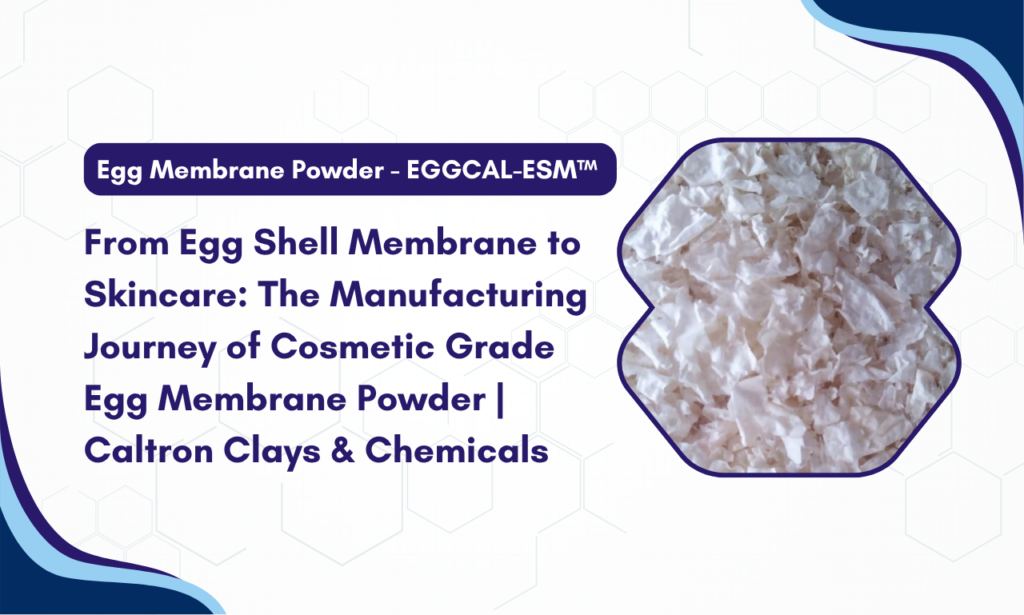
Introduction: The Remarkable Journey From Egg Shell Membrane to Skincare
What if a thin membrane hidden inside an eggshell could become a valuable ingredient for modern skincare?
An egg is made up of several naturally occurring layers, each serving a different purpose. While the hard outer shell is widely recognized as a mineral-rich structure, the delicate membrane beneath it has a completely different composition. This naturally occurring layer contains proteins and other components that have attracted growing interest in cosmetic ingredient research and formulation development.
For the cosmetics industry, egg shell membrane represents an interesting category of naturally derived raw materials. Its composition includes collagen Types I, V and X, elastin, hyaluronic acid and essential amino acids, making it relevant to skincare concepts focused on conditioning, hydration, firmness and age-conscious beauty.
However, transforming a naturally occurring membrane into a professional cosmetic ingredient is not a simple collection-and-powdering process. The material must move through a controlled journey involving sourcing, collection, separation, cleaning, moisture management, drying, powder processing, quality evaluation, packaging and storage.
This is where the expertise of an Egg Membrane Powder Manufacturer in India becomes important. Cosmetic manufacturers require ingredients that are not only interesting from a formulation perspective but can also be evaluated for identity, quality, consistency, documentation and supply reliability.
Caltron Clays & Chemicals offers EGGCAL-ESM™, a premium cosmetic-grade Egg Shell Membrane derived from the natural inner membrane of hen eggshells. Its naturally occurring composition includes collagen Types I, V and X, elastin, hyaluronic acid and essential amino acids.
EGGCAL-ESM™ can be explored by cosmetic manufacturers and formulators for applications such as firming serums, under-eye treatments, skin-conditioning creams, hydration-focused products and collagen-focused skincare concepts.
Understanding the manufacturing journey helps buyers see what happens between the original egg shell membrane and the finished cosmetic raw material. It also provides a practical framework for evaluating suppliers and determining whether an ingredient is appropriate for a particular formulation.
What Lies Beneath the Egg Shell?
The familiar eggshell is only one part of the egg’s natural protective structure. Beneath the mineral shell are thin membranes that contribute to the egg’s protective environment.
Unlike the hard shell, the membrane is organic and fibrous. Its composition includes structural proteins and other naturally occurring components, making it fundamentally different from conventional eggshell calcium materials.
This distinction is particularly important for cosmetic ingredient sourcing because an eggshell-derived mineral and an egg membrane ingredient have different identities, properties and potential applications.
Understanding the Inner Membrane
The inner membrane is located directly beneath the mineral eggshell. It has a thin, fibrous structure and contains a naturally complex biological matrix.
Scientific literature has examined eggshell membrane for its collagen-related proteins, glycosaminoglycan-associated components and other biological constituents. Research has also explored its potential in cosmetic and other higher-value applications.
For cosmetic formulation teams, this natural composition makes the membrane worth investigating as a specialized ingredient.
EGGCAL-ESM™ is derived from this membrane fraction and is positioned for professional cosmetic formulation applications.
Its ingredient profile includes:
- Collagen Types I, V and X
- Elastin
- Hyaluronic acid
- Essential amino acids
The significance of this profile is not that it guarantees a particular finished-product result. Instead, it gives formulators a distinctive naturally derived material to evaluate within specific skincare formulations.
Egg Shell Membrane vs Egg Shell Calcium
The two materials originate from the same biological source, but their composition is substantially different.
| Parameter | Egg Shell | Egg Shell Membrane |
|---|---|---|
| Nature | Mineral | Organic |
| Structure | Hard and rigid | Thin and fibrous |
| Primary formulation interest | Calcium/mineral applications | Cosmetic ingredient applications |
| Ingredient category | Eggshell-derived mineral | Egg membrane raw material |
| Cosmetic positioning | Mineral-based ingredient | Bio-based skincare ingredient |
For procurement teams, this distinction should be established before supplier qualification. A requirement for egg membrane powder should always be matched with a clearly identified membrane ingredient.
Why Is Egg Shell Membrane Gaining Attention in Skincare?
Cosmetic formulation has moved beyond choosing ingredients solely according to a single functional property. Today’s R&D teams may also consider natural origin, ingredient composition, processing, formulation compatibility, sensory characteristics, quality documentation and supply consistency.
Egg shell membrane offers a distinctive combination of these considerations.
Its naturally occurring composition makes it relevant to formulation concepts that focus on skin conditioning, hydration, firmness, elasticity and mature-skin care.
Research interest in eggshell membrane has also expanded because the material contains multiple components within one naturally occurring matrix.
A Naturally Complex Cosmetic Ingredient
Some cosmetic raw materials are highly purified substances designed around one primary component. Egg membrane presents a different proposition.
It is a naturally complex material containing several types of proteins and other constituents.
EGGCAL-ESM™ includes collagen Types I, V and X, elastin, hyaluronic acid and essential amino acids as part of its natural ingredient profile.
This can make it interesting for cosmetic R&D teams exploring multi-component, naturally derived ingredients.
The formulation developer should nevertheless distinguish the raw-material composition from finished-product performance. The final cosmetic’s characteristics depend on the complete formulation, processing conditions, concentration, ingredient interactions and testing.
Why Bio-Based Ingredients Matter to Formulators
The growing interest in bio-based cosmetic ingredients is influencing ingredient discovery and product development.
Brands may look for materials that provide:
- A distinctive natural origin
- Interesting composition
- Formulation versatility
- Differentiated ingredient stories
- Appropriate technical documentation
- Consistent commercial supply
Egg membrane can be evaluated within this wider ingredient-development landscape.
From Egg Processing to Cosmetic Raw Material: Where Does the Journey Start?
The production of a cosmetic egg membrane ingredient begins with the source material.
Because eggshell membrane is a biological material, sourcing and handling are important parts of the manufacturing process. The objective is to establish a controlled material stream before the membrane enters separation and powder processing.
Selecting Appropriate Source Material
The first stage involves sourcing suitable eggshell material for membrane recovery.
Material selection can influence the consistency of the subsequent manufacturing process. Appropriate source management also helps establish traceability.
For professional cosmetic raw materials, knowing the origin and handling pathway of the starting material can support supplier qualification.
Collection and Segregation
Collected eggshell material needs to be appropriately managed and segregated.
This helps prevent confusion between different egg-derived materials and maintains the identity of the intended membrane fraction.
Segregation also supports controlled movement through the manufacturing workflow.
Hygienic Material Handling
Controlled handling is an important consideration for any biological-origin raw material.
The objective is to maintain suitable conditions throughout collection and processing while minimizing the risk of unwanted contamination.
For cosmetic manufacturers, this upstream control forms part of the broader quality story of the ingredient.
Separating the Membrane From the Egg Shell
The membrane and the mineral shell are physically connected, which makes separation a defining stage in the manufacturing journey.
The purpose is to recover the organic membrane fraction while minimizing unwanted shell material.
Research has explored several approaches for recovering eggshell membrane, including mechanical separation and other processing techniques. Commercial manufacturers may use different process configurations depending on their equipment, product format and quality requirements.
Why Membrane Separation Matters
The separation stage directly relates to ingredient identity.
If a material contains significant amounts of unwanted eggshell mineral, its composition may differ from what a formulator expects from a dedicated membrane ingredient.
For this reason, controlled membrane recovery is an important part of producing a specialized raw material.
Cleaning the Recovered Membrane
Following separation, the recovered membrane can undergo appropriate cleaning and preparation.
The objective is to establish a suitable membrane fraction for further processing while maintaining its intended identity.
Cleaning should be considered as one component of a complete quality-management system rather than a standalone activity.
The Manufacturing Journey of Cosmetic Grade Egg Membrane Powder
The conversion of a natural membrane into Cosmetic Grade Egg Membrane Powder involves multiple processing stages.
Individual manufacturing methods can differ, but the overall journey can be understood through a series of logical steps.
1. Raw-Material Sourcing
Suitable eggshell material enters the manufacturing workflow.
Source management establishes the foundation for material traceability and subsequent processing.
2. Collection and Segregation
The source material is collected and separated from unrelated materials.
This supports material identity and controlled processing.
3. Membrane Recovery
The organic membrane is separated from the mineral eggshell.
The aim is to obtain a membrane-focused material suitable for further processing.
4. Cleaning and Preparation
The recovered membrane undergoes appropriate preparation and cleaning.
This stage supports the quality objectives established for the finished ingredient.
5. Moisture Management
Moisture is managed before the material is converted into powder.
Appropriate moisture control is important because moisture can influence storage, handling and powder characteristics.
6. Drying
The material undergoes an appropriate drying or moisture-reduction process according to the established manufacturing method.
Specific processing conditions should be determined by the manufacturer and product specification rather than assumed.
7. Pulverisation
The processed membrane is reduced into a powder suitable for its intended cosmetic application.
Powder processing can influence physical handling and formulation behaviour.
8. Particle Control
Where applicable, particle-control or sieving processes can be used to establish a more consistent powder profile.
The actual particle characteristics should always be reviewed from the relevant product specification.
9. Quality Evaluation
The resulting powder is assessed against defined quality requirements.
Depending on the product specification, evaluation may include identity, appearance, odour, moisture-related characteristics, microbiological parameters and other relevant attributes.
10. Packaging and Storage
The finished ingredient is packed appropriately and stored under recommended conditions.
Suitable packaging and storage help maintain the agreed characteristics until the material reaches the cosmetic manufacturer.
What Happens During Cleaning and Moisture Management?
The transition from natural membrane to finished powder requires careful control of the material’s physical condition.
Cleaning helps prepare the recovered membrane for subsequent processing, while moisture management supports the transition into a stable powdered ingredient.
Maintaining Material Quality During Processing
Processing should be designed around the intended characteristics of the final raw material.
The manufacturer needs to manage the material through each stage without compromising its identity or creating unnecessary variation.
This is particularly important for organic ingredients because their physical characteristics can influence downstream processing.
Why Moisture Control Matters
Moisture can influence powder flow, storage and handling.
For an organic membrane ingredient, moisture management is therefore an important part of preparing the material for packaging and commercial distribution.
Buyers should review the supplier’s actual product specification rather than relying on generalized assumptions about moisture requirements.
From Membrane to Powder: Why Pulverisation Matters
Powder preparation is more than simply changing the physical form of the ingredient.
The way a material is processed can influence its handling characteristics, dispersion and behaviour during formulation.
Powder Characteristics in Cosmetic Manufacturing
A cosmetic formulator may need to weigh, transfer, disperse and incorporate the ingredient into a formulation.
Consistent powder characteristics can make these activities more predictable.
This is why R&D teams should evaluate a sample not only for its ingredient identity but also for how it behaves during actual formulation trials.
Understanding Ingredient Format
Different egg membrane products may have different characteristics.
A conventional membrane powder should not automatically be treated as equivalent to hydrolyzed, modified or water-soluble membrane derivatives.
The buyer should therefore confirm the exact ingredient format before beginning formulation development.
What Makes Cosmetic Grade Egg Membrane Powder Different?
The phrase Cosmetic Grade Egg Membrane Powder should represent more than a naturally sourced ingredient.
For B2B use, the material should be appropriately identified, characterized and controlled according to its intended application.
Ingredient Identity
The first consideration is confirming that the product is specifically egg shell membrane.
This prevents confusion with eggshell calcium or other egg-derived raw materials.
Appearance and Odour
Appearance and odour can form part of routine incoming-material evaluation.
The buyer should compare these characteristics against the agreed specification.
Moisture-Related Characteristics
Moisture can affect powder handling and storage.
Appropriate control helps maintain a predictable raw-material profile.
Microbiological Considerations
Because the starting material is biological in origin, microbiological quality is an important consideration for cosmetic ingredient qualification.
Testing requirements should be established according to the applicable product specification and market requirements.
Contaminant Evaluation
Buyers should determine which contaminant parameters are relevant to their formulation and target market.
Supplier documentation can support this assessment.
Batch Consistency
Commercial cosmetic manufacturing depends on repeatability.
If an ingredient changes significantly between batches, R&D and production teams may need to investigate its impact on the finished product.
Quality Documentation: What Should B2B Buyers Look For?
A professional ingredient relationship requires more than a sample.
Cosmetic procurement and quality teams often need documentation that helps them establish the identity and suitability of a raw material.
Depending on the buyer’s requirements, relevant information may include:
- Product specifications
- Technical information
- Certificate of analysis
- Safety-related documents
- Packaging information
- Storage recommendations
- Batch information
- Other applicable quality records
A Cosmetic Raw Material Supplier in India serving professional customers should be prepared to discuss the documentation required for supplier qualification.
International customers may also have additional requirements depending on their destination market.
Why Processing Control Matters for Cosmetic Formulation
An ingredient may have an attractive composition, but formulators still need to understand how it behaves in a real formulation.
Processing can influence physical characteristics such as powder handling, dispersion, appearance and odour.
Eggshell membrane also has a naturally complex structure. Scientific research has investigated processing and modification techniques partly because the native membrane structure can present challenges related to solubility and functional use.
This is why the precise form of the ingredient matters.
Laboratory Evaluation
During early formulation development, R&D teams may assess:
- Dispersion
- Compatibility
- Appearance
- Odour
- Processing behaviour
- Sensory characteristics
- Stability
These evaluations help determine whether the raw material is appropriate for the intended product concept.
Moving From R&D to Commercial Manufacturing
Laboratory success does not automatically guarantee commercial repeatability.
When production scales up, differences in mixing, processing, filling and storage can influence the finished product.
A reliable raw-material supply therefore becomes increasingly important as the formulation moves toward commercialization.
Cosmetic Applications of Egg Membrane Powder
The composition of egg membrane creates opportunities for exploration across several specialized skincare categories.
Cosmetic Grade Egg Membrane Powder can be considered by brands developing naturally derived skincare products where skin conditioning, hydration, firmness and age-conscious positioning are relevant.
Firming Serums
Firming serums are often formulated around ingredients associated with skin conditioning and the appearance of firmness and elasticity.
Egg membrane can be evaluated within these formulations because of its naturally occurring collagen and elastin profile.
The finished serum should be tested as a complete formulation to establish its actual performance.
Age-Conscious Skincare
Egg membrane is particularly interesting for formulations positioned around mature-skin care.
Its composition can support cosmetic concepts focused on the appearance of firmness, elasticity, hydration and fine lines.
Finished-product claims should be appropriately substantiated rather than inferred solely from ingredient composition.
Under-Eye Treatments
Under-eye creams and serums require careful attention to formulation characteristics and intended use.
Egg membrane can be investigated in such products as part of a conditioning and hydration-oriented ingredient strategy.
The finished formulation should be assessed for its specific sensory, stability and compatibility requirements.
Skin-Conditioning Creams
Egg membrane may also be considered in creams designed to support the appearance and feel of well-conditioned skin.
This provides an opportunity for brands to explore a naturally derived ingredient within specialized facial-care formulations.
Hydration-Focused Products
The naturally occurring hyaluronic acid associated with egg membrane contributes to its relevance for hydration-oriented skincare concepts.
However, actual hydration performance depends on the complete formulation and should be evaluated through appropriate testing.
Collagen-Focused Skincare
Collagen-focused cosmetic products represent another potential application area.
EGGCAL-ESM™ provides a naturally occurring membrane profile containing collagen Types I, V and X, giving formulators an ingredient option for investigating collagen-oriented skincare concepts.
How to Choose an Egg Membrane Powder Manufacturer in India
Supplier qualification should combine technical evaluation with commercial considerations.
For businesses searching for an Egg Membrane Powder Manufacturer in India, the evaluation should begin with the requirements of the finished formulation.
1. Understand the Source
Ask where the membrane originates and how the source material is collected and handled.
This provides insight into traceability and raw-material management.
2. Review the Manufacturing Process
Understand the main stages involved in separation, cleaning, drying and powder preparation.
The supplier should provide appropriate technical information while protecting confidential manufacturing details.
3. Confirm Ingredient Identity
Ensure the material is specifically egg shell membrane rather than another egg-derived ingredient.
4. Evaluate Quality Parameters
Review the relevant specifications and testing requirements.
The parameters should align with the intended cosmetic application.
5. Examine Batch Consistency
Ask how the manufacturer controls variations between batches.
This is particularly important for products intended for repeat commercial manufacturing.
6. Review Technical Documentation
Determine whether the supplier can provide the documents required by your internal quality system.
7. Check Packaging and Storage
Understand how the ingredient is packaged, stored and transported.
8. Assess Commercial Capacity
Discuss expected volumes, lead times, repeat orders and production planning.
9. Evaluate Communication
A supplier should be able to communicate clearly with procurement, R&D and quality teams.
10. Consider International Supply
For export customers, evaluate documentation, logistics coordination and destination-market requirements.
Why Choose Caltron Clays & Chemicals as Your Egg Membrane Powder Supplier in India?
A successful B2B ingredient relationship involves more than purchasing a raw material. Cosmetic manufacturers need a supplier that understands the importance of ingredient identity, quality, consistency, technical information and commercial continuity.
Caltron Clays & Chemicals offers EGGCAL-ESM™, a premium cosmetic-grade Egg Shell Membrane derived from the natural inner membrane of hen eggshells.
The ingredient naturally contains Collagen Types I, V and X, elastin, hyaluronic acid and essential amino acids.
EGGCAL-ESM™ for Cosmetic R&D
EGGCAL-ESM™ can be explored for:
- Firming serums
- Under-eye formulations
- Hydration-focused skincare
- Skin-conditioning creams
- Age-conscious formulations
- Collagen-focused skincare
- Specialized facial-care products
The ingredient gives formulation teams an opportunity to investigate a naturally derived membrane material within their own product-development framework.
A Quality-Conscious B2B Approach
Caltron Clays & Chemicals focuses on specialized raw materials for professional customers.
For buyers, this means evaluating EGGCAL-ESM™ through relevant considerations such as ingredient identity, processing, quality characteristics, documentation, packaging and supply requirements.
The company’s approach is centered on the needs of cosmetic manufacturers, formulators and ingredient buyers rather than consumer-facing marketing alone.
Supporting Formulation Development
Introducing a new raw material often involves several internal teams.
R&D professionals evaluate formulation behaviour, procurement teams evaluate supply and commercial terms, and quality teams review specifications and documentation.
A useful supplier relationship should support these different stages of ingredient qualification.
Supporting Commercial Requirements
Once a cosmetic formulation moves into production, the importance of consistent sourcing increases.
Repeat orders, supply planning, documentation and communication can all influence the efficiency of ongoing manufacturing.
Caltron Clays & Chemicals provides EGGCAL-ESM™ as a specialized cosmetic raw material for businesses evaluating egg membrane within their skincare portfolios.
What Should Cosmetic Brands Evaluate Before Adding Egg Membrane Powder?
Before introducing any new ingredient, cosmetic brands should define how it is expected to function within the product.
Define the Product Concept
Start by identifying whether the formulation is focused on:
- Hydration
- Skin conditioning
- Firmness
- Mature-skin care
- Collagen-focused positioning
- Specialized facial care
Evaluate Compatibility
The ingredient should be assessed alongside the complete formulation.
Consider its interaction with:
- Emulsifiers
- Preservatives
- Other active ingredients
- Base materials
- Processing conditions
- Packaging
Review Sensory Characteristics
Appearance, odour, texture and finished-product feel should be assessed as part of formulation development.
Conduct Stability Testing
The finished product should undergo appropriate stability and compatibility evaluation before commercialization.
Consider Regulatory Requirements
Cosmetic regulations vary between countries.
Brands should verify applicable requirements for ingredients, finished products, labelling and claims in each target market.
Plan for Scale-Up
An ingredient should be evaluated beyond laboratory scale when commercial manufacturing is planned.
This can reveal issues that may not be apparent during small-scale trials.
The Emerging Future of Egg-Derived Cosmetic Ingredients
The development of egg membrane ingredients reflects a wider movement toward investigating naturally derived materials for specialized applications.
Eggshell membrane has historically received less attention than the mineral shell itself. Research has nevertheless identified the material as an underutilized biological resource with potential across cosmetics, nutraceuticals and other industries.
This makes egg membrane an interesting example of how ingredient innovation can emerge from materials that already exist within established supply chains.
From Underutilized Material to Ingredient Opportunity
The cosmetic industry’s interest in bio-based materials creates opportunities for exploring alternative ingredient sources.
Egg membrane can contribute to this discussion because it contains a naturally complex biological composition and can be processed into a specialized raw material.
Processing Will Remain Important
The future of egg-derived cosmetic ingredients will depend partly on how effectively raw materials can be separated, processed and standardized.
Different processing approaches can result in different ingredient formats, including conventional powders and modified or hydrolyzed derivatives.
For formulators, understanding the specific material remains essential.
Traceability and Responsible Sourcing
Modern cosmetic procurement increasingly considers where ingredients come from and how they are processed.
A responsible ingredient story should be supported by actual sourcing and manufacturing information.
For B2B buyers, this means asking specific questions about the supply chain rather than relying solely on broad natural-ingredient claims.
New Possibilities for Cosmetic R&D
Egg membrane provides formulators with another option for developing differentiated skincare concepts.
Its naturally occurring collagen-related proteins, elastin, hyaluronic acid and amino acids give it a distinctive profile for ingredient research.
The category’s future will ultimately depend on formulation science, manufacturing consistency, appropriate quality controls and the ability to deliver reliable ingredients for commercial cosmetic production.
Frequently Asked Questions
What is Egg Membrane Powder?
Egg Membrane Powder is derived from the natural inner membrane of hen eggshells and contains naturally occurring proteins and other components. Caltron Clays & Chemicals offers EGGCAL-ESM™ as a cosmetic-grade ingredient for skincare formulation development.
What is Cosmetic Grade Egg Membrane Powder used for?
Cosmetic Grade Egg Membrane Powder can be explored in firming serums, under-eye products, hydration-focused formulations, skin-conditioning creams and age-conscious skincare. Caltron Clays & Chemicals supplies EGGCAL-ESM™ for professional cosmetic applications.
Does egg shell membrane contain collagen?
Egg shell membrane naturally contains collagen-related proteins, including Types I, V and X in the EGGCAL-ESM™ ingredient profile. Caltron Clays & Chemicals provides this specialized membrane ingredient for cosmetic formulation evaluation.
How is egg membrane powder manufactured?
The process can involve sourcing, collection, segregation, membrane separation, cleaning, moisture management, drying, pulverisation, particle control, quality evaluation, packaging and storage. Caltron Clays & Chemicals supplies EGGCAL-ESM™ as a cosmetic-grade egg membrane raw material.
Can egg membrane powder be used in anti-aging skincare?
Egg membrane can be evaluated in age-conscious formulations focused on the appearance of firmness, elasticity and skin conditioning. Caltron Clays & Chemicals positions EGGCAL-ESM™ for specialized skincare concepts and professional formulation development.
What should I check before buying egg membrane powder?
Buyers should review source, ingredient identity, manufacturing controls, specifications, testing, documentation, batch consistency, packaging and storage requirements. Caltron Clays & Chemicals provides EGGCAL-ESM™ for B2B cosmetic ingredient sourcing and evaluation.
How do I choose an Egg Membrane Powder Manufacturer in India?
Compare raw-material sourcing, processing controls, quality systems, documentation, consistency and commercial supply capability. Caltron Clays & Chemicals offers EGGCAL-ESM™ for cosmetic manufacturers and R&D teams evaluating specialized egg-derived ingredients.
How do I find an Egg Membrane Powder Supplier in India?
Look for a supplier offering clearly defined specifications, appropriate documentation, consistent material and dependable B2B support. Caltron Clays & Chemicals supplies EGGCAL-ESM™ to cosmetic manufacturers, formulators and skincare brands.
Can egg membrane powder be used in skincare formulations?
Yes, it can be evaluated in products such as creams, serums, under-eye treatments and hydration-focused formulations. Caltron Clays & Chemicals offers EGGCAL-ESM™ for professional cosmetic formulation and product-development applications.
Where can I source EGGCAL-ESM™?
EGGCAL-ESM™ is available from Caltron Clays & Chemicals as a cosmetic-grade Egg Shell Membrane for B2B ingredient sourcing. Cosmetic manufacturers and formulators can explore the official product information for further details.
Conclusion: From a Hidden Egg Layer to a Specialized Cosmetic Ingredient
The journey from egg shell membrane to cosmetic raw material illustrates how a naturally occurring biological material can be transformed through controlled manufacturing. Sourcing, segregation, membrane separation, cleaning, moisture management, drying, pulverisation, quality evaluation, packaging and storage each contribute to the final ingredient profile. The manufacturing process therefore plays a critical role in turning a delicate membrane into a practical raw material for professional cosmetic development.
For cosmetic manufacturers, selecting Cosmetic Grade Egg Membrane Powder requires a broader evaluation than simply looking at natural origin. Ingredient identity, processing controls, physical characteristics, microbiological considerations, documentation, batch consistency, formulation compatibility and commercial supply should all be reviewed before approval. A structured approach allows R&D, procurement and quality teams to assess whether an ingredient can move successfully from laboratory evaluation to commercial manufacturing.
EGGCAL-ESM™ by Caltron Clays & Chemicals offers a specialized cosmetic-grade Egg Shell Membrane for brands and manufacturers exploring advanced skincare concepts. Businesses evaluating an Egg Membrane Powder Manufacturer in India can assess EGGCAL-ESM™ according to their own formulation, quality and commercial requirements.
Caltron Clays & Chemicals Pvt. Ltd.
Address: Office No. 211, 2nd Floor, Orbit Premises, Next to Sheetal Banquets, Opp to Inox Plaza, Mindspace, Malad West, Mumbai, Maharashtra 400064 India
Phone No.: 022 3571 9844 | +91 70214 37453 | +91 22 2876 4864
Website: https://caltronclays.com
Email: marketing@caltronclays.com | sales@caltronclays.com
Google Maps: https://maps.app.goo.gl/jCuz1ZCf1iAhzZiH7
