Introduction
A false ceiling may look perfectly straight and well finished when newly installed, but over time, issues such as uneven levels, visible deflection, cracks, waves or localised sagging can begin to appear. These problems are usually not caused by one material alone. The long-term performance of a ceiling depends on how the gypsum board, GI framework, suspension system, section selection, fixing quality, moisture conditions and applied loads work together.
For contractors, architects, interior designers and procurement teams, the hidden framework is therefore just as important as the visible surface. Allied Ispat Pvt. Ltd., a POP Parts Manufacturer in India, manufactures galvanized false ceiling and drywall partition sections for residential, commercial and industrial applications.
The Allied Ispat Pvt. Ltd. range includes Ceiling Sections, Intermediate Sections, Perimeter Sections, Angles, C-Studs, Floor Sections, GypsPlus Premium and GypsPlus Xpert-Plus.
Quality framing sections can help create a more consistent and stable framework, but they must be correctly selected and properly installed. Appropriate spacing, suspension planning, service coordination, moisture control and load management remain equally important.
Why Do False Ceilings Start Sagging Over Time?
False ceiling sagging usually develops when the board, supporting framework or suspension system begins to lose its intended alignment or support.
The visible problem may come from different sources. Gypsum boards can deflect if they are inadequately supported, exposed to excessive moisture or subjected to unsuitable loads. The GI framework can also become uneven when the wrong section is selected, connections are poorly executed or the suspension arrangement is incorrect.
Moisture is another major factor. Roof leakage, plumbing problems, condensation or prolonged humidity can affect board stability and may also increase corrosion risk for metal components over time.
Before repairing a sagging ceiling, contractors should identify the actual source of the problem. Replacing only the visible board without addressing the framework, moisture source or loading condition may allow the same issue to return.
7 Common Causes of False Ceiling Sagging and Framework Problems
False ceiling problems often develop from a combination of design, material, installation and environmental factors. Understanding these causes can help project teams reduce avoidable rework and improve long-term ceiling performance.
1. Incorrect Framework Spacing
Gypsum boards rely on the supporting framework to maintain a level ceiling plane. If the supporting members are spaced incorrectly, larger unsupported areas can develop.
This can increase the possibility of visible deflection, especially when the ceiling is also exposed to moisture, additional loads or unsuitable installation conditions.
Framework spacing should therefore follow the approved ceiling system and relevant board manufacturer recommendations. Reducing the number of framing members simply to save material may affect performance.
Even well-manufactured GI sections cannot compensate for an incorrectly planned framework.
2. Wrong Section Selection for the Application
Not every false ceiling requires the same section profile or thickness.
A residential ceiling, hotel lobby, hospital corridor, office interior or industrial ceiling may all have different framing requirements. Section selection should therefore consider the ceiling design, expected loads, application, environmental conditions and suspension system.
Thickness is important, but thicker steel does not automatically mean a better ceiling. The correct section is the one that suits the complete system.
Working with an experienced POP Parts Manufacturer in India such as Allied Ispat Pvt. Ltd. gives contractors access to different framing options instead of depending on one generic profile for every project.
3. Excessive Loads from Lighting, HVAC and Services
Modern ceiling spaces often contain much more than simple wiring.
Lighting fixtures, speakers, access panels, air-conditioning components, signage, decorative features and other services may interact with the ceiling framework.
A common mistake is assuming that every service can be supported directly by the ceiling framing. In many cases, heavier equipment or concentrated loads may require independent support from the building structure.
MEP coordination should therefore be completed before the ceiling is closed. Contractors should know where major services will be positioned, how they will be supported and whether access openings will affect the framework.
Unplanned additions after completion can introduce stresses that were not considered during installation.
4. Moisture, Leakage and High Humidity
Moisture can have a major impact on false ceiling performance.
Roof leakage, plumbing leakage, condensation and prolonged high humidity can affect gypsum boards and may contribute to visible deformation.
Metal framing also requires attention. Galvanized steel offers improved corrosion resistance compared with untreated steel, but it is not completely corrosion-proof.
The environment, protective coating condition and duration of moisture exposure still matter.
In coastal locations, hospitals, industrial buildings and moisture-prone interiors, material selection and moisture management should be considered carefully.
The correct approach is not only to select suitable materials but also to identify and control the source of water or condensation.
5. Poor Fixing, Connections and Installation
Even properly manufactured sections can perform poorly if they are installed incorrectly.
Loose connections, inadequate suspension, poor alignment, damaged framing members, unsuitable fixing methods and deviations from the approved system can all create problems.
Before board installation, contractors should inspect:
- Framework alignment
- Ceiling level
- Connection quality
- Suspension points
- Section condition
- MEP coordination
When framing sections have consistent dimensions and geometry, installers can work more predictably. Precision-manufactured sections from Allied Ispat Pvt. Ltd. can therefore support a more controlled installation process when correctly specified.
6. Corrosion and Inconsistent Steel Framework
The steel framework remains hidden after the ceiling is completed, but its quality directly affects installation accuracy.
Poorly formed, bent or inconsistent sections can make it difficult to maintain straight lines and uniform levels.
Galvanized GI sections are commonly used because zinc coating helps improve resistance to corrosion. However, the condition of the sections should still be checked before installation.
Working with Allied Ispat Pvt. Ltd. as a POP Parts Supplier in India can help contractors source consistent framing sections for repeat and bulk project requirements.
7. Poor Storage, Handling and Site Modifications
Steel sections can become damaged even before installation begins.
Improper stacking, storage on uneven surfaces, careless handling or unnecessary exposure to moisture can cause bending or distortion.
Uncontrolled cutting or modification can also affect the intended framework arrangement.
Similarly, additional lights, signage or equipment installed after ceiling completion may change how loads interact with the system.
Good site practices should therefore continue from material delivery to final installation.
How Quality POP Parts Help Create a More Stable False Ceiling Framework
A reliable ceiling framework depends on the consistency of its components.
Well-manufactured GI sections can offer:
- More predictable dimensions
- Straighter alignment
- Consistent section geometry
- Better fitment between connected profiles
- Reduced unnecessary site adjustment
- Easier installation across larger areas
When profiles vary significantly from one batch to another, installers may spend more time cutting, forcing or modifying sections to achieve proper fitment.
This can increase labour, material wastage and installation time.
Correct section selection is equally important. Different projects may require different thicknesses, profiles and framing configurations.
Allied Ispat Pvt. Ltd., a POP Parts Manufacturer in India, manufactures customizable galvanized false ceiling and drywall partition sections for different project requirements.
Quality framing is most effective when combined with appropriate design, spacing, suspension, fixing and installation practices.
Understanding the Key POP Framework Components
A false ceiling or drywall partition is built using several different steel sections. Each profile has a specific function within the overall system.
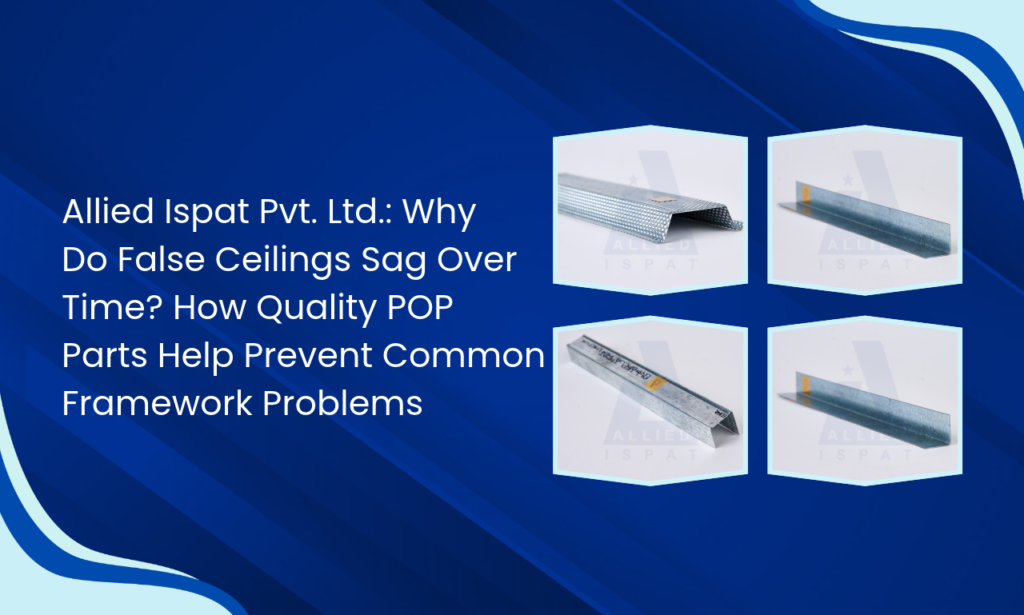
Allied Ispat Pvt. Ltd. manufactures Ceiling Sections, Intermediate Sections, Perimeter Sections, Angles, C-Studs and Floor Sections.
Ceiling Section: Supporting the Ceiling Surface
Ceiling Sections form part of the supporting structure behind gypsum boards or other compatible ceiling materials.
Their geometry and straightness help installers maintain a consistent ceiling plane.
Allied Ispat Pvt. Ltd. manufactures GI Ceiling Sections for applications where accurate framing and consistent profile formation are important.
Intermediate Section: Strengthening the Internal Grid
Intermediate Sections contribute to the internal support framework.
When correctly aligned, they help maintain uniformity across larger ceiling areas and support the intended framework arrangement.
Consistent Intermediate Sections can also help reduce unnecessary corrections during installation.
Perimeter Section: Establishing the Ceiling Boundary
Perimeter Sections are positioned around the edges of the ceiling where the framework meets surrounding walls.
They help define the ceiling boundary and create a reference line for maintaining level and alignment.
Accurate perimeter installation can help the entire framework remain more organised.
Ceiling Angle: Supporting Edge Alignment
Ceiling Angles are used in supporting or perimeter arrangements depending on the ceiling design.
They help create clean wall junctions and contribute to framework alignment.
Their exact use should follow the specified ceiling system.
C-Stud: Designed for Drywall Partition Framing
C-Studs are primarily used for drywall partition systems rather than being treated as universal ceiling components.
They form the vertical framework that supports wall boards in non-load-bearing partition systems.
Allied Ispat Pvt. Ltd. manufactures C-Stud sections where consistent geometry and board support are important.
Floor Section: Creating the Base for Partitions
Floor Sections form part of the horizontal track system used in drywall partition construction.
They help establish the base and guide the correct positioning of C-Studs.
Together, these components create a more organised partition framing system when correctly installed.
Why GI Steel Quality Matters in Ceiling and Partition Frameworks
The metal framework may not be visible after installation, but its quality has a direct impact on the finished result.
Galvanized steel is commonly used because its zinc coating offers better corrosion resistance than untreated steel.
However, corrosion protection is only one factor.
Contractors should also consider:
- Section thickness
- Profile geometry
- Straightness
- Surface condition
- Forming accuracy
- Edge quality
- Connection compatibility
- Batch consistency
Small dimensional variations can become more noticeable when the same profile is used across a large project.
This is especially important for contractors purchasing hundreds or thousands of sections.
Working with Allied Ispat Pvt. Ltd. as a POP Parts Supplier in India can support more predictable procurement across repeat deliveries and different project phases.
GypsPlus Premium vs GypsPlus Xpert-Plus: Which Is Right for Your Project?
Every ceiling project has different requirements.
A large commercial or industrial ceiling may need a more robust framing approach, while modern residential interiors may prioritise precision, handling convenience and design flexibility.
Allied Ispat Pvt. Ltd. offers GypsPlus Premium and GypsPlus Xpert-Plus for these different application needs.
GypsPlus Premium: Heavy-Duty Framing
GypsPlus Premium from Allied Ispat Pvt. Ltd. is positioned for demanding industrial and commercial ceiling applications.
Key characteristics include:
- Prime-grade GI steel
- Approximately 0.5–0.7 mm thickness
- Knurled surface
- Work-hardened steel positioning
- Heavy-duty application focus
Allied Ispat Pvt. Ltd. publishes a 50 kg/m² load-capacity specification for this range.
This figure should not be interpreted as a universal rating for every finished ceiling. Overall performance still depends on the framing arrangement, suspension, spacing, connections, board specification and installation quality.
For demanding commercial and industrial projects, GypsPlus Premium provides a heavier-duty framing option when appropriately specified.
GypsPlus Xpert-Plus: Precision for Modern Interiors
GypsPlus Xpert-Plus from Allied Ispat Pvt. Ltd. is designed for modern residential and commercial interiors.
Key characteristics include:
- Prime-grade GI steel
- Approximately 0.40–0.45 mm thickness
- Folded edges
- Precision-formed profiles
- 8 ft and 12 ft options where applicable
- Suitability for offices, apartments and decorative interiors
A lighter profile should not automatically be considered lower quality.
When correctly matched to the application, GypsPlus Xpert-Plus can provide an efficient framing solution without unnecessary material weight.
How Contractors Can Reduce False Ceiling Sagging Before Installation
Many ceiling problems can be reduced before the boards are fixed.
Project teams should first understand the ceiling layout, environmental conditions, expected loads and service requirements.
Important checks include:
- Review the approved ceiling design.
- Confirm the required framing sections.
- Coordinate lighting, HVAC and electrical services.
- Identify concentrated or heavy loads.
- Follow the intended suspension arrangement.
- Inspect steel profiles for damage.
- Store sections properly before use.
- Check for leakage or condensation.
- Avoid placing unsupported equipment on the ceiling framework.
- Use trained installers.
- Follow relevant board-system installation guidance.
- Inspect framework level and alignment before closing the ceiling.
The objective is not simply to add more steel. It is to use the correct framing system for the project.
Allied Ispat Pvt. Ltd. supports contractors with GI ceiling and partition sections for different residential, commercial and industrial requirements.
What Contractors Should Check Before Buying POP Parts
The quality of a false ceiling begins with procurement.
Selecting POP sections only on price may lead to additional site cutting, alignment correction, wastage or installation delays.
Before selecting a POP Parts Manufacturer in India, contractors should evaluate several factors.
Steel Quality
The steel should be suitable for the intended false ceiling or drywall application.
Galvanization
The protective coating should match the expected environmental conditions.
Thickness Options
Different projects may require different section specifications.
Thickness should therefore be selected according to the system design.
Dimensional Accuracy
Consistent dimensions can support easier installation and better alignment.
Straightness
Bent or twisted sections may increase adjustment work.
Edge Quality
Well-formed edges can make handling and installation more convenient.
Available Lengths
Suitable profile lengths can help reduce unnecessary cutting and material wastage.
Customisation Capability
Some projects may require specific dimensions or thickness ranges.
Bulk Supply Reliability
Large developments often require repeat deliveries.
Consistency across batches is therefore important.
Allied Ispat Pvt. Ltd. offers customizable GI ceiling and partition sections, including relevant 8 ft and 12 ft length options.
As a POP Parts Manufacturer in Mumbai with manufacturing operations in Navi Mumbai, Allied Ispat Pvt. Ltd. supports residential, commercial and industrial projects across India.
Choosing Allied Ispat Pvt. Ltd. as a POP Parts Supplier in India can help contractors maintain better consistency across repeat and bulk requirements.
Why Manufacturing Consistency Matters for Large Projects
A small variation in one steel section may appear insignificant.
When the same variation is repeated across hundreds or thousands of pieces, it can become a major site issue.
Inconsistent sections can lead to:
- Fitment difficulties
- Repeated cutting
- Alignment problems
- Higher material wastage
- Slower installation
- More manual adjustments
- Difficulty maintaining uniform ceiling levels
These challenges become more significant in hospitals, hotels, factories, offices, institutional buildings and large residential developments.
Contractors also need confidence that later material deliveries will match earlier batches.
Allied Ispat Pvt. Ltd. uses automated manufacturing for its false ceiling and drywall framing range and states production capacity of 3,000+ units per day.
For large-volume projects, working with an experienced POP Parts Manufacturer in India such as Allied Ispat Pvt. Ltd. can support better procurement planning and repeat specification requirements.
Allied Ispat Pvt. Ltd. – A Reliable POP Parts Manufacturer in India
A strong false ceiling or drywall partition begins with suitable framing components and a dependable manufacturing partner.
Allied Ispat Pvt. Ltd. manufactures galvanized false ceiling and drywall partition sections for residential, commercial and industrial applications.
Allied Ispat Pvt. Ltd. is ISO 9001:2015 certified, reflecting its quality-management approach, and operates from Mumbai with manufacturing operations in Navi Mumbai.
Complete Ceiling and Partition Range
Allied Ispat Pvt. Ltd. offers:
- Ceiling Sections
- Intermediate Sections
- Perimeter Sections
- Ceiling Angles
- C-Studs
- Floor Sections
- GypsPlus Premium
- GypsPlus Xpert-Plus
This allows contractors, builders, interior companies and procurement teams to source multiple framing components from one manufacturer.
Support for Bulk and Repeat Requirements
Allied Ispat Pvt. Ltd. supports:
- Custom dimensions
- Different thickness options
- Relevant 8 ft and 12 ft lengths
- Automated manufacturing
- Bulk project requirements
- 3,000+ units daily stated production capacity
- Pan-India supply
- Residential, commercial and industrial applications
As a POP Parts Manufacturer in Mumbai serving customers across India, Allied Ispat Pvt. Ltd. can support ongoing and phased procurement requirements.
The value of working with a specialized manufacturer is not simply the availability of steel sections. It is the ability to source consistent, correctly specified profiles for professionally designed ceiling and partition systems.
Allied Ispat Pvt. Ltd.: Beyond POP Parts, Explore Complete Steel Solutions
Allied Ispat Pvt. Ltd. also serves manufacturers, fabricators and contractors with a wider range of steel products and machinery.
Its portfolio extends beyond ceiling framing to include roll forming machines, rolling shutter parts and trading coils.
Roll Forming Machines: Supporting Efficient Profile Production
Allied Ispat Pvt. Ltd. operates as a Roll Forming Machine Manufacturer in India, offering machinery for metal-profile production.
The machines support industries requiring repeatable profile formation, efficient processing and consistent metal shaping.
Through its experience in steel profile manufacturing, Allied Ispat Pvt. Ltd. supports businesses involved in construction sections, fabrication and other industrial applications.
Rolling Shutter Parts: Components for Reliable Shutter Fabrication
Allied Ispat Pvt. Ltd. is also a Rolling Shutter Parts Manufacturer in India.
Its product portfolio includes:
- Bottom sections
- Guide channels
- Brackets
- Springs
- Pulley plates
- Locking components
- Other rolling shutter accessories
These products support shutter fabricators, contractors and industrial businesses requiring dependable components for commercial and industrial shutter systems.
Trading Coils & Sheets: Steel for Fabrication and Manufacturing
Allied Ispat Pvt. Ltd. supplies GI, CR, HR and coated coils and sheets for fabrication, construction and industrial applications.
As a Trading Coil Manufacturer in India, Allied Ispat Pvt. Ltd. serves businesses involved in roll forming, rolling shutter production, sheet-metal fabrication and other steel-processing activities.
By offering POP framing sections, roll forming machines, rolling shutter parts and trading coils, Allied Ispat Pvt. Ltd. provides a diversified steel product portfolio for contractors, manufacturers and fabricators.
Frequently Asked Questions
1. Why do false ceilings sag over time?
False ceilings may sag because of improper framing, moisture, excessive loading, poor suspension or unsuitable sections. Allied Ispat Pvt. Ltd. manufactures GI framing sections designed to support consistent ceiling frameworks when correctly specified and installed.
2. How can false ceiling sagging be reduced?
Correct framework design, suitable GI sections, proper suspension, moisture control and professional installation can help reduce sagging risks. Allied Ispat Pvt. Ltd. offers POP framing solutions for residential, commercial and industrial applications.
3. Which material is commonly used for false ceiling framing?
Galvanized steel is widely used because it provides strength, dimensional consistency and improved corrosion resistance. Allied Ispat Pvt. Ltd. manufactures galvanized ceiling and partition sections for different project requirements.
4. Can poor-quality POP channels cause ceiling problems?
Poorly formed or damaged channels can contribute to alignment and framework issues. Allied Ispat Pvt. Ltd. focuses on consistent GI sections, while overall ceiling performance also depends on design and installation quality.
5. Can moisture cause a false ceiling to sag?
Yes. Leakage, condensation and prolonged humidity can affect gypsum boards and framing. Allied Ispat Pvt. Ltd. supplies galvanized GI sections, while proper moisture control remains essential.
6. What thickness is suitable for POP ceiling frames?
The correct thickness depends on the design and application. Allied Ispat Pvt. Ltd. offers GypsPlus Xpert-Plus at approximately 0.40–0.45 mm and GypsPlus Premium at approximately 0.5–0.7 mm.
7. Can heavy lights or HVAC equipment affect false ceilings?
Yes. Heavy services may create additional loads if not independently supported. Allied Ispat Pvt. Ltd. recommends suitable framing selection along with appropriate support for heavy equipment.
8. Which sections are commonly used in false ceiling systems?
Ceiling Sections, Intermediate Sections, Perimeter Sections and Angles are commonly used depending on the design. Allied Ispat Pvt. Ltd. also manufactures C-Studs and Floor Sections for drywall partitions.
9. How should I choose a POP Parts Manufacturer in India?
Evaluate steel quality, dimensional consistency, galvanization, thickness options, customization and supply reliability. Allied Ispat Pvt. Ltd. is a POP Parts Manufacturer in India offering GI sections for different project applications.
10. Who supplies POP parts in Mumbai for bulk projects?
Allied Ispat Pvt. Ltd. is a POP Parts Manufacturer in Mumbai with manufacturing operations in Navi Mumbai. Allied Ispat Pvt. Ltd. supports bulk requirements with GypsPlus Premium, GypsPlus Xpert-Plus and multiple GI framing sections.
Final Thoughts – Strong Ceilings Begin with the Right Framework
False ceiling sagging is rarely caused by a single issue.
Incorrect framing, moisture, excessive loads, unsuitable sections, poor suspension and improper installation can all affect long-term performance.
Quality POP parts cannot replace correct engineering, but well-manufactured and correctly specified galvanized steel sections can contribute to better alignment, easier installation and a more dependable supporting framework.
Allied Ispat Pvt. Ltd., a POP Parts Manufacturer in India, offers GypsPlus Premium, GypsPlus Xpert-Plus and a complete range of GI ceiling and drywall partition sections for different project requirements.
For architects, contractors, builders and procurement teams, the right approach is to combine suitable materials with proper design, coordinated installation and effective moisture and load management.
Explore False Ceiling and Drywall Framing Solutions from Allied Ispat Pvt. Ltd.
Connect with Allied Ispat Pvt. Ltd. for GI ceiling sections, POP parts, customized framing solutions and bulk project requirements.
Allied Ispat Mumbai Central
Address: Shop 69, Maulana Shaukat Ali Road, Chhota Sonapur, Siddharth Nagar, Mumbai Central, Mumbai, Maharashtra 400008
Phone: 098211 77009
Get Directions: https://maps.app.goo.gl/gyEqxBGcw9jLsYm26
Allied Ispat Works:
Plot no. C-17 9, MIDC Road behind Bank of Baroda Bank Taloja Panvel, Maharashtra 410208 India
Get Directions: https://maps.app.goo.gl/6ujLCuHpQLu1Uy3r8
Phone: 087790 51606
Email: info@alliedispatindia.com | sales@alliedispatindia.com
Website: www.alliedispatindia.com
