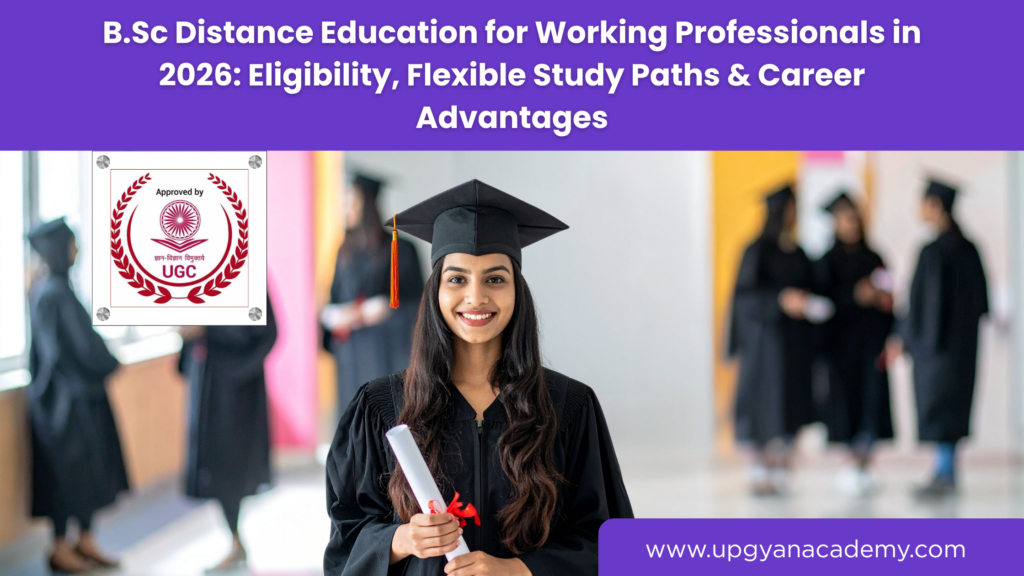
Higher education does not always follow a straight path. Many people start earning immediately after Class 12, leave college midway because of financial responsibilities, relocate for employment, or simply find that regular college timings no longer fit their lifestyle. Years later, the absence of a bachelor’s qualification may become noticeable when they apply for higher positions, postgraduate programmes, competitive examinations, or career changes. For science-background learners facing these situations, B.Sc Distance Education can be one option to explore while continuing professional responsibilities.
A Bachelor of Science develops a structured understanding of scientific concepts along with analytical thinking, numerical skills, observation, reasoning, and problem-solving ability. Depending on the specialization, learners may study Mathematics, Statistics, Computer Science, Information Technology, Physics, Chemistry, Biology, Microbiology, or other science disciplines. For an employed learner, the objective is not merely earning another qualification—it is finding an academically appropriate programme that can coexist with work.
The flexibility associated with distance education is particularly attractive to professionals who cannot attend lectures every weekday. At the same time, learners frequently encounter terms such as Graduation in one year and Single sitting degree while searching for faster ways to finish previously discontinued education. These expressions must be understood according to the candidate’s academic history and the university’s current rules rather than being treated as universal shortcuts.
UGC-DEB currently advises students to verify the Higher Educational Institution, exact programme, mode, and academic session before taking admission into an ODL or online programme. Recognition from an earlier academic session should not automatically be assumed for a later session.
This guide explains how working professionals can evaluate a B.Sc in 2026, from eligibility and study formats to course duration, recognition, career opportunities, and unfinished-degree situations.
What Is a B.Sc for Working Professionals and How Does It Work?
A B.Sc for working professionals is generally a regular Bachelor of Science qualification pursued through a study arrangement that can be managed alongside employment. It should not be confused with a separate degree category created exclusively for employees. The curriculum, examinations, credits, assignments, and practical requirements continue to be governed by the university offering the programme.
In a flexible programme, learners may receive digital or printed study resources, recorded content, scheduled counselling, assignments, examinations, and academic assistance. B.Sc Distance Education can therefore reduce dependence on daily campus attendance, but it does not remove academic responsibility. Science learners may still have practical, laboratory, project, examination, or attendance requirements depending on the exact programme.
For someone working five or six days a week, this arrangement can make higher education easier to plan. Instead of leaving employment for several years, the learner can create a structured routine around professional responsibilities while continuing to progress academically.
Who Is Eligible for a B.Sc Course for Working Professionals?
Eligibility is primarily determined by the chosen university and specialization. Generally, a candidate should have completed 10+2 or an equivalent recognised qualification, and many B.Sc programmes expect learners to have studied relevant science subjects at the higher-secondary level. Mathematics may be required for certain quantitative or computing programmes, whereas Biology may be expected for some life-science courses.
Being employed does not usually create a separate eligibility route. A professional with several years of work experience must still satisfy the academic requirements prescribed for the programme. Candidates should therefore check their Class 12 subject combination, marks, board recognition, and any programme-specific conditions before applying.
People who studied at a college previously should also retain semester marksheets, university enrolment information, and academic transcripts. Those records may become important if the university permits any recognised process for continuing or evaluating previous study.
Can Working Professionals Pursue a B.Sc Degree While Doing a Full-Time Job?
Yes, studying for a B.Sc while remaining employed can be possible when the programme schedule is compatible with the candidate’s working hours. B.Sc Distance Education is particularly relevant to professionals because much of the theoretical preparation may be organised around evenings, weekends, weekly holidays, or other available periods instead of requiring daily attendance at a traditional college.
The key is to understand the complete timetable before enrolling. Examinations may take place on fixed dates, assignments may have deadlines, and science subjects can involve compulsory practical sessions. Professionals working shifts or travelling frequently should find out how often in-person academic activities occur and whether examination or practical centres are reasonably accessible.
A practical approach is to reserve short study periods during weekdays and longer sessions on weekends. Professionals who make education part of a fixed weekly routine usually find it easier to manage than those who postpone the entire syllabus until examination time.
Can You Pursue a B.Sc After a Long Study or Career Gap?
An academic break does not automatically prevent someone from returning to higher education. Professionals frequently resume studies after several years because their career goals have changed, graduation has become necessary for a new job, or they now have the time and financial stability to complete the education they previously postponed.
A person who completed only Class 12 may need to follow the programme structure applicable to a new B.Sc admission. Someone who previously completed a year or several semesters of a recognised degree may have a different situation. The concerned university may evaluate previous records under its applicable rules for credit recognition, migration, re-entry, or continuation.
This is especially relevant to learners researching Graduation in one year. A five-year employment gap itself does not convert a multi-year B.Sc into a one-year course. Previous valid academic achievement, university rules, recognised credits, and the remaining curriculum are the factors that need to be examined.
What Are the Best Flexible Study Options for Working Professionals Pursuing B.Sc?
Open and Distance Learning can be attractive for employees because it allows a larger portion of academic preparation to take place away from a conventional classroom. Depending on the course, students may work through self-learning materials, attend learner-support activities, submit assignments, appear for examinations, and complete practical work. B.Sc Distance Education can therefore suit professionals whose biggest challenge is fixed daily attendance.
Some science specializations, however, contain substantial laboratory requirements. In those cases, a regular or blended academic arrangement may be more suitable. A professional with flexible working hours or employer-supported study leave may prefer a format that provides greater access to laboratories, faculty, and practical learning.
Online formats should also be evaluated programme by programme. Flexible delivery is useful, but availability depends on regulatory and academic requirements. Learners should choose a mode based on the nature of the subject rather than selecting the option that simply appears easiest.
Can Working Professionals Pursue a B.Sc Through Online or Distance Learning?
Working professionals can consider an eligible B.Sc offered through a permitted ODL or online structure, but the two learning modes should not be treated as identical. Distance learning can include self-study along with examination centres, learner-support activities, and physical practical sessions. Online education depends more heavily on digital platforms and technology-enabled learning.
Science programmes require additional caution because practical components may influence whether a specialization can be delivered in a particular mode. Therefore, anyone considering B.Sc Distance Education should first identify the specialization and then verify how theoretical classes, practical work, examinations, and assessments are actually organised.
The better question is not simply, “Can I study B.Sc from home?” Students should instead ask whether a particular university is authorised to offer the exact B.Sc programme in the proposed mode during the academic session in which they intend to enrol.
Is an Online or Distance B.Sc Degree Valid in India?
Recognition depends on the institution, exact programme, learning mode, and applicable academic session. Students should not assume that finding the words “UGC recognised university” on an advertisement automatically confirms every course offered by that institution through every possible mode.
UGC-DEB advises students to check the recognition status of the HEI for the specific session, verify programme details on the institution’s own website, examine prohibited programmes, and ensure that ODL arrangements comply with the applicable rules. Recognition in one academic session does not automatically confirm recognition in another.
For someone choosing B.Sc Distance Education for employment or further education, there are therefore two checks: first, determine whether the programme is appropriately recognised; second, check whether the employer, recruitment authority, professional body, or postgraduate institution has any additional eligibility conditions.
How Can Students Check Whether a B.Sc Programme Is UGC-DEB Recognised?
Start with the official UGC-DEB website. Search the recognition or entitlement information for the relevant academic session, locate the university, and then verify the exact programme and approved learning mode. Do not stop after confirming only the institution’s name because programme-wise recognition is equally important.
The information should then be cross-checked against the university’s official website, prospectus, admission notice, programme duration, examination information, and learner-support details. UGC-DEB’s current instructions relate recognition to the applicable ODL/online regulations and academic session.
Candidates should also complete required academic identification formalities, including DEB-ID where applicable. Keeping copies of programme details, fee receipts, enrolment information, and university communication can provide a useful record throughout the student’s academic journey.
What Is the Duration of a B.Sc Course for Working Professionals?
Employment status does not independently determine how long a B.Sc takes. The duration is established by the approved curriculum, degree framework, and rules of the university. Choosing a flexible learning format changes the way a learner accesses education; it does not automatically remove years, semesters, credits, examinations, or practical components.
Working professionals should therefore check both the minimum and maximum completion periods specified for their chosen programme. This is particularly important in B.Sc Distance Education, where learners sometimes assume that the absence of daily classroom attendance allows the curriculum to be finished at any desired speed.
A professional should treat flexibility as the ability to manage academic work around employment—not as permission to bypass the prescribed structure. Understanding this distinction before admission prevents unrealistic expectations later.
Can a Working Professional Complete a B.Sc Degree in One Year, and Is It Valid?
Searches for Graduation in one year are common among professionals who started college in the past but never completed their qualification. A student beginning a B.Sc from scratch after Class 12 should not assume that an entire bachelor’s curriculum can automatically be compressed into twelve months. The correct route depends on the programme’s prescribed structure and the university’s academic rules.
The situation can be different for somebody with recognised previous study. For example, a learner who already completed certain semesters may ask the university whether earlier credits can be evaluated through an approved continuation, migration, or credit-transfer mechanism. Upgyan Academy itself currently explains its one-year education content mainly in the context of eligible learners with previous study, academic credits, credit transfer, lateral entry, or continuation possibilities rather than an instant degree after Class 12.
The same caution applies to the phrase Single sitting degree. Upgyan’s current guidance describes it as terminology commonly associated with pending education and structured academic pathways rather than receiving a qualification without study or examinations. Candidates should verify the awarding institution, previous credits, remaining curriculum, examination system, and current recognition before proceeding.
Which B.Sc Specializations Are Best for Working Professionals in 2026?
The strongest specialization is generally one that connects the learner’s Class 12 background, current profession, and future career objective. Mathematics and Statistics can be useful for people interested in quantitative analysis, business reporting, data-oriented work, banking, or research. Computer Science and Information Technology may appeal to employees already working around software, digital operations, technical support, or technology services.
Physics and Chemistry can provide a foundation for scientific, technical, manufacturing, quality, education, and research-oriented pathways. Biology, Microbiology, Biochemistry, and related life-science disciplines may interest professionals looking towards laboratory, research, scientific, or postgraduate pathways, subject to eligibility and programme availability.
The decision should not be based only on which B.Sc Distance Education option appears most convenient. A learner should consider subject interest, practical requirements, higher-study eligibility, current workplace experience, and whether the specialization can genuinely contribute to long-term career development.
What Documents Are Required for B.Sc Admission for Working Professionals?
Typical admission documents can include Class 10 and Class 12 marksheets, passing certificates, proof of identity, photographs, signatures, and any other records requested by the university. Learners should ensure that personal information such as name and date of birth is consistent across academic and identity documents.
Professionals who attended college earlier may also need semester marksheets, university registration details, migration or transfer records, academic transcripts, and evidence of previously completed credits. These become especially relevant when asking the university to assess unfinished education rather than treating the application as an entirely new admission.
Anyone investigating Graduation in one year or a Single sitting degree should be prepared to submit complete and genuine academic records. A credible decision about previous-credit recognition cannot be made merely on the basis of how many years have passed since the learner left college.
What Is the Admission Process for a B.Sc Course for Working Professionals?
The first step is to identify the purpose of completing B.Sc. A professional may want graduation for career progression, further study, competitive examination eligibility, a career transition, or completion of an unfinished qualification. The next step is to compare specializations with Class 12 subjects and determine which programmes the student is academically eligible to pursue.
After shortlisting courses, learners should compare study modes, verify the university and programme, understand practical requirements, review duration, and check the admission session. Candidates interested in B.Sc Distance Education should perform the programme-wise UGC-DEB verification before making an admission decision.
Once these checks are complete, the learner can follow the university’s official application process, submit documents, pay the applicable fee, and obtain formal enrolment information. Admission confirmation, enrolment numbers, receipts, programme details, and academic communication should be retained throughout the course.
How Can Working Professionals Balance a Job and B.Sc Studies?
The easiest way to manage employment and education is to create a repeatable study routine. Rather than waiting for a completely free evening, professionals can allocate 30–60 minutes on selected weekdays for concepts, numerical problems, or revision and reserve longer weekend blocks for assignments, difficult topics, or practical preparation.
Academic calendars should also be checked well in advance. Professionals who know their examination, assignment, and practical dates can coordinate workplace leave or adjust professional commitments earlier. This is especially useful during busy office periods, client projects, audits, or seasonal workloads.
Small academic targets can also improve consistency. Completing one chapter, ten practice questions, a section of an assignment, or one recorded lecture is more achievable than trying to “finish the subject” in one sitting. Flexible education works best when flexibility is supported by discipline.
What Career Opportunities Are Available After Completing a B.Sc Degree?
Career possibilities depend largely on specialization and additional skills. Mathematics and Statistics graduates may consider data processing, reporting, research support, analytics-related positions, or quantitative roles. Computer Science and IT learners can build profiles for technical support, software testing, junior development, application support, or digital operations.
Physics, Chemistry, and life-science graduates can explore opportunities connected with technical services, manufacturing, quality functions, laboratory assistance, scientific operations, research support, and education, depending on the role’s eligibility requirements. A B.Sc can also provide an academic foundation for postgraduate study in relevant disciplines.
For working professionals, an important advantage is that they may already possess practical experience. Combining existing professional exposure with a completed academic qualification can make a candidate more versatile than someone relying only on a degree without applied workplace skills.
Can a B.Sc Degree Help Working Professionals Get Better Jobs or Promotions?
A B.Sc may expand access to opportunities where graduation is listed as a basic requirement. An employee who previously could not apply for a graduate-level role may become academically eligible after completing an appropriate qualification. Similarly, graduation can create pathways towards postgraduate education and other career-development programmes.
However, career improvement depends on much more than possessing a degree. Employers may consider professional experience, job performance, communication, technical ability, leadership, certifications, industry knowledge, and role-specific expertise. No B.Sc programme should therefore be presented as a guaranteed promotion or salary increase.
The strongest strategy is to connect academic learning with practical skills. For example, Statistics can be combined with SQL and data visualisation, Computer Science with programming and cloud tools, Mathematics with analytics, or Chemistry with quality-related expertise. Education becomes more valuable when it supports the professional’s actual career direction.
How Can Upgyan Academy Help Working Professionals Explore the Right B.Sc Study Option?
Upgyan Academy positions its services around flexible education, distance-learning choices, working professionals, learners with study gaps, and people attempting to resume unfinished education. Its current website also discusses pathways involving previous study, credit transfer, lateral entry, and career-restart situations.
Guidance can help candidates understand eligibility, compare B.Sc specializations, organise previous academic documents, examine study formats, and identify the questions they should ask a university. This can be particularly valuable for learners searching for Graduation in one year or a Single sitting degree, because their previous education must be considered before any faster-completion possibility can be evaluated.
Students should nevertheless independently verify the degree-awarding university, exact programme, session, mode, and regulatory recognition before final enrolment. UGC-DEB specifically advises students to verify these elements and cautions against prohibited programmes and unauthorised franchising arrangements.
Explore More Career-Focused Options: MBA and BTech
MBA
Professionals who have already completed the necessary undergraduate qualification and want to move into management may research an MBA in One Year. Before selecting a programme, they should determine whether the qualification being offered is formally an MBA, an executive course, postgraduate diploma, certificate, or another management credential. Entry requirements, awarding institution, duration, recognition, curriculum, and career relevance should all be compared before admission.
BTech
Technology-focused learners may also encounter advertisements for an Online BTech Degree. This requires particularly careful verification because Engineering is listed among the disciplines prohibited through ODL and/or online mode under current UGC-DEB guidance. Candidates interested in engineering education should therefore check the authorised delivery format and applicable regulatory requirements rather than relying on the convenience suggested by the word “online.”
Both educational paths should be selected according to eligibility and career purpose rather than speed alone. A verifiable qualification that fits long-term professional goals is more useful than choosing a course simply because the advertised duration appears shorter.
Frequently Asked Questions About B.Sc for Working Professionals
1. Can I pursue B.Sc Distance Education while doing a full-time job?
Yes. B.Sc Distance Education can offer working professionals greater flexibility in managing study alongside employment. Students should still check examination dates, practical requirements, assignments, and any compulsory academic activities before enrolling.
2. Is B.Sc Distance Education recognised in India?
Recognition depends on the university, exact programme, academic session, and approved study mode. Students should verify current details through UGC-DEB and the official website of the degree-awarding institution rather than relying solely on advertisements.
3. Can I join a B.Sc after a 5-year or 10-year study gap?
A long education gap does not automatically make a student ineligible. Admission depends on previous qualifications, subject requirements, and the current eligibility policy of the chosen university.
4. Is Graduation in one year possible for a B.Sc dropout?
Graduation in one year should be evaluated according to the learner’s previous academic record. Students who already possess legitimate credits may ask whether a university permits an approved continuation or credit-recognition process; the option is not automatically available simply because someone dropped out.
5. Can I complete Graduation in one year immediately after Class 12?
Students beginning a bachelor’s programme from scratch should not assume that a complete multi-year curriculum can automatically be finished in one year. Academic duration and credit requirements remain subject to the concerned university and applicable regulatory framework.
6. What does Single sitting degree mean?
A Single sitting degree is a commonly searched phrase associated with faster or pending-degree completion. The terminology alone does not confirm recognition. Previous credits, examinations, university rules, programme structure, and regulatory status must be verified.
7. Which B.Sc specialization is best for working professionals?
The answer depends on career objectives. Statistics and Mathematics may suit analytical roles, Computer Science or IT may fit technology careers, while Physics, Chemistry, and life sciences can support scientific, technical, research, or further-study pathways.
8. Are practical classes compulsory in B.Sc Distance Education?
They can be compulsory when practical or laboratory work forms part of the curriculum. Students should check the programme’s official syllabus, practical schedule, and learner-support arrangements before taking admission.
9. Can previous college credits help me finish an incomplete B.Sc?
They may be considered where the concerned university’s academic rules permit transfer, migration, re-entry, or another approved credit mechanism. Students should submit their original marksheets and academic records for formal evaluation.
10. How do I check whether a distance B.Sc programme is recognised?
Visit the official UGC-DEB portal, select the applicable academic session, find the university, and verify the exact programme and learning mode. Then cross-check those details against the university’s official programme information.
Conclusion: Is a Flexible B.Sc Worth Considering for Working Professionals?
Continuing education while already employed can be challenging, but it can also help professionals address an academic gap without completely stepping away from their careers. For eligible science-background learners, B.Sc Distance Education may offer a workable balance between professional responsibilities and higher education when the programme is appropriately structured and verified.
Its value comes from flexibility rather than from eliminating academic requirements. Learners may organise much of their study around employment, but they must still satisfy the curriculum, assessments, examinations, practical requirements, and university regulations. Choosing a relevant specialization can also help professionals connect new academic knowledge with existing workplace experience.
Candidates returning after a long academic break should pay particular attention to their previous university history. Searches for Graduation in one year often come from people who already completed part of a degree and now want to know whether those credits can contribute towards completion. The correct answer depends on documentary academic evidence and the university’s current rules, not simply on the duration of the education gap.
Similarly, a Single sitting degree should never be judged only by how quickly it promises completion. Students should know exactly which institution will award the qualification, how previous study is being recognised, what academic work remains, how examinations will be conducted, and whether the programme is properly recognised for the relevant session.
Before making a decision, every working professional should verify:
- Eligibility for the chosen specialization
- University and programme details
- Approved study mode
- Academic session
- Course duration
- Practical requirements
- Previous-credit rules
- Examination process
- UGC-DEB status where applicable
- Career or postgraduate eligibility after completion
Upgyan Academy can help learners understand education pathways, compare flexible study possibilities, organise previous academic information, and identify suitable questions before admission. Upgyan’s current content also recognises that learners searching for faster completion routes can have very different academic histories and that prior study or credits matter when assessing available pathways.
For a working professional, the best B.Sc option is therefore not simply the shortest or easiest course. It is a programme that matches previous education, fits realistically around employment, can be independently verified, and contributes meaningfully to future academic and professional goals.
Contact Upgyan Academy
UpGyan Academy – Graduation In One Year in Mumbai | One Year Degree Course | Direct Admission In B.Tech
Address: 69, Level-2, Dewan Centre, S.V. Road, Jogeshwari (West), Mumbai – 400 102
Phone: 09867864152
Website: https://upgyanacademy.com/
Google Maps: Get Directions.