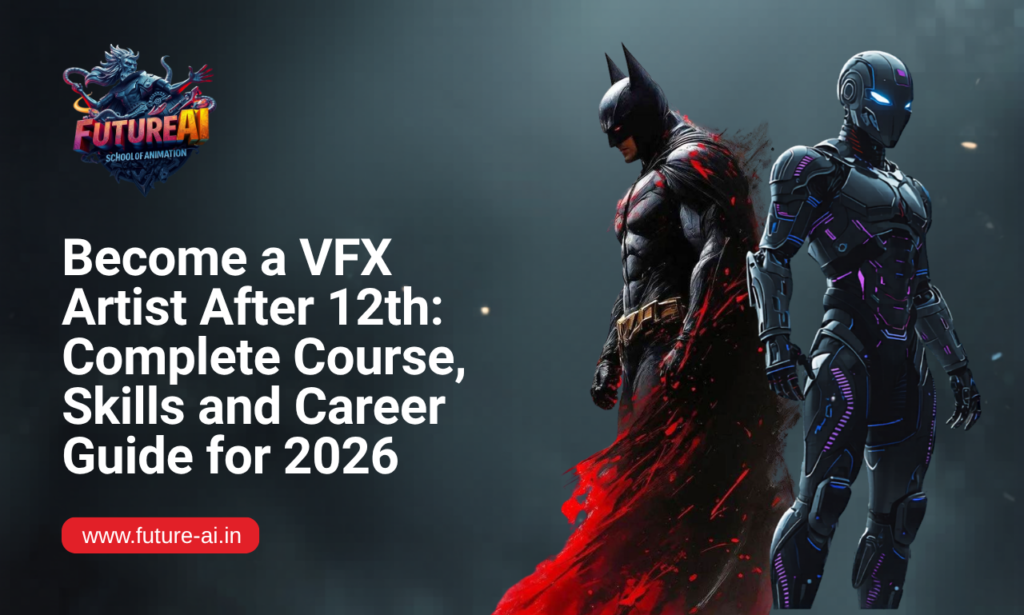
Students today are exploring career options that go beyond conventional degrees and allow them to combine creativity with technology. If movies, CGI, digital environments, animation, filmmaking or cinematic effects interest you, choosing a VFX Course in Andheri after Class 12 can help you begin developing the practical skills required for visual-effects careers. VFX is now used across feature films, OTT productions, advertisements, gaming, digital media and branded content, opening several creative possibilities for students who enjoy working with visuals. Students interested in broader 3D and character-based creative careers can also consider an Animation Course in Andheri while comparing their options.
Visual effects are responsible for many of the scenes audiences see on screens today. A location may be digitally expanded, an actor may be placed inside a completely computer-generated world, objects may be removed from a frame, or smoke, fire, water and destruction may be created using specialized software. Behind these results are artists who understand both visual storytelling and technical production.
The career path is also changing in 2026. AI-assisted tools are becoming more common in visual creation and post-production, but strong knowledge of composition, lighting, tracking, compositing and filmmaking remains important. Students entering the field therefore need a combination of artistic awareness, technical ability, practical experience and willingness to adapt.
Future AI School of Animation in Andheri West follows a production-focused learning approach supported by Raj Studios industry professionals. Its current VFX Film Making program runs for approximately 18 months across four terms and covers areas such as compositing, camera tracking, 3D workflows, post-production and simulations.
This guide explains the complete pathway for students who want to become VFX artists after 12th.
Can I Become a VFX Artist After 12th?
Yes. Students can start preparing for VFX careers after completing Class 12. You do not necessarily need prior professional experience in animation, editing or computer graphics before joining a beginner-friendly program.
The key is choosing structured training that starts with fundamentals and gradually moves into professional techniques.
Who Should Explore a Career in VFX?
VFX may suit students who frequently wonder:
- How superhero scenes are created
- How green-screen footage becomes a cinematic environment
- How creatures are added to real footage
- How explosions and smoke are generated digitally
- How filmmakers create locations that do not exist
- How unwanted elements are removed from scenes
- How computer graphics blend naturally with actors
- How AI is changing visual production
Interest is an important starting point because VFX involves constant learning and experimentation.
You Do Not Need to Be an Expert Before Joining
Many students mistakenly believe that they should already know professional software before beginning a VFX course.
That is not necessary. Training should introduce students to basic visual concepts before moving into more complicated applications. The purpose of joining a professional program is to learn the skills you do not already have.
What Does a VFX Artist Do?
A VFX artist helps create, enhance or manipulate elements within filmed footage.
For example, an actor may perform against a green screen in a studio while the final movie shows that actor standing inside a futuristic city. VFX professionals may create the background, remove the green screen, add atmospheric effects, integrate CGI objects, match lighting and combine every element into one final shot.
Common VFX Tasks
Depending on specialization, VFX professionals may work on:
- Rotoscoping
- Chroma keying
- Compositing
- Camera tracking
- Match moving
- Digital clean-up
- Wire removal
- Matte painting
- CGI integration
- 3D modelling
- Lighting
- Rendering
- Motion graphics
- Fire simulation
- Smoke simulation
- Water effects
- Particle systems
- Environment creation
VFX Is Not Always Obvious
Some of the best visual effects are barely noticed by audiences. A VFX team may simply remove a building, change a sky, replace a laptop screen or extend a road.
The purpose is to make the final visual support the story without appearing artificial.
What Qualifications Are Required to Become a VFX Artist After 12th?
Eligibility varies between institutes and academic programs, but students who complete Class 12 can generally explore different professional VFX training options. A specific school stream is not always required.
Academic Marks Are Not the Only Measure of Potential
Visual effects is strongly skill-oriented.
As students progress, factors such as these become increasingly important:
- Portfolio quality
- Showreel
- Practical skills
- Software knowledge
- Creative judgement
- Attention to detail
- Problem-solving
- Ability to handle feedback
A student may have excellent marks but still need significant practical training. Another student with average academic results may build an impressive portfolio through consistent practice.
Personal Qualities That Can Help
VFX can suit students who are:
- Patient
- Curious
- Creative
- Detail-oriented
- Comfortable learning software
- Interested in filmmaking
- Open to revisions
- Consistent with practice
A professional VFX shot may go through several revisions before it is approved, so patience is particularly useful.
Which Stream Is Best for VFX After 12th?
There is no single compulsory Class 12 stream for becoming a VFX artist. Students from Arts, Commerce and Science backgrounds can enter professional visual-effects training.
Arts Students
Arts students may already have exposure to:
- Drawing
- Design
- Colour
- Photography
- Storytelling
- Visual communication
These skills can provide a useful creative foundation.
Science Students
Science students may find technical areas such as 3D environments, simulations, lighting and procedural workflows interesting.
However, science is not a mandatory requirement for learning VFX.
Commerce Students
Commerce students can also build careers in visual effects because the required software and production techniques can be learned through structured training.
Your stream should therefore not stop you from entering the field.
Can Arts, Commerce and Science Students Learn VFX After 12th?
Yes. VFX is accessible to students from multiple academic backgrounds.
Once professional training begins, students gradually develop a common foundation in visual communication and production.
What Every Beginner Needs to Understand
Regardless of their Class 12 stream, learners should eventually understand concepts such as:
- Perspective
- Colour
- Composition
- Lighting
- Camera movement
- Scale
- Timing
- Motion
- Storytelling
- Digital image creation
These fundamentals help VFX artists make digital elements look believable.
A Commerce student, for instance, can become an excellent compositor if they develop strong visual judgement and technical skill. Similarly, an Arts student can learn procedural tools, while a Science student can become a creative motion designer.
The quality of your work becomes more important than the stream printed on your Class 12 certificate.
Can I Learn VFX Without Drawing or Coding Skills?
Yes. Students can start learning VFX without advanced drawing or programming knowledge. Both can become useful in certain specialized roles, but they are not universal requirements.
Is Drawing Compulsory for VFX?
Drawing can help students understand:
- Perspective
- Composition
- Character design
- Storyboards
- Concept development
However, several VFX roles do not require advanced illustration skills.
For example, compositing, camera tracking, rotoscoping and digital clean-up rely heavily on software expertise and visual observation.
Is Coding Needed to Learn VFX?
Coding is also not essential for most beginners. Students can learn keying, tracking, editing, compositing and motion graphics without knowing programming.
Advanced scripting may become useful for technical artists, pipeline specialists or procedural FX professionals. Houdini users, for example, may eventually benefit from a deeper understanding of procedural logic.
Beginners should first focus on creative and technical fundamentals.
Which VFX Course Is Best After 12th?
The best course should help students understand how professional visual-effects production works rather than teaching isolated software commands.
Students should evaluate both the syllabus and teaching methodology.
Important Subjects to Look For
A career-focused VFX curriculum can include:
- Visual design fundamentals
- Digital imaging
- Storytelling
- Video editing
- Motion graphics
- 3D basics
- Camera tracking
- Chroma keying
- Rotoscoping
- Compositing
- CGI integration
- Post-production
- Rendering
- Simulations
- Portfolio development
Future AI currently lists an approximately 18-month VFX Film Making program covering cinematic VFX, graphics illustration, compositing, camera tracking, fluid simulations and real film workflows.
Choose Practical Learning Over Software Count
Some courses advertise long software lists.
Students should instead ask:
- What type of projects will I create?
- Will I work with filmed footage?
- Will I learn complete shot workflows?
- Who will review my work?
- Will I create a showreel?
- Is interview preparation included?
- Are trainers connected with the industry?
Practical application is what ultimately develops confidence.
Should I Choose a Degree, Diploma or Professional VFX Course After 12th?
Students may find several education pathways while researching VFX careers. There is no universally correct option.
Degree Programs
A degree may suit students seeking broader academic education along with creative subjects.
Degree programs usually have a longer duration and may cover multiple areas of media, animation or design.
Diploma Programs
A diploma can provide focused training within a shorter academic structure.
The quality and depth of diploma programs can vary, so students should carefully check the syllabus.
Professional Career Programs
Professional programs can be useful for students who want concentrated exposure to studio-oriented tools and production methods.
Compare More Than Fees
Before joining, evaluate:
- Course duration
- Training modules
- Faculty background
- Practical projects
- Software exposure
- Student portfolios
- Infrastructure
- Industry interaction
- Showreel preparation
- Placement training
The cheapest or longest course is not automatically the best one. The right program should help you create stronger work.
How Long Does It Take to Become a VFX Artist?
Learning VFX is an ongoing process. Students can understand basic concepts relatively quickly, but reaching professional quality requires practice across different types of projects.
Course Duration Depends on Depth
A short course may focus on individual software, whereas career-oriented programs can extend for a year or longer. Future AI’s VFX Film Making course is currently listed at approximately 18 months across four terms.
This duration allows students to gradually progress from foundational design and visual concepts toward more specialized VFX techniques.
Practice Matters Beyond Classroom Hours
Students improve when they attempt projects that are slightly more difficult than their previous work.
For instance, practise keying with:
- Different lighting
- Moving subjects
- Hair details
- Motion blur
- Shadows
- Transparent materials
Similarly, camera tracking should be practised with multiple camera movements rather than one perfect tutorial clip.
Real learning happens when students solve problems.
What Skills Should You Learn to Become a Professional VFX Artist?
Successful visual effects require creative, technical and professional abilities.
Creative Understanding
Artists should develop knowledge of:
- Composition
- Lighting
- Colour theory
- Perspective
- Cinematography
- Motion
- Storytelling
- Visual balance
These principles help digital elements feel connected to the footage.
Technical Skills
Students may gradually learn:
- Rotoscopy
- Chroma keying
- Tracking
- Compositing
- 3D workflows
- Rendering
- Simulations
- Motion graphics
- Editing
- Post-production
Observation Skills
A strong VFX artist notices small details.
Ask questions such as:
- Is the shadow direction correct?
- Does the CGI element match the camera perspective?
- Is the object too sharp compared with the footage?
- Is the lighting consistent?
- Does the motion look natural?
- Do the colours belong in the same environment?
These observations make the difference between an effect that looks pasted on and one that feels convincing.
Professional Skills
Studios also expect artists to understand:
- Deadlines
- Teamwork
- Communication
- File organisation
- Revision processes
- Feedback
- Project responsibility
VFX is collaborative, so professional behaviour matters.
Which VFX Software Should Beginners Learn?
The best software depends on the specialization a student eventually chooses. Beginners should learn tools progressively rather than trying to master everything together.
Adobe After Effects
After Effects is useful for areas such as:
- Motion graphics
- Video effects
- Basic compositing
- Keying
- Tracking
- Typography animation
Nuke
Nuke is commonly associated with node-based compositing.
Students interested in professional compositing workflows can benefit from understanding how different nodes, masks, colour corrections and visual layers are organised.
3ds Max
3ds Max can help students develop knowledge of:
- 3D modelling
- Animation
- Lighting
- Rendering
Cinema 4D
Cinema 4D is widely used for motion design and 3D visual creation.
Houdini
Houdini is particularly important for procedural visual effects.
It can be used for:
- Fire
- Smoke
- Destruction
- Particles
- Fluids
- Procedural environments
RealFlow
RealFlow is associated strongly with fluid simulation.
Future AI’s curriculum includes exposure to tools and workflows involving 3ds Max, Cinema 4D, RealFlow and Houdini as students progress into advanced production areas.
Students should remember that software is only a tool. Their goal should be to produce convincing visual results.
What Is the Step-by-Step Process to Become a VFX Artist After 12th?
A clear roadmap can prevent beginners from becoming overwhelmed.
Step 1: Understand What VFX Really Is
Before selecting a course, watch professional breakdowns and observe how a shot changes.
A typical sequence might look like:
Raw Footage → Rotoscopy → Tracking → CGI → Effects → Compositing → Final Shot
Step 2: Choose a Career-Focused Course
Look for practical instruction, experienced trainers and portfolio development.
Step 3: Build Visual Fundamentals
Understand lighting, perspective, colour and camera principles.
Step 4: Learn Core Software
Start with tools relevant to your initial area of interest.
Step 5: Practise With Actual Footage
Try creating:
- Green-screen composites
- Screen replacements
- Object removals
- Set extensions
- Camera tracking
- Background replacements
Step 6: Discover Your Specialization
After learning the basics, identify the work you enjoy most.
Potential specializations include:
- Compositing
- Rotoscopy
- Match moving
- Motion graphics
- 3D lighting
- FX simulation
Step 7: Create Original Projects
Do not rely entirely on class assignments.
Personal projects demonstrate curiosity and creative independence.
Step 8: Build a Showreel
Select polished work that reflects your target job role.
Step 9: Prepare for Interviews
Learn how to explain the process behind each portfolio piece.
Step 10: Start Applying and Continue Improving
Look for junior opportunities, internships and studio roles while continuing to update your skills.
How Do You Build a Strong VFX Portfolio or Showreel as a Fresher?
A showreel provides visual evidence of your skills.
It should demonstrate what you are capable of creating rather than simply listing the software you have studied.
Use Only Your Strongest Work
Avoid adding every classroom assignment.
Choose pieces that clearly demonstrate technical and visual ability.
Start Strong
Place your best project near the beginning.
A recruiter should see your abilities quickly.
Show Breakdowns
Where appropriate, demonstrate the process:
Original Plate → Tracking → Rotoscope → Effects → Composite → Final Output
This helps viewers understand your actual contribution.
Make Your Portfolio Relevant to Your Role
A student applying for compositing should show compositing.
Someone interested in FX should prioritize:
- Fire
- Smoke
- Destruction
- Fluids
- Particles
Your portfolio should communicate where your strongest capabilities lie.
Future AI VFX Course with 100% Placement Training and Industry Expert Guidance
Learning VFX techniques is only one part of becoming career-ready. Students also need guidance for portfolios, interviews, studio environments and professional expectations.
Future AI states that students receive 100% placement-focused training guided by Raj Studios industry professionals. The institute highlights portfolio development, interview preparation, studio exposure and career mentoring as elements of its placement preparation.
Training Guided by Raj Studios Professionals
Future AI was founded by professionals including Chirag Chandrakant Bhuva, VFX Producer and Director at Raj Studios, and Shambhu J. Singh, VFX Director at Raj Studios.
This industry connection allows training to reflect production processes rather than remain limited to theoretical lessons.
Studio-Oriented Learning
Future AI highlights student exposure to:
- VFX shoots
- Live projects
- Editing workflows
- Studio assignments
- Post-production pipelines
- Portfolio building
- Interview preparation
The institute states that students participate in production assignments designed around studio-style tasks.
Placement Training Versus Job Guarantee
Students should understand the distinction between placement-focused training and guaranteed employment. Placement training prepares learners through skills, portfolios, interviews and industry connections. Actual employment depends on individual performance, portfolio quality, openings and employer selection.
This distinction keeps expectations realistic while ensuring students understand the value of structured career preparation.
What Career Options Are Available After Completing a VFX Course?
The VFX industry includes multiple career specializations.
VFX Compositor
Compositors combine different visual layers into a final believable shot.
Rotoscopy Artist
Rotoscopy artists isolate moving subjects so they can be manipulated independently.
Match Move Artist
Match move professionals reproduce camera movement digitally so CGI assets remain aligned with live footage.
FX Artist
FX artists specialize in simulations such as:
- Fire
- Smoke
- Water
- Dust
- Explosions
- Destruction
3D Artist
3D professionals can specialize further in:
- Modelling
- Texturing
- Lighting
- Rendering
- Environment design
Motion Graphics Artist
Motion designers produce animated graphics for advertising, branding, entertainment and digital content.
VFX Generalist
Generalists understand several stages of production and may handle diverse responsibilities within smaller teams.
Where Can VFX Professionals Work?
Opportunities can exist across:
- Film production
- OTT content
- Television
- Advertising
- Gaming
- Post-production
- Digital agencies
- Music videos
- Branded content
- Virtual production
- Online media
Your showreel and specialization can influence which roles become suitable.
Is VFX a Good Career in India in 2026?
VFX can be a rewarding career option for students who genuinely enjoy creative technology and are willing to keep learning.
Digital visuals are required across an increasingly broad range of media.
The Industry Goes Beyond Movies
VFX skills now contribute to:
- Streaming series
- Advertisements
- Games
- Online campaigns
- Social content
- Product visualisation
- Virtual production
- Immersive experiences
The diversification of digital content gives artists more areas in which to apply their skills.
Career Growth Depends on Continuous Improvement
Students should not assume that completing a course guarantees a successful career.
Long-term development requires:
- Better portfolios
- Strong specialization
- Updated software knowledge
- Production experience
- Networking
- Professional discipline
- Continuous experimentation
The students who remain curious and adaptable are usually better positioned for industry changes.
Will AI Replace VFX Artists or Create New Career Opportunities?
AI is changing visual production, but the future is unlikely to be as simple as replacing every artist with automated software.
Instead, artists may increasingly work alongside AI-based tools.
Areas Where AI Can Assist
AI can support tasks involving:
- Rotoscoping
- Mask generation
- Object removal
- Background creation
- Upscaling
- Concept generation
- Previsualization
- Cleanup
- Image enhancement
Automating repetitive steps can allow artists to spend more time on creative decisions.
Why Artistic Judgement Still Matters
Professional VFX requires understanding of:
- Narrative purpose
- Composition
- Lighting
- Continuity
- Scale
- Client feedback
- Cinematography
- Quality standards
AI may generate an element, but an experienced artist still needs to decide whether it works within the sequence.
Learn AI as Part of the Creative Toolkit
Students entering the industry should not think:
“Should I learn AI or VFX?”
A more future-ready approach is:
“How can I use AI while becoming technically strong in VFX?”
AI literacy can become an advantage when combined with strong artistic fundamentals.
Why Choose Future AI for a VFX Course After 12th?
Students researching a VFX Course in Andheri should evaluate whether the institute provides opportunities to understand actual production workflows.
Future AI School of Animation is based in Andheri West, Mumbai and offers career-focused programs across VFX filmmaking, animation, gaming, dynamics, web design and AI-oriented creative media.
Practical VFX Training
Future AI’s approximately 18-month VFX Film Making program introduces students to areas including:
- Graphics and visual concepts
- 3D workflows
- Camera tracking
- Compositing
- Post-production
- Motion graphics
- Cinema 4D
- Fluid simulations
- Houdini FX
- Showreel development
Industry Mentorship
Training is guided by professionals associated with Raj Studios and the media industry, helping students connect classroom learning with practical production expectations.
Real Production Exposure
Future AI states that its learners participate in real VFX shoots, live projects and production-style assignments.
This kind of experience can help students understand the complete workflow around a shot.
Portfolio and Career Development
Students receive structured support around portfolio creation, interview preparation and placement-focused training.
These areas matter because professional opportunities depend heavily on the work students are able to present.
Animation Learning for Students Exploring Broader Creative Careers
Students who want to learn more about 3D characters, rigging, animation principles and complete animation pipelines can also explore an Animation Course in Andheri at Future AI.
Future AI’s Animation Prime program currently runs for 18 months across four terms and covers areas from graphic concepts and digital illustration to advanced 3D character animation, rigging, rendering and FX.
Students can therefore choose between VFX-focused and animation-focused pathways depending on whether they are more interested in manipulating filmed footage, creating digital characters and environments, or developing skills across both areas.
Frequently Asked Questions About a VFX Career After 12th
1. Can I Learn VFX Directly After Completing Class 12?
Yes. Students can begin professional VFX training after 12th. Beginner-oriented courses usually start with foundational visual concepts before progressing into professional software and production techniques.
2. Can Commerce Students Become VFX Artists?
Yes. Commerce students can learn VFX. Your academic stream is less important than your ability to develop strong practical skills, visual understanding and a professional portfolio.
3. Is Science Required for VFX?
No. Science is not compulsory for many skill-based VFX programs. Arts, Commerce and Science students can all explore visual-effects careers.
4. Can I Learn VFX If I Cannot Draw?
Yes. Advanced drawing ability is not necessary for every VFX role. Drawing can support certain creative areas, but compositing, tracking and several other VFX specializations rely more on technical skills and visual judgement.
5. Does a VFX Artist Need Coding Knowledge?
Coding is not usually required for beginners. It may become beneficial for advanced technical roles, procedural workflows and pipeline development.
6. How Long Does It Take to Learn Professional VFX?
Duration depends on the training depth and practice level. Career-oriented programs can take a year or longer. Future AI’s VFX Film Making program is currently approximately 18 months across four terms.
7. Which Software Is Good for Starting VFX?
Students commonly begin with tools connected to compositing and motion graphics before progressing into advanced applications. Software such as After Effects, Nuke, 3ds Max, Cinema 4D and Houdini can serve different areas of VFX production.
8. Can a VFX Course Help Me Work in Films or OTT?
VFX skills are relevant to films, OTT productions and post-production studios. However, professional opportunities depend on your portfolio, specialization, practical abilities and employer requirements.
9. What Is the Difference Between VFX and Animation After 12th?
VFX frequently involves combining digital effects with live-action footage, while animation focuses more on creating and animating characters, objects and environments. Students interested in the animation path can consider an Animation Course in Andheri, while those attracted to cinematic effects and compositing may prefer VFX filmmaking.
10. How Should I Choose the Best VFX Course in Andheri?
Compare the curriculum, faculty experience, software, practical projects, student showreels, production exposure and career preparation. Avoid selecting a program based only on fees or the number of software applications advertised.
Conclusion: Start Preparing for Your VFX Career After Class 12
Becoming a VFX artist after Class 12 is a gradual process of developing creative awareness, technical knowledge and practical problem-solving skills. Students do not need to enter the field as expert designers, programmers or filmmakers. They need curiosity, structured learning and the discipline to practise consistently. The journey begins by understanding how visual-effects production works. From there, students can develop fundamentals in lighting, perspective, colour, composition and cinematography before learning professional software. Practical projects then help transform theoretical knowledge into usable skills.
As experience grows, students should begin identifying a specialization. Some may enjoy compositing and integrating visual elements. Others may be attracted to simulations, camera tracking, 3D environments or motion graphics. Choosing a specialization can make portfolio development more focused and help students communicate their strengths clearly to employers. A professional showreel is particularly important. Rather than simply mentioning software on a resume, a strong showreel demonstrates exactly what an artist can create. For this reason, practical training, project feedback and portfolio development should be major considerations when selecting a course.
The rise of artificial intelligence is another important factor for students entering VFX in 2026. AI tools may automate parts of production, but artistic judgement, filmmaking knowledge, storytelling, visual consistency and professional problem-solving remain valuable. Students should therefore learn how AI can complement traditional VFX skills instead of treating the two as competing career paths. For students searching for a VFX Course in Andheri, Future AI provides an approximately 18-month VFX Film Making program in Andheri West built around practical production workflows, compositing, camera tracking, simulations, post-production, showreel development and industry-guided training. Future AI also provides 100% placement-focused training under guidance from Raj Studios professionals, including portfolio development and interview preparation.
Students whose interests extend toward character animation, modelling, rigging and 3D storytelling can alternatively explore an Animation Course in Andheri and build a broader foundation in animation production. Whether you eventually choose animation, compositing, simulations or another VFX specialization, the most important objective should be to become capable of producing work that demonstrates professional potential. A VFX career is not built by collecting software certificates. It is built one project at a time—through observation, experimentation, feedback, improvement and a genuine understanding of how compelling digital visuals are created.
Contact Future Ai
Address: Unit No. 1606, Chandak Unicorn, Dattaji Salvi Marg, Off Veera Desai Rd, Andheri, Mumbai, Maharashtra 400053
Phone: 08879998001
Website: www.future-ai.in
Google Maps: https://maps.app.goo.gl/cLeb9zBsJJEADR9x6