Introduction
For pharmaceutical and nutraceutical companies, calcium sourcing is not simply about finding an ingredient with a high calcium value. The origin of the material, chemical assay, mineral profile, purity, processing route, particle properties, consistency, documentation and intended formulation all play a role in raw-material approval.
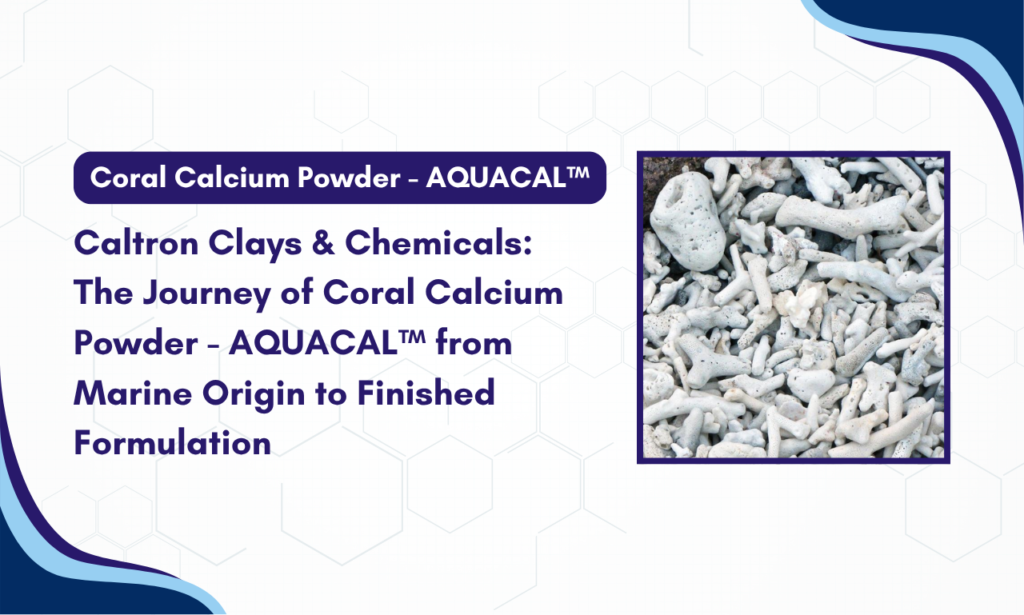
Coral calcium powder offers a distinctive option because it originates from naturally mineralized coral deposits formed in a marine environment. Calcium carbonate is its major calcium-bearing component, while the material may also contain naturally associated trace minerals originating from the marine mineral matrix.
Caltron Clays & Chemicals markets its coral calcium ingredient under the brand AQUACAL™. According to Caltron’s product information, AQUACAL™ is manufactured from dead coral reef material obtained from selected above-sea and seashore deposits. The company reports a 99.5% assay as CaCO₃ and describes the material as undergoing extensive beneficiation and quality checks before being processed into a fine powder.
For companies evaluating a Coral Calcium Powder Manufacturer in India, Coral Calcium Powder Supplier in India, or Coral Calcium Powder Exporter in India, understanding the complete journey of the ingredient can make supplier selection more systematic.
That journey starts with the natural marine source and continues through processing, quality evaluation, raw-material qualification, formulation development and finally incorporation into a finished nutritional product.
What Is Coral Calcium Powder?
Coral calcium powder is a naturally derived marine calcium material obtained from mineralized coral deposits. Its main chemical component is calcium carbonate, commonly expressed as CaCO₃, together with naturally associated minerals present within the original coral structure.
What differentiates coral calcium from many conventional calcium carbonate materials is its source identity.
Rather than beginning with limestone or a purely synthetic chemical route, coral calcium begins with a naturally mineralized marine structure. This can be relevant to supplement manufacturers developing products positioned around natural, marine-derived or differentiated mineral sources.
However, a natural source should never be the only basis for ingredient selection.
Before approving coral calcium for commercial use, manufacturers may need to evaluate:
- CaCO₃ assay
- Purity and impurity profile
- Heavy-metal requirements
- Particle characteristics
- Batch-to-batch consistency
- Quality documentation
- Formulation compatibility
- Intended application
- Regulatory requirements
Caltron offers this ingredient as AQUACAL™ Coral Calcium Powder, with a reported 99.5% CaCO₃ assay.
This provides formulation teams with a clearly positioned marine-origin calcium material that can be assessed against their own product and quality requirements.
Understanding the Natural Marine Origin of Coral Calcium
Coral calcium begins with a biological mineralization process in the marine environment.
Coral-forming organisms create hard mineralized structures primarily composed of calcium carbonate by utilizing mineral components available in seawater. Over long periods, these structures contribute to the formation of coral deposits.
This natural mineralization gives coral-derived material a distinctly different origin from calcium produced through conventional industrial processing.
Caltron describes the source used for AQUACAL™ as dead coral material obtained from selected above-sea or seashore deposits.
For B2B buyers, this sourcing information is important because the term “marine calcium” can describe several different categories of raw materials.
Marine-derived calcium can originate from:
- Coral deposits
- Algae
- Oyster shells
- Fish bone
- Other marine mineral sources
Each source can have different chemical, physical and commercial characteristics.
For this reason, procurement and R&D professionals should evaluate three separate questions.
Where does the material come from?
The source determines the ingredient’s natural-origin story and can influence raw-material characteristics.
What does the material contain?
The current technical specification and analytical documentation provide information about the material’s actual composition.
How will it be used?
The finished formulation, dosage form and regulatory requirements determine whether the ingredient is suitable for the intended product.
Keeping these questions separate helps manufacturers distinguish ingredient origin from measurable technical performance.
From Coral Deposit to AQUACAL™: How the Raw Material Is Processed
A naturally occurring coral deposit is only the starting point.
Before coral calcium can be evaluated for pharmaceutical or nutraceutical use, the material needs to undergo controlled processing to reduce unwanted matter and prepare it as a consistent powder ingredient.
Caltron states that AQUACAL™ undergoes extensive quality checks and a beneficiation process intended to remove foreign particles and impurities.
The broad journey can be represented as:
Selected Coral Deposit → Raw-Material Inspection → Beneficiation → Purification → Fine Powder Processing → Quality Evaluation → B2B Supply → Customer Qualification → Finished Formulation
Raw-Material Inspection
Natural mineral sources can vary depending on geographical and environmental conditions.
Selecting suitable source material helps establish a more controlled starting point for subsequent processing.
Beneficiation
Beneficiation is an important stage in preparing naturally occurring mineral material.
The process is used to reduce unwanted components and improve the suitability of the desired mineral fraction before further processing.
For pharmaceutical and nutraceutical buyers, this step matters because the final raw material must be significantly more controlled than the original natural deposit.
Fine Powder Processing
After beneficiation and purification, the processed material is converted into powder form.
Caltron describes AQUACAL™ as an ultra-fine coral calcium powder.
Powder characteristics can influence multiple manufacturing processes, including:
- Mixing
- Blending
- Flow
- Tablet compression
- Capsule filling
- Dispersion
- Finished-product consistency
Where a specific particle-size profile is important, manufacturers should evaluate the latest supplier specification during qualification.
Quality Evaluation
Once the coral material has been processed, it is assessed against relevant quality parameters.
Analytical data generated at this stage helps determine whether the material is suitable for commercial B2B supply.
Customer Qualification
Supplier release does not automatically mean the material is approved for every formulation.
The pharmaceutical or nutraceutical manufacturer still needs to apply its own raw-material qualification process before commercial use.
AQUACAL™ Coral Calcium Powder: Key Characteristics for Formulation Teams
AQUACAL™ is positioned by Caltron Clays & Chemicals as a marine-origin calcium ingredient for B2B pharmaceutical and nutraceutical requirements.
Caltron highlights several characteristics that can be relevant during technical evaluation:
- Natural coral-derived origin
- Sourced from dead above-sea or seashore coral deposits
- Reported 99.5% assay as CaCO₃
- Non-synthetic positioning
- Beneficiation-based processing
- Fine powder form
- Extensive quality checks
- Control of foreign matter and impurities
- Attention to heavy-metal levels
- Naturally associated trace minerals
- Zero irradiation/radioactivity positioning as described by Caltron
These characteristics can help R&D and procurement teams decide whether AQUACAL™ should proceed to detailed qualification.
However, product-page information should be viewed as a starting point rather than a replacement for formal documentation.
Manufacturers should distinguish between:
Product information: General characteristics of the ingredient.
Technical specification: Defined material parameters and limits.
Certificate of Analysis: Batch-specific analytical data.
Application testing: Actual performance in the intended formulation.
Together, these elements provide a much stronger basis for raw-material approval.
Beyond Calcium: Understanding the Natural Mineral Profile
Calcium carbonate forms the principal calcium component of coral calcium, but coral-derived material may also contain naturally associated minerals due to its marine origin.
Caltron describes its coral source as containing a broad spectrum of naturally occurring trace minerals and refers to 74 minerals associated with the coral deposits.
For formulation teams, the value of this characteristic should be interpreted responsibly.
The presence of trace minerals within a natural source does not automatically mean that every mineral is present at a nutritionally significant concentration.
If a specific mineral is intended to support:
- Nutritional labelling
- Formula calculations
- Product claims
- Regulatory submissions
- Ingredient declarations
its actual concentration should be confirmed through appropriate analytical documentation.
A useful distinction for product developers is:
Marine origin provides the mineral story. Analytical results provide the formulation evidence.
This distinction allows manufacturers to communicate the natural-source positioning of coral calcium while keeping finished-product claims technically and regulatory appropriate.
Why Purity Is Important in Coral Calcium Powder
Purity is especially important for natural mineral ingredients because the desired mineral source may occur alongside unwanted materials.
This is why processing and quality assessment are central to transforming a natural deposit into a usable B2B ingredient.
Caltron states that AQUACAL™ undergoes extensive quality evaluation and beneficiation before being supplied as coral calcium powder.
Manufacturers should assess purity through several areas.
CaCO₃ Assay
The assay indicates the measured amount of the principal chemical component.
Caltron reports 99.5% CaCO₃ for AQUACAL™.
Formulators should use the current specification and batch documentation when performing formulation calculations.
Heavy-Metal Requirements
Natural mineral materials should be evaluated against appropriate heavy-metal limits for the intended market and application.
This is particularly relevant for manufacturers supplying products across multiple regulatory markets.
Foreign Matter
Beneficiation helps reduce unwanted particles and other materials that may be present in the original source.
Physical Characteristics
Powder performance can influence how a raw material behaves during manufacturing.
Depending on the dosage form, formulators may need to study:
- Flow
- Bulk properties
- Blending behaviour
- Compression
- Capsule filling
- Dispersion
Batch Consistency
A commercial formulation requires repeatable raw-material quality.
Manufacturers should therefore consider how future batches are expected to perform within the agreed specification.
Documentation
Quality documentation is an important part of supplier qualification.
Specifications, analytical data and other relevant documents allow procurement, QA and R&D teams to evaluate the material more systematically.
For B2B buyers, purity is therefore not simply a marketing description. It is a collection of measurable quality characteristics.
Coral Calcium Powder vs Other Calcium Raw Materials
Calcium raw materials can come from many different sources, and the right choice depends on the intended formulation.
Coral calcium should therefore be compared with other calcium ingredients based on source, composition, physical characteristics, product positioning and commercial requirements.
Source
Coral calcium originates from naturally mineralized coral deposits.
Other calcium raw materials may come from:
- Algae
- Oyster shells
- Eggshells
- Milk
- Fish bone
- Limestone
- Other mineral sources
Natural-Source Positioning
For companies developing marine-origin or naturally positioned products, coral calcium can provide a differentiated raw-material story.
Chemical Composition
Coral calcium is primarily a calcium carbonate material.
Manufacturers should compare actual chemical assay and specifications rather than relying only on ingredient names.
Mineral Matrix
Coral calcium can contain naturally associated minerals derived from its marine origin.
Other calcium sources can have different mineral profiles depending on the starting material.
Powder Behaviour
Raw materials with similar chemistry may still behave differently because of differences in particle size, density, morphology and flow.
Commercial Suitability
The final ingredient decision should also consider:
- Required volume
- Cost
- Availability
- Packaging
- Technical documents
- Logistics
- Destination market
- Supplier support
No calcium source should automatically be considered superior in every formulation. The appropriate choice depends on the finished-product brief.
How AQUACAL™ Moves into Finished Supplement Formulations
Once AQUACAL™ reaches a pharmaceutical or nutraceutical manufacturer, the ingredient enters a second journey.
The raw material must move through sourcing, qualification, product development and commercial manufacturing before it becomes part of a finished supplement.
Ingredient Sourcing
The process often begins with supplier identification.
Procurement teams may search for a Coral Calcium Powder Manufacturer in India, Coral Calcium Powder Supplier in India, or Coral Calcium Powder Exporter in India based on technical requirements, location, volume and target market.
At this stage, price should be evaluated together with specification, quality, documentation and supply capability.
Raw-Material Qualification
Before commercial use, the buyer generally reviews whether the ingredient meets internal requirements.
Qualification may include:
- Supplier assessment
- Technical document review
- Specification comparison
- Sample evaluation
- Laboratory testing
- Regulatory review
Formulation Development
Once approved for development, AQUACAL™ can be evaluated in the intended dosage form.
Depending on the manufacturer’s product strategy, potential applications may include:
- Tablets
- Capsules
- Nutritional powders
- Mineral blends
- Other suitable supplement formats
Actual suitability should always be established through formulation testing.
Compatibility Assessment
Finished calcium products may contain multiple components.
A formulation may include:
- Other minerals
- Vitamins
- Binders
- Disintegrants
- Flavours
- Sweeteners
- Processing aids
R&D teams need to evaluate how AQUACAL™ behaves within the complete formulation rather than studying the calcium ingredient in isolation.
Prototype Development
Pilot or laboratory batches allow formulators to assess manufacturing behaviour before scale-up.
Tablet developers may study compression and finished tablet characteristics.
Capsule manufacturers may evaluate flow, fill weight and volume.
Powder formulations may require attention to mixing, uniformity and dispersion.
Quality Testing
The finished product must meet its own quality requirements.
Raw-material specifications do not automatically become finished-product specifications.
Commercial Scale-Up
After successful development trials, the formulation must remain reproducible at larger production volumes.
This is where batch consistency and dependable raw-material supply become increasingly important.
Finished Formulation
Once formulation, manufacturing, quality and regulatory requirements are completed, coral calcium becomes part of the commercial finished product.
For overseas manufacturers, selecting an experienced Coral Calcium Powder Exporter in India may also help align ingredient sourcing with international procurement planning.
What Should B2B Buyers Evaluate Before Sourcing Coral Calcium Powder?
A structured sourcing process can help manufacturers reduce technical and commercial uncertainty.
Verify the Assay
Review the current calcium carbonate specification.
Caltron reports 99.5% CaCO₃ for AQUACAL™.
Confirm the Raw-Material Source
Understand how the supplier identifies the coral material and where it originates.
Examine Purity
Review relevant impurity and contaminant parameters based on the intended application.
Check Heavy-Metal Specifications
The ingredient should be evaluated against applicable quality and destination-market requirements.
Review Particle Characteristics
Physical powder properties can influence downstream manufacturing behaviour.
Evaluate Batch Consistency
The commercial formulation requires consistent material over repeated purchases.
Review Documentation
QA, regulatory and R&D teams should establish which supplier documents are required before approval.
Assess Supply Capacity
Commercial supply should align with both current production volume and future scale-up requirements.
Evaluate Packaging
Packaging should protect the powder throughout storage and transportation.
Review Logistics for Export Markets
An international buyer searching for a Coral Calcium Powder Exporter in India should also consider documentation, packaging, shipping and destination-country requirements.
Why the Right Coral Calcium Supplier Matters Beyond Price
The role of a raw-material supplier continues after the first purchase order.
Once an ingredient becomes part of a commercial formulation, supplier performance can influence R&D, QA, procurement and manufacturing simultaneously.
Consistent supply can support:
- Predictable incoming material
- Easier raw-material qualification
- Repeatable manufacturing
- Quality-control efficiency
- Production scheduling
- Commercial scale-up
- Inventory planning
- Documentation management
- International logistics
- Long-term continuity
This is why choosing a Coral Calcium Powder Manufacturer in India should involve technical and operational evaluation in addition to commercial pricing.
A Coral Calcium Powder Supplier in India should also be able to support the requirements of both development-stage projects and ongoing production.
For overseas procurement, a Coral Calcium Powder Exporter in India needs to fit into a broader international ingredient supply chain where consistency, documentation and logistics are all important.
AQUACAL™ by Caltron Clays & Chemicals: A Marine-Origin Calcium Ingredient for B2B Formulators
Caltron Clays & Chemicals offers AQUACAL™ as part of its range of natural calcium raw materials.
The ingredient can be summarized through four core characteristics:
Marine-Derived Origin → 99.5% CaCO₃ Assay → Natural Mineral Matrix → Quality-Focused Processing
For R&D teams, AQUACAL™ provides a marine-source calcium ingredient that can be evaluated for suitable pharmaceutical and nutraceutical formulations.
For procurement teams, the evaluation may include:
- Current specification
- Analytical documentation
- Sample requirements
- Bulk quantities
- Packaging
- Logistics
- Commercial supply
- Target-market requirements
For international manufacturers searching for a Coral Calcium Powder Exporter in India, Caltron Clays & Chemicals can also be evaluated against their B2B sourcing and documentation requirements.
Why Consider Caltron Clays & Chemicals?
Caltron Clays & Chemicals focuses on pharmaceutical and cosmetic raw materials, including a portfolio of naturally derived calcium ingredients.
For buyers comparing potential suppliers, several aspects are relevant.
Natural Calcium Ingredient Portfolio
Caltron works with multiple calcium sources, giving formulation teams access to a broader range of natural-origin raw materials.
This can be useful for manufacturers comparing different calcium concepts during new-product development.
AQUACAL™ Product Positioning
AQUACAL™ is positioned around:
- Coral-derived marine origin
- Reported 99.5% CaCO₃ assay
- Beneficiation
- Fine powder preparation
- Naturally associated trace minerals
- Quality-focused processing
These characteristics provide B2B buyers with a clear starting point for technical evaluation.
B2B Manufacturer and Supplier Positioning
Caltron operates as a manufacturer, supplier and exporter of raw materials.
For businesses looking for a Coral Calcium Powder Manufacturer in India, this manufacturing-focused positioning can be relevant when conducting supplier qualification.
Companies looking for a Coral Calcium Powder Supplier in India can similarly assess AQUACAL™ according to their technical, commercial and supply requirements.
Support for International Sourcing
Companies purchasing ingredients across borders often require stronger alignment between product specifications, documentation and logistics.
For buyers evaluating a Coral Calcium Powder Exporter in India, Caltron can be assessed as part of an international procurement strategy.
Pharmaceutical Raw-Material Expertise
Businesses searching for a Pharmaceutical Raw Material Manufacturer in India generally require more than product availability.
They also need technical information, material consistency and clear supplier communication.
Likewise, selecting a Pharmaceutical Raw Material Supplier in India should involve reviewing documentation, raw-material quality and long-term commercial supply capability.
From Marine Origin to Modern Finished Formulation
The coral calcium journey shows how a natural mineral source moves through increasingly controlled stages before reaching the final product.
The full pathway can be summarized as:
Marine Mineral Environment → Coral Mineralization → Selected Coral Deposit → Beneficiation → Fine Powder Processing → Quality Evaluation → AQUACAL™ → Customer Qualification → Product Development → Manufacturing → Finished Supplement
Each stage has a different purpose.
The marine source establishes origin.
Processing transforms the natural material into a controlled powder.
Analytical evaluation provides measurable specifications.
Customer qualification determines whether the ingredient fits internal quality requirements.
Formulation development establishes practical application suitability.
Commercial manufacturing converts the qualified ingredient into a finished product.
AQUACAL™ connects these stages as Caltron Clays & Chemicals’ marine-origin coral calcium ingredient.
For R&D professionals, it provides a natural calcium source to evaluate.
For purchasing teams, it represents a decision involving assay, purity, documentation, consistency, price, volume and supply.
For businesses seeking a Coral Calcium Powder Manufacturer in India, Coral Calcium Powder Supplier in India, or Coral Calcium Powder Exporter in India, AQUACAL™ can be assessed against the specific technical and commercial requirements of the intended formulation.
Frequently Asked Questions
1. What is Coral Calcium Powder?
Coral calcium powder is a naturally derived marine calcium material obtained from mineralized coral deposits. It primarily contains calcium carbonate along with naturally associated trace minerals.
2. What is AQUACAL™ Coral Calcium Powder?
AQUACAL™ is Caltron Clays & Chemicals’ coral calcium powder for B2B formulation requirements. Caltron reports a 99.5% assay as CaCO₃ for this marine-derived calcium ingredient.
3. Where does Coral Calcium come from?
Coral calcium comes from mineralized coral deposits formed in marine environments. Caltron describes AQUACAL™ as being produced from dead coral material found in selected above-sea or seashore deposits.
4. Is Coral Calcium a natural calcium source?
Yes. Coral calcium is naturally derived from mineralized coral material and provides calcium primarily in the form of calcium carbonate.
5. What is Coral Calcium Powder used for?
Coral calcium powder may be evaluated as a calcium raw material for suitable nutraceutical formulations such as tablets, capsules, mineral blends and nutritional powders.
6. Does Coral Calcium contain trace minerals?
Coral calcium may naturally contain trace minerals associated with its marine source. Caltron describes AQUACAL™ as having a broad naturally occurring mineral profile.
7. What is the CaCO₃ assay of AQUACAL™?
Caltron Clays & Chemicals reports a 99.5% CaCO₃ assay for AQUACAL™ Coral Calcium Powder. Buyers should confirm current specifications during qualification.
8. Can Coral Calcium Powder be used in tablets and capsules?
Coral calcium powder may be considered for suitable tablet and capsule formulations. Actual suitability depends on formulation design, dosage, powder characteristics and applicable regulations.
9. Who is a Coral Calcium Powder Manufacturer in India?
Caltron Clays & Chemicals manufactures AQUACAL™ Coral Calcium Powder for B2B pharmaceutical and nutraceutical raw-material requirements.
10. How should I choose a Coral Calcium Powder Supplier in India?
Evaluate assay, purity, technical documentation, batch consistency, supplier capability, commercial availability and support for the intended application.
11. Is Caltron Clays & Chemicals a Coral Calcium Powder Exporter in India?
Caltron Clays & Chemicals positions itself as a manufacturer, supplier and exporter of pharmaceutical raw materials, including AQUACAL™ Coral Calcium Powder for B2B sourcing.
12. What is the difference between Coral Calcium and Calcium Carbonate?
Coral calcium primarily contains calcium carbonate, but its distinguishing feature is its natural marine coral origin and associated mineral matrix.
13. Is Coral Calcium better than conventional Calcium Carbonate?
Not necessarily. The appropriate calcium source depends on the formulation, technical specifications, physical characteristics, commercial requirements and target market.
14. What should manufacturers check before sourcing Coral Calcium Powder?
Manufacturers should evaluate source, assay, purity, heavy-metal specifications, particle properties, documentation, batch consistency and commercial supply capability.
15. Where can I buy Coral Calcium Powder in bulk in India?
Pharmaceutical, nutraceutical and dietary supplement manufacturers can contact Caltron Clays & Chemicals for AQUACAL™ specifications, documentation, sample requirements and bulk B2B enquiries.
Looking for AQUACAL™ for Your Next Calcium Formulation?
Selecting the right calcium raw material requires balancing source, technical specifications, formulation performance and commercial supply.
Caltron Clays & Chemicals offers AQUACAL™ Coral Calcium Powder for pharmaceutical and nutraceutical manufacturers evaluating a naturally derived marine calcium ingredient.
Connect with the Caltron team to discuss current product specifications, technical documentation, samples and bulk raw-material requirements.
Caltron Clays & Chemicals Pvt Ltd
Address: Office No. 211, 2nd Floor, Orbit Premises, Next to Sheetal Banquets, Opp to Inox Plaza, Mindspace, Malad West, Mumbai, Maharashtra 400064 India
Phone No.: 022 3571 9844 | +91 70214 37453 | +91 22 2876 4864
Website: https://caltronclays.com
Email: marketing@caltronclays.com | sales@caltronclays.com
Google Maps: https://maps.app.goo.gl/jCuz1ZCf1iAhzZiH7
