Animation has moved far beyond cartoons and children’s entertainment. In 2026, it plays an important role in films, OTT content, gaming, advertising, social media, visual effects, education, product visualization and immersive digital experiences. For students who enjoy creativity, storytelling and technology, choosing an Animation Course in Andheri can be a practical first step towards understanding professional animation workflows and building career-ready skills. As AI tools and new production technologies reshape creative industries, students who combine strong animation fundamentals with modern digital skills can explore an increasingly diverse range of career opportunities.
For students completing Class 12, graduating from college or thinking about changing careers, one question is becoming increasingly common: is animation actually a good career in India? The answer depends on your interests, skills, training and willingness to continuously improve. Animation can offer a rewarding professional path, but success comes from learning the fundamentals, developing technical expertise, working on projects and creating a strong portfolio.
This complete student guide explains the scope of animation in India in 2026, eligibility, required skills, career opportunities, AI’s impact, job roles and what aspiring animators should consider before choosing a course.
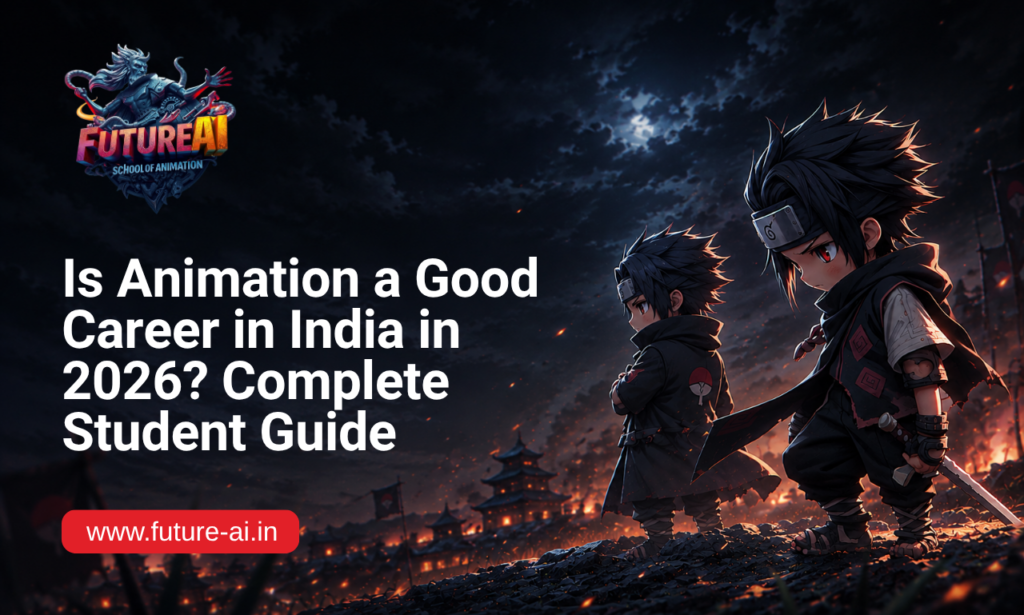
Is Animation a Good Career in India in 2026?
Yes, animation can be a good career option in India in 2026 for students who are genuinely interested in visual storytelling, design, filmmaking, games or digital content.
Animation is no longer limited to animated movies. Today, animation professionals contribute to feature films, OTT shows, advertisements, gaming projects, YouTube content, social media campaigns, educational videos, product presentations, architectural visualization and interactive experiences.
The growth of streaming entertainment, gaming, digital advertising and short-form video has also increased the number of formats in which animation skills can be applied. At the same time, AI-assisted creative tools and virtual production are changing how artists work rather than eliminating the need for creative professionals altogether. Current 2026 career guidance from universities and industry-focused institutions similarly highlights films, OTT, gaming, digital content and AI-driven workflows as important areas for animation and VFX professionals.
Students should therefore think about animation as a combination of creativity and technology rather than simply learning software.
Is Animation a Good Career After 12th?
Animation can be a suitable career after Class 12, especially for students who prefer creative and practical work over conventional academic career paths.
After 12th, students have enough time to build strong fundamentals before entering the professional industry. They can learn concepts such as drawing fundamentals, character design, storytelling, composition, animation principles, 3D modelling, texturing, lighting, rigging and rendering.
Starting early can also give students more time to experiment with different specializations before deciding which area interests them most.
A student may begin by wanting to become a 3D animator but later discover a stronger interest in modelling, lighting, character design, compositing, VFX or game art. This exploration is an important part of professional creative education.
The most important factor is not simply joining a course after 12th. Students must practise consistently and develop a portfolio that demonstrates what they can actually create.
Can Arts, Commerce and Science Students Learn Animation?
Yes. Students from Arts, Commerce and Science backgrounds can all learn animation. Unlike some professional courses that require specific subjects in Class 12, animation is largely skill-oriented. Your academic stream does not automatically determine whether you can become a successful animator.
Arts students may already have experience with drawing, visual communication or design concepts. Science students may be comfortable with technology, logical thinking and technical software. Commerce students may bring communication, business awareness and different creative perspectives.
However, none of these backgrounds guarantees success. What matters more is your ability to observe, learn, practise, take feedback and improve your creative work. Students who have never studied design can start by learning fundamental concepts before moving towards professional software and advanced production techniques.
Can I Learn Animation Without Drawing Skills?
Yes, you can learn animation even if you are not already good at drawing. This is one of the most common concerns among beginners. Drawing is highly useful in areas such as concept art, storyboarding, character design and traditional 2D animation. However, modern animation includes many roles where professional-level drawing ability is not the primary requirement.
For example, students interested in 3D animation, rigging, lighting, rendering, compositing or certain VFX roles may rely more heavily on observation, software knowledge, timing, movement, spatial understanding and technical problem-solving. That does not mean artistic fundamentals should be ignored.
Learning basic sketching, composition, anatomy, form, perspective and colour theory can improve your visual understanding even if you never become a professional illustrator. The goal for a beginner should therefore be improvement, not perfection.
What Skills Do You Need to Become an Animator?
A professional animator requires more than software knowledge. The first essential skill is observation. Animators constantly study how people walk, objects move, facial expressions change and weight shifts from one position to another.
Storytelling is equally important. Even technically impressive animation can feel weak when the movement does not communicate emotion, personality or purpose. Students should gradually develop skills such as:
- Animation principles
- Visual storytelling
- Character development
- Drawing and design fundamentals
- 3D modelling
- Texturing
- Rigging
- Lighting
- Rendering
- Composition
- Cinematography basics
- Editing
- Problem-solving
- Communication
- Project management
- Portfolio presentation
Soft skills also matter.
Professional animation projects usually involve collaboration between multiple departments. An animator may need to work with directors, designers, modellers, riggers, lighting artists, VFX professionals and editors. Learning how to understand feedback and work within deadlines is therefore part of becoming industry-ready.
What Is the Scope of Animation in India in the Future?
The career scope of animation extends across several industries.
Films remain an obvious area, but they are only one part of the ecosystem. OTT platforms, advertising agencies, gaming companies, digital marketing agencies, production houses, educational companies and content studios also use animation professionals.
Animation skills can be useful in:
Films and OTT Content
Animated characters, environments, title sequences, simulations and visual storytelling elements are regularly used across entertainment projects.
Gaming
Games require character artists, environment artists, animators, modellers, lighting artists and other creative specialists.
Advertising
Brands increasingly use animated advertisements, motion graphics, product visualization and short-form digital videos.
Digital Content
YouTube channels, social media creators, digital agencies and content businesses use animation to explain concepts and make content visually engaging.
Education and E-Learning
Animation helps simplify complex concepts through visual explanations, simulations and educational storytelling.
Architectural and Product Visualization
3D artists can create product demonstrations, interiors, buildings and realistic digital previews.
This diversity is one reason animation skills can remain valuable even when individual platforms or technologies change.
What Are the Best Career Options After an Animation Course?
Animation education does not lead to only one job title.
Students can specialize according to their creative strengths and interests.
Some common career paths include:
2D Animator
A 2D animator creates movement using two-dimensional artwork and characters. This can be used in entertainment, advertising, explainer videos and digital content.
3D Animator
A 3D animator creates realistic or stylized movement for digital characters and objects.
3D Modelling Artist
Modelling artists build three-dimensional characters, props, objects and environments that can later be textured, rigged and animated.
Character Animator
Character animators focus on bringing personalities to life through movement, body language and facial expressions.
Lighting Artist
Lighting artists control how scenes look by creating mood, depth and visual focus through digital lighting.
Rigging Artist
Rigging artists build digital skeletal systems and controls that allow 3D characters to move correctly.
Texture Artist
Texture artists create surfaces and material details that make digital objects look realistic or stylized.
Motion Graphics Designer
Motion graphics combines design, typography and movement. It is widely used in advertising, social media, broadcast design and branded content.
VFX Artist
Animation and VFX often overlap. Students with the appropriate skills can explore compositing, simulations, tracking and other visual-effects roles.
Game Artist
Students interested in gaming may move towards character creation, environment design, animation or other game-art specializations.
How Is AI Changing Animation Careers in 2026?
Artificial intelligence is one of the most important developments affecting creative industries in 2026. AI tools can assist creators with idea generation, references, concept exploration, repetitive processes and certain production tasks. However, professional animation still requires creative judgment.
A tool may generate an image or assist with a process, but professionals still need to understand composition, storytelling, character consistency, motion, timing, lighting, camera language and production requirements.
This means students should avoid thinking in terms of “AI versus animation.” A stronger approach is animation plus AI. Students who understand traditional creative fundamentals and also learn how new tools fit into modern workflows may be better prepared for changing production environments.
The future animator is likely to be someone who knows when technology can accelerate a task and when human creative control is necessary.
Will AI Replace Animators in the Future?
AI will change some animation tasks, but that does not mean every animator will disappear. Animation is based on communication and creative decision-making. Directors and studios need artists who can understand a brief, communicate emotion, maintain visual continuity and solve production problems.
Routine processes may become faster. As that happens, the value of creative thinking, storytelling, art direction and technical problem-solving may increase.
Students entering animation in 2026 should therefore learn professional fundamentals instead of depending completely on one software application or one AI tool. Software changes. Creative principles remain useful across tools.
Is an Animation Course in Andheri Suitable for Beginners?
Yes, beginners can start learning animation without previous professional experience when the training follows a structured progression.
A well-designed program should begin with creative foundations before introducing increasingly complex production processes. Students should understand why animation works instead of simply memorising which buttons to press inside software.
Future AI’s Animation Prime program, for example, begins with areas including graphics, digital illustration, storytelling, anatomy study, character design, animation principles, cinematography and photography concepts before progressing further through the animation pipeline. The institute currently describes the complete Animation Prime program as an 18-month course divided into four terms. This type of structured progression can help a beginner build both creative and technical confidence.
How Long Does It Take to Learn Animation?
There is no single duration that applies to every student. Basic software operations can be understood relatively quickly, but becoming employable as an animation professional requires considerably more practice.
The course duration can depend on:
- The specialization selected
- Depth of the curriculum
- Number of software applications covered
- Project complexity
- Practice hours
- Portfolio development
- Student learning speed
Students should therefore avoid selecting a course only because it promises the shortest duration. A longer program is not automatically better either.
What matters is whether students have enough time to understand concepts, practise them, complete projects, receive feedback and develop presentable work.
What Software Should Animation Students Learn in 2026?
Software requirements vary according to specialization. Different studios may use different production pipelines, so students should focus on understanding creative concepts along with professional tools.
Common areas of software training may include:
- Digital illustration
- Image editing
- 3D modelling
- Character animation
- Rigging
- Lighting
- Rendering
- Compositing
- Editing
- Motion graphics
Students should avoid believing that learning ten applications automatically makes them more employable than someone who understands two or three applications deeply. Studios ultimately evaluate what you can create. Software is a tool. Your portfolio demonstrates your skill.
Is Animation a High-Paying Career in India?
Animation income varies widely according to skill level, specialization, city, portfolio quality, studio, project experience and professional reputation. Beginners usually start with junior roles and gradually increase their earning potential as they build stronger skills and production experience.
Highly specialized artists can develop greater value in areas such as character animation, technical animation, FX, advanced lighting, game art and other production-intensive roles. Freelancing can also provide another path, but income may be inconsistent in the beginning.
Students should therefore avoid choosing animation only because of salary expectations. The more sustainable approach is to become highly skilled in an area you genuinely enjoy and then build professional value through consistent work.
What Is More Important: Animation Certificate or Portfolio?
A certificate can demonstrate that you completed a program, but your portfolio is usually a much stronger representation of your abilities.
A good portfolio should show:
- Your strongest work
- Technical understanding
- Creative thinking
- Improvement over time
- Attention to detail
- Understanding of animation principles
- Ability to complete projects
- Specialization strengths
Quality matters more than quantity. Five polished pieces are often more useful for demonstrating skill than dozens of unfinished exercises. Students should begin thinking about their portfolios while they are learning rather than waiting until the course ends.
How Do I Choose the Right Animation Course?
Students should evaluate a course based on practical learning rather than advertising alone.
Before joining, ask questions such as:
Does the curriculum teach fundamentals before software?
Are students completing practical projects?
Do trainers have real production experience?
Will you learn the complete workflow?
Does the institute provide opportunities to develop a portfolio?
Are current technologies and AI-assisted workflows discussed?
Can you see student work before enrolling?
Is there career and interview guidance?
Students considering an Animation Course in Andheri should also look at the quality of faculty, studio exposure, learning environment, curriculum depth and opportunities to work on production-oriented assignments.
The best course is not necessarily the one teaching the largest number of software applications. It is the one that helps you understand how professional creative work is actually produced.
Why Is Practical Training Important for Animation Students?
Animation cannot be mastered through theory alone. Imagine learning swimming only by reading a textbook. Animation works in a similar way. Students need to create. They need to make mistakes, receive feedback, correct those mistakes and repeat the process.
Practical projects help students understand problems that may never appear during software demonstrations. A model might deform incorrectly. Lighting may fail to create the intended mood. Character movement may appear unnatural. Rendering could produce unexpected results. Solving such problems is part of professional learning.
Project-based education also gives students material that can eventually contribute to a portfolio or showreel.
Why Consider Future AI for Animation Training?
Future AI School of Animation in Andheri West focuses on bridging classroom learning with real production processes. The institute is founded and mentored by professionals associated with Raj Studios and positions its training around hands-on learning, studio-level workflows and production exposure. Its current programs cover animation, VFX filmmaking, gaming, web design, dynamics and applied AI-related creative training.
For animation students, this approach is valuable because learning should extend beyond software commands. Understanding storytelling, cinematography, project workflows, creative problem-solving and professional production practices can help students develop a more complete perspective on the industry.
Future AI also emphasizes portfolio development, interview preparation and placement-focused guidance as part of its student career support. Students evaluating an Animation Course in Andheri can therefore consider factors such as practical projects, industry mentorship, portfolio preparation and exposure to evolving AI-based creative workflows while deciding whether a program matches their career goals.
Can Animation Become a Long-Term Career?
Yes, but long-term success depends on continuous learning. The animation industry changes rapidly. New software, rendering technologies, production pipelines, gaming engines and AI-assisted tools continue to emerge. Professionals who stop learning may find it difficult to remain competitive. However, students who build strong foundations can adapt more easily.
A person who truly understands animation principles, composition, movement, storytelling and visual communication can transfer those skills to new software. This adaptability is particularly important in 2026. Students should view their first animation course as the beginning of their learning journey rather than the end.
How Can Students Start a Career in Animation?
A simple career roadmap can make the process easier.
First, understand what animation includes and explore different areas such as 2D, 3D, character animation, modelling, motion graphics, VFX and game art.
Second, choose structured training that covers both fundamentals and professional tools.
Third, practise consistently outside class.
Fourth, complete projects rather than only following tutorials.
Fifth, identify the specialization you enjoy most.
Sixth, build a focused portfolio or showreel.
Seventh, learn how professional studios operate and prepare for interviews or internships.
Finally, continue upgrading your skills as new technologies emerge. Students who follow this process are more likely to build meaningful capabilities than those who focus only on obtaining a certificate.
Conclusion: Is Animation Worth Choosing as a Career in 2026?
Animation can be a promising career choice in India in 2026 for students who enjoy creativity, storytelling, visual design and technology. Opportunities now extend beyond traditional animated films into VFX, OTT content, gaming, advertising, social media, digital content, educational media and several other creative industries. However, students should enter the field with realistic expectations. Simply completing a course does not guarantee a successful career. Professional growth depends on practical skills, consistent practice, specialization, portfolio quality, adaptability and the ability to work within real production environments.
AI is also changing how creative work is produced, making it increasingly important for aspiring artists to combine strong animation fundamentals with modern technology instead of relying entirely on automated tools. For students who want to start from the fundamentals and progress towards professional production skills, Future AI provides training that combines animation education with practical projects, industry-oriented workflows and exposure to emerging creative technologies.
Choosing the right Animation Course in Andheri can provide the foundation, but your curiosity, discipline, creativity and willingness to keep improving will ultimately determine how far you go. In 2026 and beyond, animation is not simply about making objects move. It is about creating worlds, characters, experiences and stories—and for students prepared to develop both artistic and technical skills, it can become a serious and rewarding professional career.
Contact Future Ai
Address: Unit No. 1606, Chandak Unicorn, Dattaji Salvi Marg, Off Veera Desai Rd, Andheri, Mumbai, Maharashtra 400053
Phone: 08879998001
Website: www.future-ai.in
Google Maps: https://maps.app.goo.gl/cLeb9zBsJJEADR9x6