Introduction
In 2026, businesses are competing in a digital environment where customer expectations, online search behaviour, and marketing technologies continue to evolve. Establishing an online presence is no longer enough to attract customers and generate consistent business opportunities. Companies must understand how their target audiences discover services, compare brands, and make purchasing decisions. This makes choosing the right digital marketing strategy an important part of sustainable business growth.
Search Engine Optimization (SEO), Google Ads, and social media marketing are three widely used approaches to improving online visibility and reaching potential customers. Although each channel contributes to digital growth, they function differently. SEO helps businesses become visible through organic search results, Google Ads provides targeted advertising opportunities, and social media marketing strengthens brand awareness, communication, and customer engagement.
For small businesses, startups, and established organizations, selecting the most effective marketing channel requires careful evaluation. A business aiming to generate immediate enquiries may have different priorities from a company seeking long-term search visibility. Similarly, an e-commerce brand may rely on visual content and paid promotions, while a local service provider may benefit more from search-based customer acquisition.
As a digital marketing company in Mumbai, DGmark Agency understands the importance of aligning marketing activities with customer requirements and business objectives. This guide explains the differences between SEO, Google Ads, and social media marketing, compares their advantages, and explores how businesses can select suitable strategies for lead generation, brand development, and long-term growth in 2026.
What Is the Difference Between SEO, Google Ads, and Social Media Marketing?
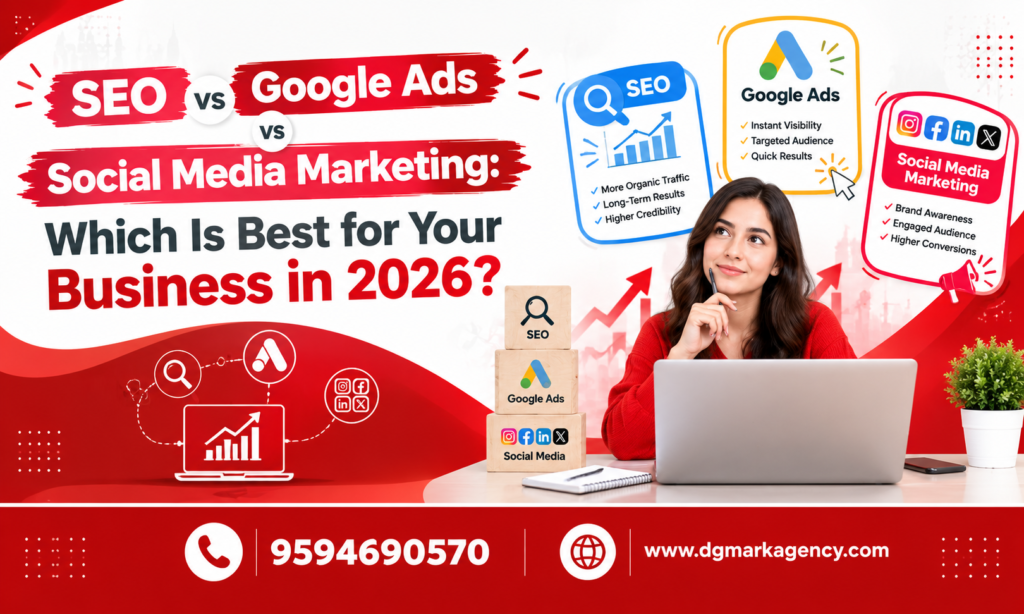
SEO, Google Ads, and social media marketing help businesses reach digital audiences, but each follows a different method of customer acquisition. SEO concentrates on improving website visibility within organic search results, Google Ads allows businesses to reach users through paid advertisements, and social media marketing focuses on creating brand familiarity through content and audience interaction. Understanding these differences helps companies make informed decisions instead of investing in marketing channels without clear expectations.
The key differences include:
- SEO: Improves organic search visibility through website optimization, relevant content, and technical improvements.
- Google Ads: Reaches users through paid advertising based on keywords, campaign settings, and audience signals.
- Social Media Marketing: Connects businesses with audiences through posts, videos, reels, and paid social campaigns.
- Customer Intent: Search users may already need a service, whereas social audiences may be discovering options.
- Traffic Generation: SEO attracts organic visits, Google Ads generates paid traffic, and social platforms support organic and paid reach.
- Performance Measurement: Success depends on qualified leads, conversions, audience engagement, and business outcomes.
While SEO and Google Ads often reach customers who are actively searching, social media can influence people before they develop a specific purchasing intention. Businesses should consider the complete customer journey when selecting their marketing channels. Understanding how audiences move from awareness to consideration and purchase helps create more effective strategies.
How Does SEO Help Businesses Grow Organically in 2026?
SEO remains an important digital marketing strategy for businesses looking to build relevant online visibility without paying for individual organic clicks. It focuses on making webpages useful, accessible, and relevant to customer searches. In 2026, effective optimization involves understanding search intent, improving technical website performance, and publishing accurate information that genuinely helps visitors make decisions.
Important SEO practices include:
- Search Intent Research: Identify whether users are looking for information, comparing options, or searching for services.
- Keyword Optimization: Use relevant phrases naturally in titles, headings, and website content.
- Technical Improvements: Maintain crawlability, indexing accessibility, mobile usability, and website performance.
- Content Quality: Publish informative blogs, service explanations, and useful industry resources.
- Local Search Visibility: Optimize business information and location-specific website content.
- Website Navigation: Create a logical structure that helps visitors find relevant information.
- Content Maintenance: Update outdated information and improve existing webpages.
- Performance Analysis: Measure organic enquiries, relevant traffic, and customer conversions.
SEO is especially useful when potential customers regularly search for particular products or services. Although meaningful organic growth often requires sustained effort, useful content can continue attracting relevant visitors over time. Businesses should prioritize content quality and accurate information rather than relying on repeated keywords or short-term ranking techniques.
How Do Google Ads Help Businesses Generate Leads and Sales?
Google Ads enables businesses to promote their offerings through targeted advertising across Google’s advertising platforms. Search advertising is particularly relevant when customers already know what they need and are actively comparing solutions. Businesses can create campaigns around relevant keywords, target geographical markets, and measure valuable actions such as enquiries, calls, and purchases.
A successful Google Ads strategy includes:
- Keyword Selection: Target relevant searches demonstrating commercial interest.
- Campaign Organization: Separate advertising groups according to services and objectives.
- Location Targeting: Reach customers within geographical areas the business serves.
- Advertisement Messaging: Communicate clear benefits and relevant information.
- Landing Page Relevance: Connect advertisements with appropriate website content.
- Conversion Tracking: Measure meaningful actions rather than only clicks.
- Campaign Optimization: Improve targeting, advertising assets, and performance.
- Lead Evaluation: Identify which campaigns attract potential customers with genuine requirements.
Google Ads can help businesses begin receiving targeted visits after campaign approval and activation. However, generating traffic does not automatically guarantee sales. Campaign performance depends on relevant customer demand, effective landing pages, competitive conditions, and the ability to convert incoming enquiries into customers.
How Does Social Media Marketing Help Businesses Build Brand Awareness and Engagement?
Social media marketing helps companies introduce their brands, demonstrate expertise, and maintain regular communication with audiences. Platforms such as Instagram, Facebook, LinkedIn, and YouTube allow businesses to communicate through different formats, including educational content, product demonstrations, videos, and interactive posts. Social media is especially valuable when customer trust and repeated exposure influence purchasing behaviour.
Effective social media marketing activities include:
- Audience Understanding: Identify suitable platforms and customer interests.
- Content Planning: Create a consistent publishing strategy around relevant topics.
- Brand Storytelling: Communicate business values, expertise, and distinctive offerings.
- Visual Content: Use creative graphics, carousels, reels, and informative videos.
- Community Engagement: Respond to relevant questions, comments, and messages.
- Social Advertising: Reach defined audiences through paid promotional campaigns.
- Customer Education: Explain products, services, and common industry concerns.
- Performance Monitoring: Evaluate engagement, enquiries, and meaningful conversions.
The effectiveness of social media marketing depends on content relevance rather than publishing frequency alone. Businesses should avoid evaluating success exclusively through follower counts or impressions. Meaningful customer conversations, website visits, and qualified enquiries provide stronger indications of how social media supports business objectives.
SEO vs Google Ads vs Social Media Marketing: Which Delivers Better Results?
Comparing these three channels requires understanding what businesses consider successful results. SEO supports organic visibility, Google Ads provides access to targeted paid audiences, and social media encourages brand discovery and engagement. Each channel performs differently depending on customer behaviour, marketing objectives, industry competition, and campaign implementation.
Comparison of SEO, Google Ads, and Social Media Marketing
| Comparison Factor | SEO | Google Ads | Social Media Marketing |
|---|---|---|---|
| Primary Objective | Organic visibility | Paid customer acquisition | Brand awareness and engagement |
| Initial Visibility | Generally gradual | Can begin quickly | Depends on content and promotion |
| Traffic Source | Organic search | Paid advertising | Organic and paid social |
| Audience Intent | Search-based | Often high-intent | Discovery and engagement |
| Investment Type | Optimization and content | Advertising and management | Content and optional advertising |
| Long-Term Value | Searchable website assets | Campaign data and conversions | Audience relationships |
| Main Challenge | Search competition | Advertising efficiency | Consistent engagement |
| Performance Metrics | Organic enquiries | Paid conversions | Engagement and leads |
Businesses should evaluate channels according to their actual commercial contribution. A campaign generating numerous impressions may provide awareness, but another campaign attracting fewer qualified customers could produce stronger sales outcomes. Measuring conversion quality, customer acquisition, and business revenue provides a more reliable basis for comparing marketing effectiveness.
Which Is Better for Small Businesses: SEO, Google Ads, or Social Media Marketing?
Small businesses generally need practical marketing strategies that balance customer acquisition with available resources. Unlike larger organizations, smaller companies may have limited capacity for advertising management, content production, and continuous platform monitoring. Selecting the right channel should therefore begin with understanding how prospective customers search for and evaluate the business.
Important selection factors include:
- Business Requirements: Determine whether the priority is awareness, enquiries, or sales.
- Customer Search Behaviour: Understand whether potential buyers actively search for services.
- Industry Competition: Evaluate the level of organic and paid marketing competition.
- Available Resources: Consider the time and expertise required for ongoing execution.
- Product Characteristics: Identify whether customers need demonstrations or detailed explanations.
- Buying Journey: Understand how long customers take to complete decisions.
- Website Quality: Ensure visitors receive clear information and convenient enquiry options.
- Growth Priorities: Balance immediate opportunities with longer-term visibility.
For example, a local service business may benefit from search-based marketing because customers often look for specific solutions. A lifestyle brand may generate interest through visual content, while a consultancy can use educational resources to demonstrate expertise. The best approach depends on customer expectations and the company’s ability to manage campaigns consistently.
Which Digital Marketing Channel Generates the Most Leads and Conversions?
Lead generation is an important objective for businesses, but the volume of enquiries does not always reflect marketing effectiveness. Qualified leads come from potential customers whose needs match the services offered and who demonstrate genuine interest. SEO, Google Ads, and social media marketing can all support lead generation when campaigns reach suitable audiences and provide clear conversion opportunities.
Key factors influencing lead generation include:
- Customer Intent: Identify whether users are exploring options or ready to make enquiries.
- Relevant Targeting: Focus campaigns on audiences matching business requirements.
- Landing Page Experience: Provide accurate information that reflects customer expectations.
- Trust Building: Present genuine company details, reviews, and relevant expertise.
- Conversion Opportunities: Make enquiry forms and contact options easy to access.
- Response Time: Address customer enquiries promptly and professionally.
- Lead Qualification: Evaluate whether enquiries have genuine purchasing potential.
- Performance Tracking: Identify which marketing channels contribute to completed sales.
A business comparing a digital marketing agency in Andheri may be looking for strategies that attract relevant enquiries through organic search and advertising. Similarly, an organization researching a digital marketing agency in Borivali may need support with location-specific customer acquisition. In both situations, the focus should remain on lead quality and conversion effectiveness rather than attracting unrelated website traffic.
Which Is More Cost-Effective: SEO, Google Ads, or Social Media Marketing?
Cost-effectiveness is determined by the relationship between marketing resources and the value generated. SEO requires investment in website optimization, content, and technical maintenance. Google Ads involves advertising expenditure alongside campaign management, while social media marketing requires creative development, publishing, and audience interaction. Businesses should compare complete operating requirements instead of assuming one channel is always more economical.
Factors affecting marketing efficiency include:
- SEO Resources: Content development, technical work, and performance monitoring.
- Advertising Resources: Campaign setup, management, and continuous optimization.
- Social Media Resources: Creative production, scheduling, and community management.
- Lead Quality: The relevance of prospective customers attracted.
- Conversion Performance: The proportion of enquiries becoming customers.
- Customer Retention: Opportunities for repeat purchases and ongoing relationships.
- Content Value: The continued usefulness of published marketing materials.
- Operational Efficiency: The ability to manage campaigns without unnecessary complexity.
A channel with relatively low operating requirements may still be ineffective if it produces irrelevant traffic. Conversely, a resource-intensive strategy may be worthwhile when it consistently generates valuable business opportunities. Companies should evaluate cost-effectiveness using actual customer acquisition results and long-term commercial value.
Which Digital Marketing Strategy Offers the Best ROI in 2026?
Return on Investment helps companies determine whether their digital marketing activities contribute sufficient financial value. However, accurate evaluation requires businesses to consider campaign costs, qualified enquiries, actual conversions, and customer revenue. SEO, Google Ads, and social media can influence purchasing decisions at different stages, making a balanced measurement approach important.
Useful performance indicators include:
- Qualified Leads: Enquiries from prospective customers with relevant requirements.
- Customer Acquisition Cost: Resources required to attract paying customers.
- Conversion Rate: The percentage of visitors completing desired actions.
- Revenue Contribution: Sales associated with marketing activities.
- Customer Lifetime Value: The potential value of ongoing customer relationships.
- Sales Cycle: The time required for prospects to become customers.
- Channel Attribution: How different marketing interactions contribute to purchases.
- Reporting Consistency: Reliable comparisons across appropriate periods.
SEO may generate continuing value through established content, while paid advertising can provide measurable acquisition opportunities. Social media can support brand recognition and influence purchasing decisions before users visit a website. Businesses should focus on their actual profitability rather than relying on universal claims about which channel provides the highest returns.
How Long Does It Take to See Results from SEO, Google Ads, and Social Media Marketing?
Digital marketing channels operate on different timelines because their underlying processes vary. SEO depends on website development, content relevance, search engine discovery, and competition. Paid advertising can produce initial visibility after activation, while social media marketing requires consistent audience communication and content development. Businesses should establish expectations based on realistic performance milestones.
Typical development stages include:
- SEO Preparation: Website audits, keyword research, and technical improvements.
- Organic Visibility: Gradual improvements in relevant search discovery.
- Content Performance: Increased engagement with useful website resources.
- Google Ads Launch: Initial advertising impressions and targeted visits.
- Campaign Learning: Testing advertisements, targeting, and landing pages.
- Social Media Development: Publishing consistent and audience-focused content.
- Audience Engagement: Building interactions and brand familiarity.
- Conversion Improvement: Refining customer journeys based on behaviour and results.
Meaningful organic search growth often takes several months, although there is no universal timeline. Google Ads may provide visibility sooner, but reliable lead quality requires optimization. Social media success also varies according to audience relevance and consistency. Companies should assess progress using qualified traffic, enquiries, and sales rather than expecting guaranteed outcomes.
Is SEO Better Than Google Ads for Long-Term Business Growth?
SEO offers opportunities to develop website assets that can remain useful over time, while Google Ads provides targeted advertising visibility when businesses choose to run campaigns. Both strategies can contribute to long-term growth, but their roles differ. SEO supports organic discovery and customer education, whereas paid advertising offers greater control over campaign targeting and promotional activity.
Important long-term considerations include:
- Owned Website Content: Create useful resources that remain accessible to customers.
- Search Relevance: Improve visibility for recurring customer requirements.
- Technical Quality: Strengthen website accessibility and navigation.
- Customer Education: Explain services through helpful and accurate content.
- Advertising Flexibility: Support launches and selected promotional activities.
- Performance Insights: Use advertising data to understand customer interest.
- Strategic Balance: Combine organic development with selective paid acquisition.
Businesses should remember that SEO rankings can fluctuate and require maintenance. Google Ads can remain useful even when organic search performance is strong, particularly for competitive services or newly introduced offerings. Long-term growth often benefits from using both channels according to measurable demand.
Are Google Ads Worth It for Small Businesses in 2026?
Google Ads can be valuable for small businesses when campaigns address existing customer demand and support clear acquisition objectives. Search advertising is particularly relevant when prospective customers actively compare services or require immediate solutions. However, successful results depend on targeting, campaign quality, website experience, and customer follow-up.
Before launching advertising campaigns, businesses should review:
- Market Demand: Confirm that customers actively search for the offering.
- Keyword Relevance: Select terms connected with meaningful commercial intent.
- Geographical Coverage: Advertise in areas the company can genuinely serve.
- Advertisement Accuracy: Communicate services and benefits clearly.
- Landing Page Quality: Ensure website content matches the advertising message.
- Conversion Measurement: Track relevant forms, calls, and customer actions.
- Lead Handling: Prepare a reliable process for responding to enquiries.
- Campaign Optimization: Review performance and adjust targeting appropriately.
A business working with a digital marketing agency in Andheri may use targeted advertising to reach nearby customers searching for specific services. Likewise, companies considering a digital marketing agency in Borivali may need campaigns focused on their relevant local markets. Advertising effectiveness ultimately depends on customer requirements, not simply geographical keyword targeting.
Which Digital Marketing Strategy Is Best for Startups and New Businesses?
Startups face the challenge of building recognition while developing reliable methods of acquiring customers. Unlike established brands, new businesses may lack historical marketing data, strong organic visibility, and established audience relationships. Their marketing strategy should therefore support market understanding, customer discovery, and gradual expansion.
Important startup marketing priorities include:
- Customer Research: Identify audience requirements and purchasing motivations.
- Brand Positioning: Communicate the value of products and services clearly.
- Website Development: Establish a professional and accessible online presence.
- Foundational SEO: Optimize important pages for relevant customer searches.
- Focused Paid Campaigns: Test demand through targeted advertising where appropriate.
- Social Media Presence: Build credibility through consistent and useful communication.
- Content Development: Answer questions that prospective customers commonly ask.
- Performance Evaluation: Improve activities based on genuine customer responses.
An effective startup strategy begins with a clear understanding of the audience and the company’s ability to deliver its offerings. Search optimization can support future visibility, advertising can test immediate demand, and social media can introduce the brand. Businesses should expand campaigns based on meaningful results rather than spreading resources across every platform immediately.
Which Marketing Channel Works Best for Local Businesses in Mumbai?
Local businesses in Mumbai must compete for attention in markets where customer preferences, service availability, and geographical convenience influence decisions. A local marketing strategy should help potential customers find accurate business information, understand available services, and contact suitable providers. SEO, Google Ads, and social media marketing can support these objectives in different ways.
Important local marketing activities include:
- Google Business Profile Management: Maintain accurate business information and service details.
- Location-Relevant Content: Explain services offered within genuine geographical markets.
- Local Search Research: Identify queries reflecting nearby customer requirements.
- Geographical Advertising: Reach customers within selected service locations.
- Mobile Optimization: Make contact information easy to access from smartphones.
- Review Management: Encourage genuine customer feedback and professional responses.
- Community Content: Publish information relevant to the local audience.
- Conversion Tracking: Measure calls, enquiries, and other useful customer actions.
For instance, businesses comparing a digital marketing agency in Andheri may prioritize visibility within active commercial areas and surrounding neighbourhoods. Organizations evaluating a digital marketing agency in Borivali may focus on reaching customers across relevant residential and business locations. Effective local marketing should reflect actual service coverage rather than targeting unrelated areas solely to attract traffic.
Should Businesses Use SEO, Google Ads, and Social Media Marketing Together?
Using multiple marketing channels can help businesses reach customers throughout their decision-making process. SEO supports organic discovery, Google Ads connects with targeted search demand, and social media marketing develops audience familiarity. When these activities share consistent objectives, they can create a coordinated digital presence instead of functioning as unrelated campaigns.
Advantages of integrated digital marketing include:
- Broader Customer Discovery: Reach relevant users across search and social platforms.
- Consistent Brand Messaging: Maintain clear communication throughout the customer journey.
- Audience Education: Explain business offerings through different content formats.
- Targeted Acquisition: Use advertising to reach customers with defined requirements.
- Remarketing Opportunities: Reconnect with eligible audiences who previously interacted.
- Better Customer Understanding: Compare engagement and enquiry patterns across channels.
- Coordinated Campaigns: Align landing pages, advertising messages, and social content.
- Performance Measurement: Evaluate results against shared commercial objectives.
Integration does not require equal investment in every channel. Businesses can prioritize one strategy initially and add complementary activities as opportunities become clear. The main advantage of coordination is creating a consistent experience that helps customers move from discovering a business to making an informed decision.
How Is AI Changing SEO, Google Ads, and Social Media Marketing in 2026?
Artificial Intelligence is influencing how customers discover information and how companies manage digital campaigns. Search experiences increasingly include conversational interfaces and AI-generated information, while advertising platforms use automated systems to assist with optimization. Social media teams also use AI-supported tools for research, creative planning, and performance analysis.
Important developments affecting digital marketing include:
- AI-Assisted Search: Customers can discover information through conversational search experiences.
- Clear Content Structure: Accurate explanations and descriptive headings improve understanding.
- Search Experience Optimization: Useful information supports discoverability across different search formats.
- Automated Advertising: Machine learning assists bidding and campaign performance decisions.
- Creative Development: AI tools can support content ideas and initial drafts.
- Audience Insights: Automated analysis can identify useful engagement patterns.
- Marketing Reporting: AI-supported tools help interpret campaign information.
- Human Quality Control: Editorial review maintains accuracy, originality, and brand relevance.
Where appropriate, businesses can apply SEO, AEO, GEO, and AI-focused content principles to make information easier to access and interpret. However, technical optimization should support genuine user needs rather than encourage repetitive content. Businesses that combine useful technology with informed human judgment can build more adaptable digital marketing strategies.
How Can Businesses Choose the Right Digital Marketing Services for Their Goals?
Selecting digital marketing services should begin with defining what the business wants to achieve and understanding how customers make decisions. Different industries require different approaches because search demand, competition, and purchasing processes vary. A structured evaluation helps companies invest in channels that match their objectives and available capabilities.
Businesses should follow these steps:
- Define Priorities: Identify whether the goal is leads, sales, awareness, or customer retention.
- Understand Customers: Research search behaviour, interests, and purchasing needs.
- Evaluate Existing Performance: Review website visibility and current marketing results.
- Analyze Competitors: Understand how comparable businesses attract customers.
- Select Relevant Channels: Match marketing strategies to customer intent.
- Set Performance Indicators: Measure meaningful enquiries and conversion outcomes.
- Review Agency Capabilities: Evaluate experience, processes, and communication.
- Optimize Regularly: Improve marketing activities using reliable performance information.
Companies looking for a digital marketing agency in Andheri should consider its ability to understand customer behaviour and develop practical acquisition strategies. Similarly, organizations researching a digital marketing agency in Borivali should assess the relevance of proposed services, reporting methods, and local market understanding. Choosing an agency should be based on strategic suitability rather than location keywords alone.
Why Choose DGmark Agency for Digital Marketing Services in Mumbai?
DGmark Agency provides digital marketing solutions for businesses seeking greater online visibility, customer engagement, and lead-generation opportunities. As a digital marketing company in Mumbai, the agency offers services covering SEO, Google Ads, social media marketing, website development, and related digital marketing activities. Its integrated service offering allows businesses to evaluate different channels within a structured marketing approach.
DGmark Agency’s Digital Marketing Services
- SEO Services: Website optimization, relevant content, and organic search visibility.
- Google Ads Management: Targeted paid advertising and campaign optimization.
- Social Media Marketing: Content development and audience engagement.
- Paid Social Campaigns: Advertising strategies for suitable audience segments.
- Website Development: Responsive websites with clear navigation and service information.
- Local SEO: Improvements supporting relevant geographical searches.
- Content Marketing: Informative resources addressing customer requirements.
- Digital Marketing Planning: Coordinating channels according to business priorities.
Businesses searching for a digital marketing agency in Andheri can consider DGmark Agency services for developing coordinated online marketing activities. Companies comparing a digital marketing agency in Borivali can also evaluate its approach to local visibility and targeted customer acquisition.
A Business-Focused Marketing Approach
A structured marketing process should include:
- Understanding customer requirements.
- Evaluating the existing digital presence.
- Identifying relevant marketing opportunities.
- Selecting suitable online channels.
- Developing useful content and campaigns.
- Monitoring performance indicators.
- Improving activities based on measurable outcomes.
For companies considering a digital marketing agency in Andheri or a digital marketing agency in Borivali, DGmark Agency offers a range of digital marketing services that can support search visibility, paid acquisition, and brand communication. Businesses should select the services that match their goals rather than assuming every marketing channel is equally necessary.
Frequently Asked Questions (FAQs)
1. Is SEO Better Than Google Ads for Business Growth in 2026?
SEO is useful for developing organic visibility through relevant website content, while Google Ads provides paid opportunities to reach customers searching for particular services. The better option depends on business objectives, competition, and available marketing resources.
2. Can Google Ads Generate Leads Faster Than Organic SEO?
Google Ads can begin bringing targeted visitors after campaign approval and activation. SEO usually requires ongoing optimization before significant organic improvements become visible. However, lead quality and profitability depend on campaign relevance and website conversion performance.
3. Which Is More Effective: Social Media Marketing or Google Ads?
Social media marketing can be effective for brand awareness, audience discovery, and engagement. Google Ads can be useful for capturing existing search demand. Businesses should evaluate their customers’ purchasing behaviour before selecting either channel.
4. Can Businesses Generate Leads Without Paid Advertising?
Yes. Useful website content, organic search visibility, customer referrals, and social media engagement can produce business enquiries. However, these activities still require resources, expertise, and consistent execution.
5. Is SEO Still Important for Businesses Using AI Search?
Yes. Relevant content, technically accessible websites, and accurate business information remain important. AI-assisted search introduces additional discovery experiences, but strong website foundations continue to support online visibility.
6. Which Digital Marketing Channel Works Best for B2B Companies?
B2B companies often benefit from informative SEO content, high-intent search advertising, and professional platforms such as LinkedIn. The most suitable combination depends on industry requirements and the purchasing behaviour of decision-makers.
7. Should Small Businesses Invest in All Three Marketing Channels?
Not necessarily. Small businesses should prioritize channels that match customer demand and available resources. Additional marketing activities can be introduced when existing campaigns demonstrate useful results.
8. How Can Businesses Measure Digital Marketing Success?
Businesses should track qualified leads, conversion rates, customer acquisition costs, revenue contribution, and relevant customer engagement. These indicators provide a stronger picture of performance than website traffic or impressions alone.
9. Why Is Local SEO Important for Businesses in Mumbai?
Local SEO helps businesses improve discoverability for relevant geographical searches. Accurate business details, useful local content, and genuine customer reviews can support local search visibility and help customers evaluate suitable providers.
10. How Do You Choose the Right Digital Marketing Company in Mumbai?
Evaluate the company’s relevant expertise, available services, communication, strategy development, and reporting practices. A suitable marketing partner should understand business objectives and explain how proposed activities contribute to measurable outcomes.
Conclusion
SEO, Google Ads, and social media marketing each offer valuable opportunities for businesses seeking stronger digital visibility and customer acquisition in 2026. SEO supports organic discovery through useful website content and technical optimization, Google Ads creates targeted advertising opportunities, and social media marketing encourages audience engagement and brand familiarity. The most effective approach depends on customer requirements, competition, available resources, and measurable business objectives. Companies should evaluate each channel according to the quality of visitors, enquiries, and customers it attracts rather than focusing exclusively on popularity or reach.
DGmark Agency provides digital marketing services that support businesses through search optimization, paid advertising, social media marketing, website development, and integrated planning. By understanding audience behaviour, choosing relevant marketing channels, and reviewing campaign performance consistently, businesses can strengthen their online presence and develop more effective customer acquisition strategies. A well-balanced digital marketing approach can support sustainable business development while helping companies adapt to changing digital opportunities in 2026 and beyond.
Contact DGmark Agency Today!
DGmark Agency – Best Digital Marketing Agency in Andheri, Mumbai
Address– 405, 4th Floor, Pratik, Ratan Nagar Apartment-B Wing, Bus Stop, Near, Apna Bazar Rd, opp. Dhake Colony, D.N.Nagar, Andheri West, Mumbai, Maharashtra 400053
Phone no. – 9594690570
Website: https://dgmarkagency.com/