Introduction
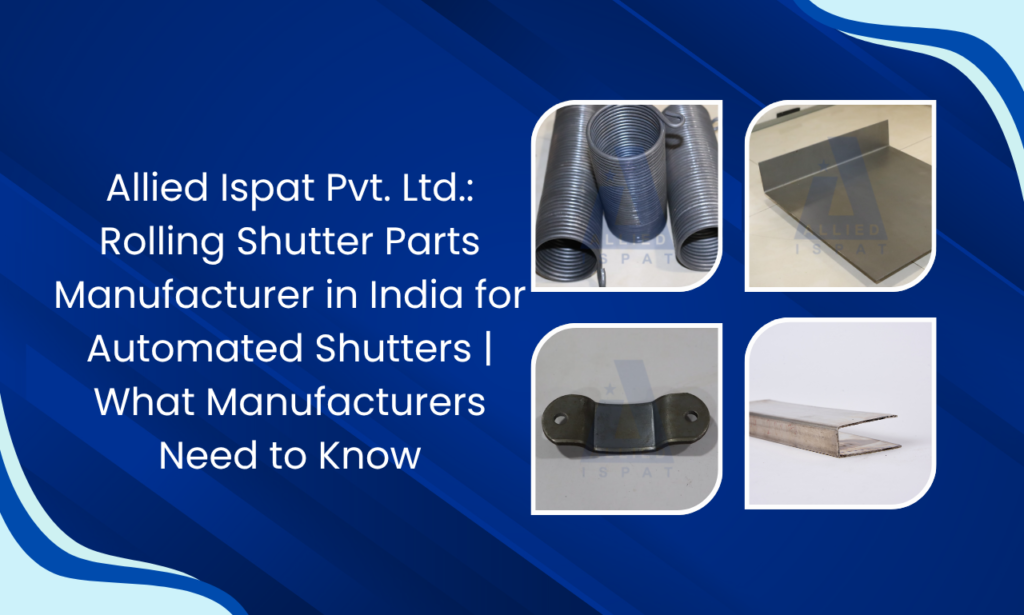
Allied Ispat Pvt. Ltd. supports rolling shutter manufacturers, fabricators, contractors and industrial procurement teams with steel components required for organised shutter production and assembly. As a Rolling Shutter Parts Manufacturer in India, the company provides components such as guide channels, bottom sections, springs, brackets, coils and related fittings for different rolling shutter manufacturing requirements.
The shift from manually operated shutters to automated systems has created new considerations for manufacturers. A motor may automate the opening and closing process, but automation does not reduce the importance of the shutter’s mechanical components. Instead, it makes coordination between the curtain, guides, brackets, supporting parts and operating mechanism increasingly important. Each component has to fit into the overall design so that the complete shutter can be fabricated and installed according to its intended configuration.
For manufacturers, this means rolling shutter component selection should begin before production reaches the assembly stage. Material type, component profile, dimensions, operating method, site conditions and fabrication requirements should all be reviewed while developing the shutter specification. This is particularly important when the same shutter design is produced repeatedly for commercial or industrial projects.
Businesses evaluating a Rolling Shutter Parts Manufacturer in Mumbai or a Rolling Shutter Parts Supplier in India should therefore look beyond basic product availability. A B2B sourcing decision should consider whether the required components can be clearly specified, incorporated into production planning and supplied according to the manufacturer’s actual fabrication requirements.
This guide explains the important rolling shutter parts used in automated systems, how materials and dimensions affect component selection, what changes when shutters are motorised, and what manufacturers and procurement teams should check before sourcing components.
1. Understanding the Core Parts Behind an Automated Rolling Shutter
An automated rolling shutter is made up of several interconnected mechanical and operating elements. Although the motor and control system attract significant attention, steel components form the physical structure through which the shutter operates.
Understanding the function of each component helps manufacturers develop more accurate specifications before purchasing begins.
Guide Channels Keep the Curtain on Its Intended Path
Guide channels are positioned vertically on both sides of the shutter opening. They provide a defined path for the shutter curtain as it moves upward and downward.
Manufacturers should evaluate guide channels based on:
- Profile dimensions
- Material requirement
- Compatibility with the curtain
- Shutter configuration
- Installation arrangement
For automated systems, appropriate guide selection becomes particularly important because the curtain is repeatedly driven through the same path by the operating mechanism.
The profile should therefore correspond with the shutter design rather than being selected as a generic component.
Bottom Sections Complete the Lower Curtain Assembly
The bottom section forms the lower end of the rolling shutter curtain. Its profile needs to integrate with the curtain configuration and closing arrangement.
Important considerations include:
- Required section profile
- Overall dimensions
- Material
- Curtain compatibility
- Associated fittings
For manufacturers handling repeat orders, defining the bottom section according to a drawing or component code can simplify identification during fabrication.
Brackets Provide Mechanical Support
Brackets form part of the supporting arrangement of a rolling shutter system. Their dimensions, material and mounting configuration should correspond with the mechanical design.
When ordering brackets, manufacturers should provide sufficient information about the intended configuration, particularly when standard dimensions are not suitable.
Springs Support the Mechanical Arrangement
Springs are used according to the operating design of the rolling shutter. Their selection requires an understanding of the shutter configuration and mechanical requirements.
Manufacturers should not treat springs as interchangeable accessories. The appropriate specification should be established by the relevant technical team according to the complete shutter design.
Coils and Fittings Complete the Component Requirement
Depending on the shutter configuration, manufacturers may also require coils and other related fittings.
Although some fittings are relatively small compared with the main shutter profiles, missing components can interrupt production or installation. A complete component requirement should therefore be prepared before procurement.
For businesses working with a Rolling Shutter Parts Supplier in Mumbai, sharing the full requirement can create a more organised sourcing process.
2. Choosing Rolling Shutter Parts According to the Application
One of the most important principles in industrial component sourcing is that the application should guide the specification. A rolling shutter installed at a warehouse may have different requirements from one used for a retail entrance, factory, workshop or commercial building.
Instead of starting with a product catalogue, manufacturers should first understand the shutter application.
Consider the Size of the Opening
Opening dimensions influence the overall shutter configuration.
Manufacturers should establish the required width and height before finalising component specifications. This information becomes part of the broader engineering process used to determine the shutter arrangement.
Understand How the Shutter Will Be Operated
Manufacturers need to establish whether the shutter will be:
- Manually operated
- Mechanically assisted
- Motorised
- Integrated with an automated control arrangement
The operating method can influence how the overall shutter system is designed.
Evaluate the Installation Environment
The environment in which the shutter will be installed can influence material and finishing decisions.
Manufacturers should consider:
- Indoor or outdoor placement
- Exposure conditions
- Commercial or industrial application
- Surrounding construction
- Project specifications
These considerations can help guide material selection.
Determine Expected Usage
Some rolling shutters may be operated only a few times during a normal working day, while others may be part of more active commercial or industrial environments.
Frequency of use should be considered during overall shutter design and operating system selection.
Match Components to the Complete Shutter
Manufacturers should avoid selecting guide channels, brackets, bottom sections and other components independently.
Each part should correspond with the overall shutter configuration.
This system based approach can help procurement teams communicate more meaningful requirements to a Rolling Shutter Parts Manufacturer in India.
3. GI, CR and HR Steel: Understanding Material Selection for Rolling Shutter Parts
Steel selection influences forming, fabrication, surface characteristics and suitability for the intended application. GI, CR and HR materials can be used across different steel manufacturing requirements, but the appropriate choice depends on what the component needs to do.
Manufacturers should therefore avoid treating material selection as a simple comparison of price.
GI Steel and Corrosion Considerations
GI steel has a zinc based coating that provides additional corrosion protection under suitable conditions.
For rolling shutter components, GI may be considered where environmental exposure and corrosion resistance are relevant to the specification.
Before selecting GI, evaluate:
- Installation conditions
- Component function
- Required profile
- Fabrication method
- Project specification
The presence of a protective coating does not remove the need to evaluate dimensions and manufacturing requirements.
CR Steel and Forming Requirements
Cold rolled steel is widely used for manufacturing applications where surface characteristics, forming behaviour and dimensional requirements can be important.
For rolling shutter components, manufacturers should consider how the material will move through forming, cutting and fabrication processes.
The appropriate grade and specification should be determined according to the intended component requirement.
HR Steel and Fabrication Applications
Hot rolled steel may be appropriate for selected fabrication requirements depending on the shutter component and design.
The final material decision should follow the manufacturer’s technical specification and intended use.
Choose Material Based on Function
Before confirming a material, manufacturers should ask:
- What function will the component perform?
- What profile needs to be manufactured?
- Where will the shutter be installed?
- What fabrication process is planned?
- Does the project have a specified material requirement?
This approach provides a more practical basis for procurement.
Do Not Separate Material From Component Design
Ordering the correct material is only one part of the requirement.
The material still needs to be formed or fabricated into the correct component geometry. Procurement enquiries should therefore include both material information and component specifications.
A Rolling Shutter Parts Manufacturer in Mumbai can evaluate an enquiry more effectively when these details are clearly communicated.
4. Why Profile Dimensions and Consistency Matter in Automated Shutters
Automated shutters repeatedly follow a defined mechanical movement. This makes component dimensions and assembly alignment important considerations during manufacturing and installation.
For B2B manufacturers, consistency also has a direct connection with production efficiency.
Guide Profiles Need to Match the Curtain
The guide channel and curtain are mechanically related.
If the guide profile does not correspond with the intended shutter configuration, additional adjustments may be required during fabrication or installation.
Manufacturers should define the required profile rather than relying only on generic product descriptions.
Bottom Sections Should Follow a Defined Specification
The bottom section should be identified according to the shutter design.
For recurring manufacturing, businesses can maintain:
- Component codes
- Approved drawings
- Material specifications
- Profile dimensions
- Application references
This makes repeat purchasing easier to control.
Bracket Dimensions Should Match the Assembly
Brackets need to correspond with the mounting arrangement and supporting components.
Where brackets are customised, drawings should indicate the required geometry and other relevant dimensions.
Consistency Supports Repeated Production
Manufacturers producing multiple shutters with the same design benefit from repeatable component specifications.
Consistent inputs can help production teams plan:
- Cutting
- Fabrication
- Assembly
- Inventory
- Installation preparation
This becomes more valuable as production volumes increase.
Drawings Create a Shared Technical Reference
A technical drawing allows procurement teams, production staff and suppliers to refer to the same component definition.
Drawings are particularly useful for custom profiles and recurring components.
For a Rolling Shutter Parts Supplier in India, clearly documented requirements also reduce dependence on assumptions during quotation and order discussions.
5. Automated vs Manual Rolling Shutters: What Manufacturers Need to Reconsider
Automating a rolling shutter changes how movement is generated, but many of the fundamental mechanical components remain part of the system.
The key difference is that manufacturers need to consider how those components interact with the automated operating arrangement.
Automation Should Begin at the Design Stage
A manufacturer planning to produce an automated shutter should consider motorisation while defining the complete system.
Waiting until the shutter has already been fabricated can make integration more complicated.
The design stage should consider:
- Shutter dimensions
- Curtain configuration
- Guide arrangement
- Supporting structure
- Operating mechanism
- Installation conditions
This allows the mechanical and automated elements to be evaluated together.
Motor Selection Does Not Replace Mechanical Accuracy
A motor can generate movement, but it cannot correct unsuitable component dimensions or poor installation alignment.
The curtain still needs to travel through its intended path.
For this reason, automated shutter manufacturing requires attention to both the drive system and the surrounding mechanical structure.
Repeated Movement Highlights Component Compatibility
An automated shutter may open and close repeatedly throughout its operating cycle.
The components should therefore be selected according to the shutter design and installed in the intended configuration.
Supporting Components Remain Important
Brackets, guides, bottom sections and other fittings may not contain electronic technology, but they remain fundamental to the shutter assembly.
Automation should not lead manufacturers to focus only on motors, switches and controls while overlooking the steel components.
Maintenance Should Be Considered During Design
Commercial and industrial shutters require appropriate inspection and maintenance according to their system and usage.
Manufacturers should design the shutter so relevant components can be accessed by qualified personnel where maintenance is required.
This creates a more complete approach to automated shutter manufacturing.
6. What Procurement Teams Should Ask Before Ordering Rolling Shutter Parts
Industrial purchasing works best when technical information is available before quotation requests are issued.
An enquiry such as “send your best price for rolling shutter parts” may begin a conversation, but it does not provide enough information for a detailed manufacturing requirement.
B2B buyers should develop a more structured enquiry.
What Component Is Required?
Identify whether the requirement is for:
- Guide channels
- Bottom sections
- Brackets
- Springs
- Coils
- Fittings
- Multiple rolling shutter components
A clear component list helps establish the scope of the enquiry.
Which Material Is Required?
Mention the required material wherever it has already been specified.
If the engineering team requires GI, CR, HR or another specification, that information should be included in the enquiry.
What Dimensions Are Needed?
Profiles should be supported with the relevant dimensions.
For custom components, technical drawings or approved samples may provide better clarity.
What Quantity Is Required?
Manufacturers should distinguish between:
- Trial requirements
- Project orders
- Regular production quantities
- Repeat orders
- Forecasted requirements
This helps procurement discussions reflect actual manufacturing needs.
Is the Requirement Standard or Custom?
Custom components should be identified early.
The buyer should share drawings, dimensions or samples and confirm feasibility before assuming that the requirement can be manufactured.
How Should the Supplier Be Evaluated?
Price is important, but procurement teams should also assess:
- Product capability
- Steel processing knowledge
- Ability to understand specifications
- Communication
- Manufacturing relevance
- Support for repeat requirements
When evaluating a Rolling Shutter Parts Manufacturer in India, these factors can be particularly useful for manufacturers seeking an ongoing B2B sourcing relationship.
7. How Better Component Sourcing Can Support Rolling Shutter Production
For a rolling shutter manufacturer, purchasing is connected directly with the factory floor. A delay, specification mismatch or incorrectly identified component can affect fabrication schedules.
Developing a structured sourcing system can therefore support more organised production.
Standardise Frequently Used Components
Manufacturers can establish specifications for commonly used parts.
A component master can contain:
- Internal component code
- Product description
- Material
- Dimensions
- Drawing reference
- Shutter application
This makes communication more consistent across purchasing, stores and production.
Separate Custom Projects From Standard Production
Custom shutter projects should have their own component references.
This can reduce the possibility of special profiles being mixed with regular production inventory.
Link Purchasing With Production Planning
Procurement teams should have visibility into upcoming manufacturing requirements.
If production plans indicate the number and type of shutters scheduled, purchasing teams can identify component requirements earlier.
Monitor Component Inventory
Holding excessive stock can affect working capital, while insufficient stock can interrupt manufacturing.
A structured inventory system helps businesses understand which rolling shutter components are regularly consumed and which are project specific.
Improve Repeat Order Communication
When a component has already been approved, future orders should reference the same specification or drawing unless a revision is required.
If a change is made, the revised requirement should be clearly communicated.
This reduces ambiguity between buyer and supplier.
Build Supplier Relationships Around Specifications
A professional supplier relationship should be based on clear technical and commercial communication.
Instead of renegotiating the definition of the product for every order, manufacturers can establish standard references for recurring requirements.
A Rolling Shutter Parts Supplier in Mumbai can become more effectively integrated into the sourcing process when the buyer maintains organised component specifications.
8. Allied Ispat Pvt. Ltd. for Rolling Shutter Parts and B2B Manufacturing Requirements
Manufacturers and fabricators require suppliers that understand industrial steel components in the context of production. The discussion needs to go beyond the name of the component and include its material, dimensions, profile, quantity and intended application.
Allied Ispat Pvt. Ltd. works with steel based manufacturing requirements and provides rolling shutter components for manufacturers, fabricators and other B2B buyers.
Rolling Shutter Component Requirements
Allied Ispat Pvt. Ltd. supports requirements involving components such as:
- Guide channels
- Bottom sections
- Springs
- Brackets
- Coils
- Related fittings
The exact requirement can be discussed according to the manufacturer’s shutter configuration.
Broader Steel Manufacturing Focus
In addition to rolling shutter components, Allied Ispat Pvt. Ltd. operates across steel related product categories including roll forming machines, trading coils and POP or false ceiling profiles.
This industrial focus is relevant for customers who need to discuss steel components from a manufacturing and fabrication perspective.
Specification Based Discussions
Manufacturers can share dimensions, drawings, material requirements, quantities and application information when discussing their component needs.
Where customised requirements are involved, feasibility should be evaluated before production is finalised.
Presence in Mumbai and Taloja
For businesses looking for a Rolling Shutter Parts Manufacturer in Mumbai, Allied Ispat Pvt. Ltd. has a business presence in Mumbai Central and works in Taloja.
This is relevant to customers operating across Mumbai, Navi Mumbai, Taloja and surrounding industrial regions.
B2B Sourcing for Manufacturers and Fabricators
Rolling shutter manufacturers need components that can become part of their production process.
A structured supplier discussion can cover:
- Required component
- Material specification
- Profile dimensions
- Quantity
- Application
- Repeat requirements
For manufacturers seeking a Rolling Shutter Parts Manufacturer in India, Allied Ispat Pvt. Ltd. provides a platform for discussing these requirements as part of a broader steel manufacturing and supply relationship.
Frequently Asked Questions
1. What are the main parts of a rolling shutter?
The main rolling shutter parts include guide channels, bottom sections, springs, brackets, coils and related fittings. Allied Ispat Pvt. Ltd. supplies rolling shutter components for manufacturers, fabricators and industrial buyers.
2. Which material is best for rolling shutter parts?
GI, CR and HR steel can be considered depending on the component, fabrication requirement and installation environment. Allied Ispat Pvt. Ltd. supports different steel based rolling shutter component requirements.
3. What parts are required for an automatic rolling shutter?
Automatic rolling shutters typically require the shutter curtain, guide channels, bottom sections, brackets, springs and related fittings along with a suitable motor and control system. Allied Ispat Pvt. Ltd. supplies key steel components used in shutter manufacturing.
4. How do I choose the right rolling shutter parts?
Consider the shutter size, material, component dimensions, profile, operating method and installation requirements. Allied Ispat Pvt. Ltd. works with B2B buyers to understand their rolling shutter component specifications.
5. Why are guide channels important in rolling shutters?
Guide channels provide the path along which the shutter curtain moves during opening and closing. Allied Ispat Pvt. Ltd. supplies rolling shutter guide channel requirements for manufacturers and fabricators.
6. Can rolling shutter parts be customized?
Rolling shutter components may require different profiles and dimensions depending on the shutter design. Buyers can share drawings, samples and specifications with Allied Ispat Pvt. Ltd. to discuss suitable requirements.
7. What is the difference between manual and automatic rolling shutters?
Manual shutters depend on manual or mechanically assisted operation, while automatic shutters use a motor and control system. Allied Ispat Pvt. Ltd. supplies steel rolling shutter components that can form part of different shutter configurations.
8. Where can I buy rolling shutter parts in India?
Industrial buyers should choose a supplier based on component range, material capability, manufacturing knowledge and specification support. Allied Ispat Pvt. Ltd. serves B2B buyers looking for rolling shutter parts in India.
9. How do I choose a Rolling Shutter Parts Manufacturer in India?
Check the manufacturer’s product range, steel processing capability, dimensional requirements and ability to support recurring B2B orders. Allied Ispat Pvt. Ltd. supplies rolling shutter components for manufacturing and fabrication requirements.
10. Where can I find a Rolling Shutter Parts Manufacturer in Mumbai?
Manufacturers and fabricators can source rolling shutter components from Allied Ispat Pvt. Ltd., with a presence in Mumbai and works in Taloja. Buyers can discuss material, profile, dimensions, quantity and application requirements with the company.
Conclusion
The transition toward automated rolling shutters is making component selection a more integrated part of shutter design and manufacturing. Motors and controls may provide automated operation, but guide channels, bottom sections, brackets, springs, coils and fittings continue to form the mechanical foundation of the shutter. Their material, dimensions, geometry and compatibility should therefore be evaluated together. For manufacturers, establishing specifications before procurement can also improve communication between engineering, purchasing, stores, fabrication and installation teams.
Allied Ispat Pvt. Ltd. supports B2B buyers looking for a Rolling Shutter Parts Manufacturer in India and Rolling Shutter Parts Supplier in India for their shutter manufacturing requirements. Manufacturers and fabricators can discuss their component requirements based on material, profile, dimensions, quantity and application. By approaching rolling shutter parts as production components rather than isolated accessories, businesses can build a more organised sourcing process for both manual and automated shutter manufacturing.
Contact Allied Ispat Pvt. Ltd.
Allied Ispat Mumbai Central
Address: Shop 69, Maulana Shaukat Ali Road, Chhota Sonapur, Siddharth Nagar, Mumbai Central, Mumbai, Maharashtra 400008
Phone: 098211 77009
Get Directions: https://maps.app.goo.gl/gyEqxBGcw9jLsYm26
Allied Ispat Works:
Plot no. C-17 9, MIDC Road behind Bank of Baroda Bank Taloja Panvel, Maharashtra 410208 India
Get Directions: https://maps.app.goo.gl/6ujLCuHpQLu1Uy3r8
Phone: 087790 51606
Email: info@alliedispatindia.com | sales@alliedispatindia.com
Website: www.alliedispatindia.com
Manufacturers, fabricators, contractors and industrial procurement teams can contact Allied Ispat Pvt. Ltd. with their rolling shutter component requirements, including material preferences, dimensions, drawings, quantities and application details.
