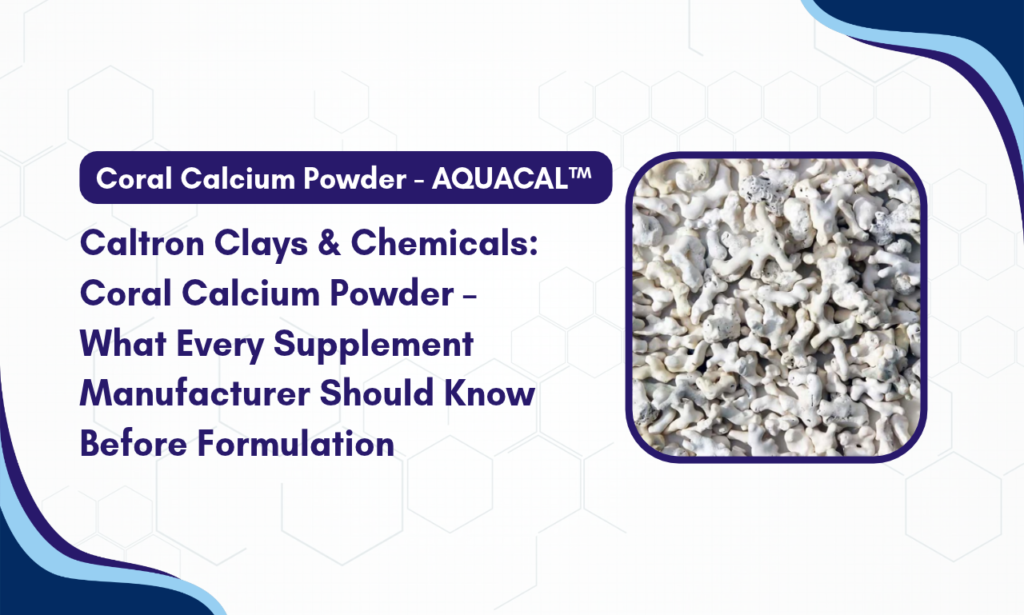
Introduction: Choosing the Right Calcium Source Is the First Step Towards Supplement Innovation
The quality of a calcium supplement is determined long before it reaches the market. Every decision, from raw material selection and nutritional composition to manufacturing processes and quality assurance, contributes to the consistency and commercial success of the finished product.
As the nutraceutical industry continues to explore naturally sourced mineral ingredients, manufacturers are looking beyond conventional calcium sources to develop differentiated nutritional products. Coral Calcium Powder offers a distinctive marine-derived ingredient option, combining a calcium carbonate-rich composition with naturally occurring associated minerals.
Caltron Clays & Chemicals, a trusted Coral Calcium Powder Manufacturer in India, offers AQUACAL™, a naturally derived marine calcium ingredient for pharmaceutical and nutraceutical applications. Sourced from suitable dead coral deposits, AQUACAL™ features a reported calcium carbonate assay of 99.5% and a naturally occurring profile of 74 minerals, as described in the company’s product literature.
As an established Coral Calcium Powder Supplier in India, Caltron Clays & Chemicals focuses on quality-oriented processing and B2B raw material sourcing. Through AQUACAL™, the company offers manufacturers opportunities to explore marine-derived calcium ingredients for modern supplement development.
However, developing a commercially viable calcium supplement requires more than selecting a naturally sourced ingredient. Manufacturers must understand elemental calcium concentration, ingredient purity, powder characteristics, formulation compatibility, quality documentation, and regulatory requirements.
This comprehensive guide explores the essential technical, nutritional, manufacturing, and procurement considerations that pharmaceutical and nutraceutical businesses should evaluate before selecting Coral Calcium Powder.
1. Understanding Coral Calcium Powder and Its Role in Nutraceutical Innovation
The growing interest in natural-origin nutritional products is creating opportunities for manufacturers to explore alternative mineral ingredients. Coral Calcium Powder offers a distinctive marine-derived calcium source that combines established calcium carbonate chemistry with naturally occurring associated minerals.
Understanding its origin, composition, and potential applications is essential before incorporating it into commercial supplement formulations.
What Is Coral Calcium Powder?
Coral Calcium Powder is a naturally derived mineral ingredient obtained from suitable dead or fossilized coral deposits. These deposits are processed through cleaning, beneficiation, milling, and quality evaluation to obtain a fine calcium-rich powder.
Its primary chemical component is calcium carbonate, an established source of elemental calcium in nutritional formulations.
Key characteristics of Natural Coral Calcium Powder include:
- Naturally derived marine origin.
- Calcium carbonate-rich composition.
- Naturally occurring associated minerals.
- Fine-powder physical characteristics.
- Potential suitability for multiple supplement formats.
- Distinctive ingredient positioning for nutraceutical products.
These characteristics provide manufacturers with an opportunity to explore marine-derived calcium formulations while maintaining a focus on measurable ingredient specifications.
Understanding the Natural Marine Origin of Coral Calcium
Coral formations develop through natural biological processes involving the deposition of calcium carbonate by marine organisms. Over time, suitable coral-derived formations may become mineral deposits that can undergo further processing.
According to Caltron Clays & Chemicals Pvt. Ltd., AQUACAL™ is sourced from dead coral deposits collected above sea level.
This sourcing approach distinguishes the ingredient from conventional geological calcium carbonate sources.
However, manufacturers should review appropriate source documentation, environmental permissions, and traceability records to establish responsible and legally compliant procurement.
Calcium Carbonate and the Naturally Occurring Mineral Matrix
Coral Calcium Powder primarily consists of calcium carbonate, represented by the chemical formula CaCO₃.
Pure calcium carbonate contains approximately 40% elemental calcium by mass, making it a widely used ingredient for calcium-based nutritional products.
Unlike some purified conventional calcium carbonate ingredients, coral-derived material may retain naturally occurring associated minerals.
Caltron Clays & Chemicals describes AQUACAL™ as featuring a natural profile of 74 minerals. The concentrations and nutritional significance of individual minerals should be confirmed through appropriate analytical testing.
Potential Applications of Coral Calcium in Nutraceutical Products
Coral Calcium for Nutraceuticals can be evaluated for various product development applications, depending on the intended nutritional objectives and manufacturing requirements.
Potential applications include:
- Calcium and vitamin D supplements.
- Bone health nutritional products.
- Calcium and mineral combination formulations.
- Nutritional tablets and capsules.
- Marine-derived mineral powder blends.
- Specialized nutritional formulations.
For businesses sourcing from a Coral Calcium Powder Exporter in India, evaluating the ingredient against application-specific requirements can support more effective product development.
Why Marine-Derived Calcium Ingredients Offer Product Differentiation
Ingredient origin is an important consideration for manufacturers developing differentiated nutritional products.
Marine-Derived Calcium Ingredients provide an alternative to conventional mineral sources and allow brands to explore distinctive ingredient narratives.
AQUACAL™ by Caltron Clays & Chemicals combines marine-origin ingredient positioning with a calcium-rich composition and quality-focused processing.
Manufacturers can evaluate these characteristics alongside technical specifications to determine whether the ingredient aligns with their formulation strategy.
2. Essential Technical Specifications Manufacturers Should Evaluate Before Formulation
A calcium ingredient may appear suitable based on its chemical composition but behave differently during commercial manufacturing. Variations in particle size, moisture content, bulk density, and powder flow can influence processing efficiency and finished-product consistency.
Before selecting a Coral Calcium Powder Bulk Supplier, manufacturers should establish technical requirements that reflect their nutritional and manufacturing objectives.
Calcium Carbonate Assay vs Elemental Calcium Content
Understanding the difference between calcium carbonate assay and elemental calcium concentration is essential for accurate formulation calculations.
Calcium carbonate assay represents the percentage of CaCO₃ present in the ingredient, while elemental calcium content indicates the actual quantity of calcium supplied.
Caltron Clays & Chemicals describes AQUACAL™ as having a calcium carbonate assay of 99.5%.
Since pure calcium carbonate contains approximately 40.04% elemental calcium, a material containing 99.5% calcium carbonate theoretically provides approximately 39.84% elemental calcium from that fraction.
For example:
| Formulation parameter | Theoretical value |
|---|---|
| Calcium carbonate assay | 99.5% |
| Elemental calcium in pure CaCO₃ | 40.04% |
| Calculated elemental calcium | 39.84% |
| Target elemental calcium dosage | 500 mg |
| Approximate raw material required | 1,255 mg |
Actual formulation quantities should be calculated using verified batch-specific analytical results and the applicable assay basis.
Ingredient Purity and Chemical Identity
Purity is a fundamental consideration when evaluating Calcium Carbonate Raw Material for pharmaceutical and nutraceutical applications.
Manufacturers should examine chemical identity, calcium carbonate assay, elemental calcium concentration, insoluble residues, additional mineral composition, and relevant impurity limits.
A high calcium carbonate assay provides valuable information about the ingredient’s composition. However, it does not independently establish compliance with all safety and regulatory requirements.
Pharmaceutical Grade Calcium Ingredients must also meet applicable pharmacopoeial or approved internal specifications.
Particle Size Distribution and Its Impact on Processing
Particle size can influence several stages of Calcium Supplement Manufacturing, including blending, powder transfer, tablet compression, and capsule filling.
Fine particles may support dispersion under suitable conditions but can also increase powder cohesion and dust formation.
Larger particles may demonstrate different flow, packing, and segregation characteristics.
Manufacturers should evaluate particle size distribution and morphology according to their manufacturing equipment and intended dosage format.
Selecting an appropriate particle grade can help minimize unnecessary processing adjustments.
Bulk Density, Moisture Content, and Powder Flowability
Physical powder properties influence how efficiently a calcium ingredient can be handled and processed.
Important evaluation parameters include bulk density, tapped density, moisture content, powder flowability, particle packing behavior, and agglomeration tendency.
Bulk density is particularly important in capsule development because it influences how much ingredient can fit within a defined capsule volume.
Moisture levels may affect powder cohesion, storage behavior, and handling consistency.
Understanding these properties helps manufacturers establish appropriate processing and storage conditions.
Heavy Metals and Microbiological Specifications
Naturally sourced marine mineral ingredients require appropriate assessment for potential environmental contaminants.
Heavy Metal Testing in Calcium Raw Materials should evaluate relevant elements such as lead, arsenic, cadmium, and mercury.
Microbiological quality and additional source-specific contaminants should also be assessed according to the intended product application.
A dependable Coral Calcium Powder Exporter in India should be able to discuss relevant testing documentation and agreed ingredient specifications.
A comprehensive technical evaluation helps manufacturers reduce uncertainty before committing to commercial-scale production.
3. Calcium Bioavailability and Trace Minerals: What Manufacturers Need to Understand
A high calcium concentration does not automatically translate into better nutritional performance. Calcium absorption depends on chemical form, digestive conditions, serving size, dissolution characteristics, and interactions with other nutrients.
Manufacturers developing Coral Calcium for Supplements should understand these factors to establish scientifically supported formulation strategies.
Understanding Calcium Bioavailability
Calcium bioavailability refers to the proportion of consumed calcium that becomes available for absorption and physiological utilization.
Elemental calcium concentration determines how much calcium an ingredient supplies, whereas bioavailability relates to how effectively that calcium becomes available to the body.
Both parameters are important during nutritional product development.
Manufacturers should avoid assuming that natural origin alone establishes superior calcium absorption.
Factors That Influence Calcium Absorption
Calcium absorption can vary depending on several nutritional, physiological, and formulation-related factors.
These include:
- Chemical form of the calcium ingredient.
- Elemental calcium quantity per serving.
- Gastric acidity and digestive conditions.
- Vitamin D status.
- Food consumption and administration conditions.
- Interactions with other nutritional ingredients.
Calcium carbonate is generally recommended for consumption with food because gastric conditions can influence its dissolution.
Manufacturers should consider these factors when establishing appropriate formulation and product-use strategies.
Why Calcium Carbonate Remains Relevant in Modern Supplements
Calcium carbonate remains an established ingredient in nutritional supplement manufacturing because of its relatively high elemental calcium concentration.
Its approximately 40% elemental calcium content makes it practical for formulations targeting defined calcium quantities.
However, manufacturers must also evaluate particle characteristics, disintegration, dissolution, excipient compatibility, and finished-product performance.
Coral-derived calcium carbonate should undergo the same technical and scientific assessment as conventional calcium carbonate ingredients.
The Significance of the Natural 74-Mineral Profile in AQUACAL™
Trace Minerals in Coral Calcium contribute to its distinctive marine-origin ingredient identity.
According to Caltron Clays & Chemicals’ product literature, AQUACAL™ Coral Calcium Powder features a naturally occurring profile comprising 74 minerals.
This characteristic offers manufacturers opportunities to explore differentiated marine-derived mineral supplement concepts.
However, mineral diversity should not be confused with nutritional significance. Individual mineral concentrations must be verified before incorporating specific nutritional claims into finished-product labeling.
Developing Scientifically Supported Calcium Formulations
The credibility of a nutritional supplement depends on reliable ingredient specifications, appropriate scientific evidence, and compliant product claims.
Natural origin, mineral diversity, and calcium concentration may contribute to ingredient differentiation but do not independently establish superior bioavailability or clinical effectiveness.
As a Coral Calcium Powder Manufacturer in India, Caltron Clays & Chemicals offers AQUACAL™ for manufacturers exploring marine-derived calcium ingredients.
A science-driven formulation approach allows businesses to balance product innovation with nutritional credibility.
4. How to Incorporate Coral Calcium Powder into Different Supplement Formulations
Selecting the right calcium ingredient is only the beginning of product development. Manufacturers must also determine how the raw material performs during blending, compression, capsule filling, and storage.
Effective Calcium Supplement Formulation requires a balance between nutritional objectives, physical ingredient characteristics, manufacturing technology, and consumer convenience.
Coral Calcium Powder for Tablet Manufacturing
Tablets remain a widely used dosage format for calcium supplements.
When selecting Calcium Powder for Tablet Manufacturing, formulation teams should evaluate:
- Target elemental calcium dosage.
- Required raw material quantity.
- Tablet weight and dimensions.
- Powder compression characteristics.
- Binder and disintegrant requirements.
- Tablet hardness and friability.
- Applicable dissolution and disintegration requirements.
Higher calcium doses may require substantial quantities of calcium carbonate, making tablet size an important formulation consideration.
Depending on ingredient properties, manufacturers may evaluate direct compression, dry granulation, or wet granulation.
Coral Calcium Powder for Capsule Formulation
Capsules provide another potential delivery format for Marine Calcium Powder.
However, achieving the intended elemental calcium dosage within a practical capsule size requires careful assessment of powder density and filling capacity.
Manufacturers selecting Calcium Powder for Capsule Formulation should evaluate capsule dimensions, powder flowability, fill weight consistency, blend uniformity, and shell compatibility.
Higher calcium dosage requirements may necessitate multiple capsules per serving.
A suitable formulation should balance nutritional targets with production practicality and consumer convenience.
Developing Calcium-Based Nutritional Powder Blends
Powder-based supplements provide additional opportunities for incorporating Coral Calcium Powder into nutritional products.
Formulation teams should consider dispersibility, sedimentation behavior, particle size, blend uniformity, and compatibility with other ingredients.
Calcium carbonate has limited solubility in neutral water. Therefore, suspension behavior, texture, and preparation instructions require careful evaluation.
Appropriate development trials can help manufacturers establish consistent finished-product characteristics.
Excipient Compatibility and Combination Formulations
Calcium supplements frequently contain additional vitamins, minerals, and functional ingredients.
When using Coral Calcium Raw Material, manufacturers should evaluate its compatibility with binders, lubricants, glidants, disintegrants, coating materials, and other nutritional ingredients.
Calcium carbonate may react with acidic components under suitable conditions, making compatibility studies particularly important.
Manufacturers should also assess packaging materials, moisture exposure, storage conditions, and intended shelf life.
Pilot-Scale Trials and Commercial Manufacturing Readiness
Laboratory and pilot-scale trials help manufacturers identify potential processing challenges before investing in commercial production.
Important evaluation areas include blend uniformity, powder segregation, compression performance, capsule filling consistency, elemental calcium content, dissolution, disintegration, and stability.
Businesses sourcing from a Coral Calcium Powder Exporter in India can request available technical specifications and representative samples to support formulation trials.
Identifying ingredient-related challenges during development can help reduce unexpected manufacturing adjustments and support commercial production readiness.
5. Quality Control and Regulatory Requirements for Coral Calcium Supplement Manufacturing
Quality assurance begins with ingredient selection and continues throughout the manufacturing process. Pharmaceutical and nutraceutical manufacturers must establish appropriate controls to evaluate raw material identity, purity, consistency, and regulatory suitability.
Effective Coral Calcium Quality Control combines analytical testing, documentation, supplier qualification, and traceability.
Raw Material Identity and Acceptance Specifications
Manufacturers should establish clear acceptance criteria before approving Coral Calcium Powder for commercial production.
These specifications should address chemical identity, calcium carbonate assay, elemental calcium content, particle characteristics, moisture levels, and relevant impurities.
Appropriate analytical methods should be used to verify that incoming materials meet agreed requirements.
Batch-specific Certificates of Analysis provide essential information for raw material assessment and quality assurance.
Heavy-Metal Testing and Contaminant Management
Marine-derived mineral ingredients may contain contaminants associated with their natural environment.
Manufacturers should evaluate relevant elemental impurities, including lead, arsenic, cadmium, and mercury.
Microbiological quality and other source-specific contaminants should also be assessed according to the intended application.
Acceptance limits must align with applicable regulations, expected daily exposure, and product classification.
A high calcium carbonate assay should always be considered alongside appropriate contaminant assessments.
Technical Documentation and Certificates of Analysis
Reliable documentation supports informed ingredient qualification and procurement decisions.
When selecting a Pharmaceutical Raw Material Supplier in India, manufacturers should request relevant documentation, including:
- Product specifications and technical data sheets.
- Batch-specific Certificates of Analysis.
- Relevant contaminant testing reports.
- Raw material origin and traceability information.
- Manufacturing and processing details.
- Applicable regulatory declarations.
Manufacturers should ensure that these documents correspond to the actual ingredient grade and supplied batch.
GMP and Regulatory Considerations
Good Manufacturing Practices provide a framework for maintaining controlled manufacturing processes and consistent quality.
In India, calcium supplements may be subject to applicable FSSAI regulations or pharmaceutical requirements, depending on their intended classification.
International markets may impose different ingredient permissions, contaminant limits, labeling requirements, and documentation obligations.
Manufacturers must verify the regulatory suitability of coral-derived calcium before commercializing their finished products.
Supplier certifications alone do not establish regulatory approval of a finished supplement.
Batch Consistency and Supply Chain Traceability
Variations in calcium concentration, particle size, moisture content, and impurity levels can influence manufacturing performance.
Manufacturers should establish appropriate controls covering incoming material assessment, batch identification, source traceability, and supplier change notifications.
When selecting a Coral Calcium Powder Exporter in India, international buyers should also evaluate export documentation and applicable environmental or trade permissions.
A well-defined quality assurance strategy supports more predictable ingredient sourcing and consistent commercial manufacturing.
6. Coral Calcium Powder vs Other Calcium Sources: Finding the Right Ingredient for Your Product
The most appropriate calcium ingredient depends on the manufacturer’s nutritional targets, formulation requirements, product positioning, and commercial objectives.
Comparing different Natural Calcium Sources through verified technical specifications helps manufacturers identify suitable ingredients rather than relying on general assumptions about superiority.
Coral Calcium vs Conventional Calcium Carbonate
Both Coral Calcium Powder and conventional calcium carbonate primarily contain CaCO₃.
However, their origins differ. Conventional calcium carbonate is generally obtained from geological mineral deposits, whereas coral calcium originates from suitable coral-derived deposits.
Coral calcium may contain naturally occurring associated minerals and offers a distinctive marine-origin identity.
Manufacturers should compare verified elemental calcium concentration, purity, particle characteristics, source documentation, and processing performance.
Coral Calcium vs Algae Calcium Powder
Coral calcium and algae calcium are both associated with marine environments but originate from different biological sources.
Coral calcium comes from suitable coral-derived deposits, while algae calcium is obtained from mineralized marine algae.
Their elemental calcium concentrations, associated mineral profiles, physical properties, and dietary positioning may differ.
Manufacturers should evaluate both ingredients according to their intended nutritional targets and formulation requirements.
Coral Calcium vs Oyster Shell Calcium
Coral calcium and oyster shell calcium primarily contain calcium carbonate and originate from marine biological materials.
However, their source materials, associated mineral composition, and physical powder characteristics may differ.
Manufacturers should compare calcium concentration, purity, particle size, contaminant specifications, source traceability, and processing requirements.
This comparison helps businesses identify the marine-derived calcium ingredient that aligns with their product development strategy.
Evaluating Formulation Compatibility Across Calcium Sources
Even calcium ingredients with similar chemical compositions may demonstrate different manufacturing characteristics.
Particle size, bulk density, moisture content, flowability, and compressibility can influence blending, tablet compression, and capsule filling.
Manufacturers should evaluate whether a selected ingredient requires additional granulation, excipient adjustments, or modifications to processing conditions.
These considerations can influence production efficiency and finished-product consistency.
Understanding the Total Cost of Calcium Ingredient Procurement
The lowest raw material price does not necessarily represent the most cost-effective ingredient.
Manufacturers should consider the cost per unit of elemental calcium, processing expenses, quality testing, material losses, packaging, and supply reliability.
Working with a dependable Coral Calcium Powder Supplier in India can support more effective procurement planning.
International manufacturers should also consider transportation costs, import documentation, shipment lead times, and destination-market requirements.
A balanced technical and commercial assessment supports more informed ingredient selection.
7. How to Select a Reliable Coral Calcium Powder Manufacturer and Supplier in India
A raw material supplier is more than a commercial vendor. Supplier capabilities can influence ingredient qualification, formulation development, production planning, and long-term business performance.
Choosing a Coral Calcium Powder Manufacturer in India requires careful evaluation of technical specifications, sourcing transparency, manufacturing capabilities, and commercial reliability.
Evaluate Technical Specifications Before Supplier Approval
Manufacturers should request detailed technical information before approving a calcium ingredient.
Important parameters include calcium carbonate assay, elemental calcium concentration, particle size distribution, moisture content, bulk density, and relevant contaminant limits.
Procurement teams should also distinguish typical product values from guaranteed specification limits.
Clearly defined specifications help manufacturers establish consistent incoming material acceptance criteria.
Verify Raw Material Origin and Traceability
Understanding ingredient origin is particularly important when sourcing marine-derived calcium raw materials.
Manufacturers should evaluate geographic origin, documentation supporting dead or fossilized coral sourcing, applicable environmental permissions, processing traceability, and relevant trade documentation.
Transparent sourcing helps businesses assess ingredient authenticity and regulatory suitability.
Responsible sourcing claims should be supported by verifiable information.
Assess Manufacturing and Quality-Control Capabilities
An experienced Pharmaceutical Raw Material Manufacturer in India should demonstrate suitable processing and quality-control procedures.
Relevant manufacturing capabilities may include raw material cleaning, beneficiation, milling, particle-size classification, impurity assessment, and contamination prevention.
Supplier questionnaires, technical discussions, and appropriate audits can help manufacturers determine whether the supplier meets their established quality requirements.
Review Bulk Supply and Export Capabilities
Large-scale supplement manufacturing depends on predictable ingredient availability.
When selecting a Coral Calcium Powder Exporter in India, procurement teams should evaluate available product grades, minimum order quantities, packaging options, lead times, shipment documentation, and destination-market requirements.
Clearly defined commercial arrangements can help manufacturers manage inventory and production schedules more effectively.
Supply reliability should be evaluated alongside technical suitability and commercial pricing.
Establish a Long-Term B2B Ingredient Partnership
A dependable Pharmaceutical Raw Material Supplier in India should communicate clearly regarding product specifications, quality documentation, technical enquiries, and commercial requirements.
Effective communication supports coordination between R&D professionals, procurement teams, and quality assurance departments.
Caltron Clays & Chemicals offers AQUACAL™ Coral Calcium Powder for businesses exploring marine-derived calcium ingredients.
Selecting a supplier that understands technical and commercial requirements can support stronger B2B relationships and long-term product development.
8. Why Choose AQUACAL™ Coral Calcium Powder from Caltron Clays & Chemicals?
Modern supplement manufacturers need ingredients that offer more than nutritional concentration. They require measurable technical characteristics, distinctive ingredient positioning, quality-focused processing, and dependable sourcing arrangements.
AQUACAL™ by Caltron Clays & Chemicals offers a marine-derived calcium ingredient for pharmaceutical companies, nutraceutical manufacturers, supplement brands, distributors, and bulk ingredient buyers.
Naturally Derived Marine Calcium Source
According to Caltron Clays & Chemicals, AQUACAL™ is obtained from dead coral deposits collected above sea level.
Its distinctive marine origin provides manufacturers with an alternative to conventional geological calcium carbonate.
This characteristic creates opportunities for businesses developing differentiated natural-origin calcium supplement concepts, subject to appropriate sourcing documentation and regulatory assessment.
Calcium Carbonate Assay of 99.5%
AQUACAL™ features a reported calcium carbonate assay of 99.5%, according to Caltron Clays & Chemicals’ product literature.
This calcium-rich composition provides manufacturers with a useful starting point for calculating elemental calcium requirements and evaluating formulation quantities.
Current technical specifications and batch-specific analytical documentation should be reviewed before approving the ingredient for commercial production.
Naturally Occurring Profile of 74 Minerals
AQUACAL™ features a distinctive naturally occurring marine mineral profile.
Caltron Clays & Chemicals describes the ingredient as containing a natural profile comprising 74 minerals.
This characteristic provides opportunities for manufacturers exploring differentiated marine-derived nutritional formulations.
Individual mineral concentrations and their nutritional significance should be confirmed through appropriate analytical testing.
Quality-Focused Beneficiation and Processing
The quality of a naturally derived mineral ingredient depends on both its source and processing methods.
AQUACAL™ undergoes beneficiation and quality-control procedures intended to improve raw material purity and suitability.
Caltron Clays & Chemicals emphasizes quality-focused ingredient processing to address the requirements of pharmaceutical and nutraceutical manufacturers.
Businesses can request available technical specifications and analytical documentation to evaluate AQUACAL™ against their internal quality requirements.
Supporting Global Nutraceutical Manufacturing and Bulk Ingredient Sourcing
As a Coral Calcium Powder Manufacturer in India, Caltron Clays & Chemicals offers AQUACAL™ for manufacturers exploring naturally derived calcium raw materials.
Key product highlights include:
- Naturally derived marine calcium origin.
- Reported 99.5% calcium carbonate assay.
- Naturally occurring profile of 74 minerals.
- Quality-focused beneficiation and processing.
- Potential applications in multiple supplement formats.
- Domestic and international B2B sourcing opportunities.
As a Coral Calcium Powder Exporter in India, Caltron Clays & Chemicals welcomes enquiries regarding product specifications, technical documentation, bulk procurement, and international supply requirements.
With AQUACAL™, manufacturers can explore distinctive calcium supplement concepts while maintaining a specification-driven approach to formulation development.
Frequently Asked Questions About Coral Calcium Powder
1. What is Coral Calcium Powder?
Coral Calcium Powder is a naturally derived marine mineral ingredient primarily composed of calcium carbonate. Caltron Clays & Chemicals offers AQUACAL™ for suitable pharmaceutical and nutraceutical formulations.
2. What are the benefits of Coral Calcium Powder?
Coral Calcium Powder supplies elemental calcium, which contributes to normal bone and teeth maintenance. AQUACAL™ by Caltron Clays & Chemicals also features a distinctive naturally occurring marine mineral profile.
3. What makes AQUACAL™ Coral Calcium Powder unique?
AQUACAL™ by Caltron Clays & Chemicals features a marine-derived origin, a reported 99.5% calcium carbonate assay, and a naturally occurring profile of 74 minerals described in its product literature.
4. Is Coral Calcium better than regular Calcium Carbonate?
Both primarily contain calcium carbonate but differ in origin and potentially in associated mineral composition. Caltron Clays & Chemicals offers AQUACAL™ as a marine-derived alternative without assuming superior absorption.
5. How much elemental calcium does AQUACAL™ contain?
Caltron Clays & Chemicals describes AQUACAL™ as having a 99.5% calcium carbonate assay, theoretically equivalent to approximately 39.8% elemental calcium from that fraction. Actual content should be verified through batch-specific analysis.
6. Can Coral Calcium Powder be used in tablets and capsules?
Coral Calcium Powder can be evaluated for suitable tablet and capsule formulations. Caltron Clays & Chemicals offers AQUACAL™ for manufacturers assessing dosage requirements, powder properties, and processing compatibility.
7. Where does AQUACAL™ Coral Calcium Powder come from?
According to Caltron Clays & Chemicals, AQUACAL™ is sourced from dead coral deposits collected above sea level and undergoes beneficiation and quality-focused processing.
8. What should manufacturers check before purchasing Coral Calcium Powder?
Manufacturers should evaluate calcium content, purity, particle size, moisture, contaminant limits, and traceability. Caltron Clays & Chemicals can be contacted for available AQUACAL™ technical specifications and quality documentation.
9. Who is a reliable Coral Calcium Powder Manufacturer in India?
Caltron Clays & Chemicals is a Coral Calcium Powder Manufacturer in India offering AQUACAL™ for pharmaceutical companies, nutraceutical manufacturers, supplement brands, and bulk ingredient buyers.
10. Where can businesses purchase Coral Calcium Powder in bulk?
Businesses can contact Caltron Clays & Chemicals for bulk AQUACAL™ sourcing requirements, technical specifications, quality documentation, and domestic or international commercial enquiries.
Conclusion: Transform Your Calcium Formulation with the Right Raw Material
The next generation of calcium supplements begins with smarter ingredient decisions. From elemental calcium concentration and natural mineral composition to manufacturing compatibility, quality assurance, and procurement reliability, every consideration contributes to successful product development.
Coral Calcium Powder offers manufacturers a distinctive marine-derived alternative to conventional calcium sources, opening opportunities for differentiated nutraceutical formulations.
Caltron Clays & Chemicals, a trusted Coral Calcium Powder Manufacturer in India, offers AQUACAL™ with a reported 99.5% calcium carbonate assay, a naturally occurring profile of 74 minerals described in its product literature, and quality-focused processing.
For pharmaceutical companies, nutraceutical manufacturers, and global ingredient buyers, AQUACAL™ provides an opportunity to explore marine-derived calcium innovation through informed, specification-driven ingredient selection.
Take Your Calcium Supplement Innovation to the Next Level with AQUACAL™
Partner with Caltron Clays & Chemicals for your Coral Calcium Powder requirements. Connect with our team to discuss technical specifications, quality documentation, and bulk ingredient sourcing opportunities.
AQUACAL™ – Naturally Derived. Mineral-Rich. Developed for Modern Formulation Possibilities.
Caltron Clays & Chemicals Pvt Ltd
Address: Suite# 1901-1904, Level-19, 9 Business Bay, Off Link Road, Mindspace, Malad West, Mumbai 400064
Phone No.: 022 3571 9844 | +91 70214 37453 | +91 22 2876 4864
Website: https://caltronclays.com
Email: marketing@caltronclays.com | sales@caltronclays.com
Google Maps: https://maps.app.goo.gl/n2TeYQcnXnS4aMio9
