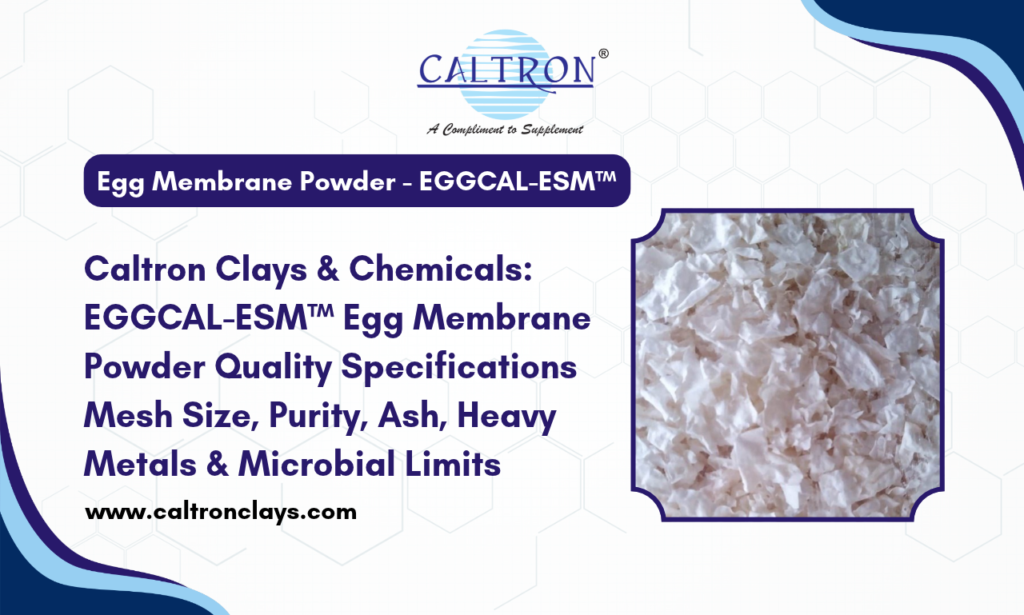
Introduction: Why Eggshell Membrane Powder Quality Specifications Matter to Manufacturers
For pharmaceutical and nutraceutical manufacturers, ingredient selection is a technical decision that directly influences formulation development, quality assurance, and commercial production. When sourcing eggshell membrane powder for joint-health, mobility, or healthy-aging formulations, manufacturers must evaluate more than the ingredient’s natural origin or nutritional profile. They need reliable information about its physical characteristics, analytical quality, processing behaviour, and consistency across production batches.
Eggshell membrane powder contains a natural matrix of structural proteins and associated compounds. However, its characteristics can vary depending on raw-material sourcing, membrane separation, drying, milling, and handling. These variations make eggshell membrane powder specifications essential for determining whether a material is suitable for a particular manufacturing process.
Important specifications include mesh size, particle size distribution, purity, ash content, moisture, heavy metals, microbial limits, and batch consistency. Each parameter provides different information. Particle-size characteristics can influence blending and encapsulation, ash testing evaluates inorganic residue, while heavy-metal and microbiological assessments support ingredient safety evaluation.
Caltron Clays & Chemicals offers EGGCAL-ESM™ Egg Membrane Powder for pharmaceutical and nutraceutical businesses developing specialized formulations. As an Egg Membrane Powder Manufacturer in India, the company serves B2B manufacturers, R&D professionals, procurement teams, and bulk ingredient buyers.
For businesses evaluating an Egg Membrane Powder Supplier in India or an Egg Membrane Powder Exporter in India, understanding these technical parameters supports better supplier qualification, quality control, and sourcing decisions.
What Is Eggshell Membrane Powder and Why Is It Used in Nutraceutical Formulations?
Eggshell membrane powder is derived from the thin biological layer found beneath the hard outer shell of an egg. Unlike eggshell calcium powder, which is primarily a mineral-based ingredient, eggshell membrane contains an organic matrix of proteins and other naturally occurring constituents. This distinction makes it relevant to manufacturers developing joint-health and mobility-oriented nutraceutical formulations.
The natural composition of eggshell membrane may include:
- Collagen and other structural proteins associated with connective-tissue composition.
- Glucosamine-related constituents occurring within the membrane matrix.
- Chondroitin sulfate, a compound familiar to joint-health ingredient research.
- Hyaluronic acid, a naturally occurring component associated with tissue hydration.
- Proteins and peptides contributing to the membrane’s biochemical characteristics.
These compounds make eggshell membrane distinct from conventional calcium-source ingredients. However, their presence does not establish the concentration of individual components in every commercial batch. Product-specific analytical documentation is necessary before manufacturers make quantitative composition claims.
Caltron Clays & Chemicals offers EGGCAL-ESM™ Egg Membrane Powder for manufacturers evaluating natural-source ingredients in joint-health supplements, mobility formulations, and healthy-aging nutrition. Its suitability depends on the intended application, formulation requirements, regulatory classification, and current technical documentation.
What Are the Essential Quality Specifications of Eggshell Membrane Powder?
Raw-material specifications establish the acceptance criteria used to determine whether an ingredient meets manufacturing requirements. For natural-source materials, specifications are especially important because sourcing and processing differences can influence the final powder.
Manufacturers should evaluate the following parameters:
- Identity: Verification that the ingredient corresponds to the intended eggshell membrane material.
- Appearance: Assessment of colour and visible physical characteristics.
- Odour: Evaluation of characteristic odour and unexpected changes.
- Mesh size: Classification of powder fineness using an appropriate sieve method.
- Particle size distribution: Measurement of the range of particle sizes present.
- Ash content: Determination of inorganic residue after controlled ignition.
- Purity: Evaluation of defined compositional and impurity-related criteria.
- Moisture: Measurement of water content or loss on drying, where applicable.
- Heavy metals: Assessment of relevant elemental contaminants.
- Microbial quality: Evaluation of microbial counts and specified organisms.
- Batch consistency: Comparison of analytical results across commercial production lots.
These parameters support egg membrane powder quality control, supplier qualification, and incoming-material assessment.
Manufacturers evaluating an Egg Membrane Powder Manufacturer in India should compare actual product specifications rather than assuming that all eggshell membrane powders have identical properties. International buyers working with an Egg Membrane Powder Exporter in India should also review destination-market requirements.
How Does Mesh Size Influence Egg Membrane Powder Performance?
Mesh size is a physical parameter used to describe powder fineness. In pharmaceutical and nutraceutical manufacturing, particle characteristics can influence blending, powder transfer, encapsulation, and tablet processing. However, mesh size is not identical to particle size distribution, which provides broader information about the range of particles present in the powder.
Important considerations include:
- Sieve analysis: Classifies powder according to specified sieve openings.
- Particle size distribution: Provides information about coarse and fine particle fractions.
- Blending: Differences in particle size may increase segregation risk.
- Encapsulation: Powder flow and packing behaviour can influence capsule-filling consistency.
- Tablet manufacturing: Particle characteristics may affect compression behaviour.
- Powder handling: Very fine powders may create dusting or flow challenges.
- Batch consistency: Stable particle characteristics may support predictable manufacturing performance.
The most suitable egg membrane powder mesh size depends on the intended dosage form, manufacturing equipment, and formulation requirements. Finer powder is not automatically preferable for every application.
Manufacturers working with an Egg Membrane Powder Supplier in India should request particle-size information and conduct practical formulation trials before approving a commercial ingredient.
Why Is Ash Content Important in Eggshell Membrane Powder Quality Control?
Ash content measures the inorganic residue remaining after a sample undergoes controlled heating. Because eggshell membrane originates beneath a mineral-rich eggshell, ash testing can provide useful information about residual inorganic material and consistency between production batches.
Ash testing can support several quality-control activities:
- Measuring inorganic residue through a defined analytical method.
- Comparing results against approved specifications.
- Monitoring consistency between production batches.
- Investigating unexpected changes in material composition.
- Evaluating potential differences associated with processing.
- Supporting supplier qualification and quality trending.
Ash content alone does not identify individual minerals or establish the cause of an unusual result. Additional analytical testing may be necessary when manufacturers require detailed information about inorganic composition.
The ash content in eggshell membrane powder should therefore be interpreted alongside other quality parameters. Procurement teams evaluating an Egg Membrane Powder Exporter in India should review the analytical method, reported result, and acceptance criteria together.
Which Heavy Metals Should Manufacturers Test in Eggshell Membrane Powder?
Heavy-metal testing is an important component of raw-material safety assessment. Natural-source ingredients may be exposed to elemental contaminants through environmental conditions, processing equipment, handling, or other supply-chain factors. Manufacturers should therefore evaluate relevant contaminants according to applicable regulations, intended use, and material-specific risk.
Commonly evaluated elemental contaminants include:
- Lead (Pb): A toxic element considered in many contaminant assessments.
- Arsenic (As): An element for which total concentration or specific chemical forms may be relevant.
- Cadmium (Cd): A contaminant evaluated in food and supplement quality frameworks.
- Mercury (Hg): An element assessed according to regulatory requirements and material-specific risk.
- Analytical methods: Techniques such as ICP-MS may be appropriate when properly validated.
- Acceptance criteria: Limits should reflect applicable regulations, product classification, and intended exposure.
There is no single numerical heavy-metal specification that automatically applies to every eggshell membrane powder in every market. Requirements may differ according to the country of sale, finished-product classification, intended daily intake, and customer specifications.
Manufacturers evaluating an Egg Membrane Powder Manufacturer in India should review current analytical documentation and determine whether the ingredient meets their intended market requirements.
How Is Purity Evaluated in Eggshell Membrane Powder?
Purity is an important consideration in pharmaceutical and nutraceutical raw-material evaluation. However, eggshell membrane is a naturally complex ingredient containing multiple organic constituents. Its overall quality cannot necessarily be represented by a single percentage unless the analytical basis is clearly defined.
A meaningful purity assessment may include:
- Identity verification to confirm the intended raw-material source.
- Composition testing for relevant proteins or other defined constituents.
- Evaluation of residual inorganic material.
- Assessment of moisture and physical characteristics.
- Testing for specified contaminants.
- Microbiological quality evaluation.
- Investigation of potential process-related impurities.
- Comparison of analytical results against approved specifications.
Identity, composition, and purity are related but different concepts. A high protein result does not independently establish the absence of residual minerals or microbiological contamination.
Manufacturers should avoid unsupported purity claims. When evaluating an Egg Membrane Powder Supplier in India, procurement teams should examine how purity is defined and measured in the current product specification.
What Microbial Limits Should Manufacturers Check in Eggshell Membrane Powder?
Microbiological quality is important for ingredients intended for oral pharmaceutical and nutraceutical formulations. Microbial testing helps determine whether a raw material meets established hygiene and safety-related acceptance criteria. Because eggshell membrane is egg-derived, manufacturers should also consider source-related microbiological risks.
Relevant microbiological parameters may include:
- Total Aerobic Microbial Count (TAMC): Estimates viable aerobic microorganisms under specified test conditions.
- Total Yeast and Mold Count (TYMC): Provides information about fungal contamination.
- Salmonella: A potentially relevant specified pathogen for egg-derived materials.
- Other specified microorganisms: Selected according to applicable regulations and risk assessment.
- Sampling requirements: Appropriate sample size and collection procedures.
- Analytical methods: Suitable methods for the material and intended application.
- Manufacturing hygiene: Controls related to processing, handling, and packaging.
- Storage conditions: Measures to reduce unwanted moisture exposure and contamination risk.
Microbial counts provide useful quality information but should not be treated as complete evidence of product safety. A satisfactory total aerobic count does not independently establish the absence of specified pathogens.
The microbial limits for eggshell membrane powder should be established according to the applicable product standard and intended market. International buyers working with an Egg Membrane Powder Exporter in India should confirm the suitability of the testing approach for their destination market.
How Do Moisture Content and Storage Conditions Affect Egg Membrane Powder Stability?
Moisture influences the physical behaviour and storage stability of powdered raw materials. In nutraceutical manufacturing, excessive moisture may create handling difficulties, affect blending performance, or contribute to stability concerns. Appropriate packaging and storage conditions are therefore important throughout the supply chain.
Manufacturers should evaluate:
- Moisture content or loss-on-drying results.
- Powder clumping and agglomeration.
- Flowability during material handling.
- Water activity where relevant.
- Packaging integrity and moisture protection.
- Storage temperature and humidity requirements.
- Transportation conditions.
- Approved shelf life or retest period.
Moisture percentage alone does not fully predict microbiological stability. Water activity, environmental exposure, and packaging characteristics may also influence material behaviour.
Manufacturers sourcing from an Egg Membrane Powder Supplier in India should request current storage and packaging guidance to support quality preservation during warehousing and transportation.
What Should Manufacturers Review in an Eggshell Membrane Powder Certificate of Analysis?
A Certificate of Analysis, commonly known as a CoA, provides batch-specific analytical information. It is an important document for quality assurance, incoming-material assessment, and supplier qualification. However, a CoA should be evaluated alongside the approved specification and the manufacturer’s own quality-management procedures.
Important information to review includes:
- Product name and grade.
- Manufacturer or supplier identification.
- Batch or lot number.
- Applicable specification reference.
- Test parameters and acceptance criteria.
- Reported analytical results.
- Test methods or method references.
- Relevant manufacturing or testing dates.
- Authorized review or approval information.
- Confirmation that the document corresponds to the supplied batch.
Manufacturers should pay attention to how results are reported. A mesh-size result should identify the measurement approach, while heavy-metal and microbiological results should be assessed against relevant acceptance criteria.
Businesses comparing an Egg Membrane Powder Manufacturer in India should consider documentation quality, traceability, and batch consistency alongside commercial pricing. A CoA is valuable evidence but does not replace supplier qualification or appropriate incoming-quality controls.
How Do Eggshell Membrane Powder Specifications Influence Formulation Development?
The suitability of an ingredient depends not only on analytical quality but also on its behaviour during manufacturing. Pharmaceutical and nutraceutical formulations often contain several ingredients with different particle characteristics, densities, and moisture sensitivities. These differences can influence blending, filling, compression, and product stability.
During formulation development, manufacturers may evaluate:
- Blend uniformity and ingredient distribution.
- Powder flow and material transfer.
- Bulk density and tapped density.
- Capsule-filling performance.
- Tablet compression characteristics.
- Moisture behaviour during processing.
- Compatibility with other formulation ingredients.
- Finished-product stability.
- Packaging compatibility.
- Consistency between ingredient batches.
Physical parameters such as particle size and moisture are particularly relevant to processing performance. Ash, purity, heavy-metal, and microbial parameters contribute to composition and safety-related evaluation.
Manufacturers should combine laboratory testing with practical formulation trials to determine whether the ingredient can support consistent commercial production.
How Should B2B Buyers Compare Egg Membrane Powder Suppliers in India?
Selecting a raw-material supplier involves technical, regulatory, and commercial considerations. For pharmaceutical and nutraceutical companies, the most suitable supplier is not necessarily the one offering the lowest quotation. Documentation quality, batch consistency, communication, and supply continuity can influence overall procurement value.
A structured supplier assessment should consider:
- Current product specifications and analytical methods.
- Batch-specific Certificates of Analysis.
- Raw-material origin and traceability.
- Relevant quality-management documentation.
- Egg-allergen information and applicable labeling requirements.
- Manufacturing and quality-control capabilities.
- Change-control and specification-update communication.
- Sample availability and formulation support.
- Bulk packaging and commercial quantities.
- Lead times and supply continuity.
- Export documentation and destination-market requirements.
Because eggshell membrane is derived from eggs, manufacturers should assess relevant allergen risks before using it in finished products.
When evaluating an Egg Membrane Powder Exporter in India, international buyers should also confirm import requirements, product classification, and documentation expectations in the destination market.
A reliable sourcing decision should balance technical suitability, quality assurance, commercial feasibility, and long-term supply requirements.
Why Consider Caltron Clays & Chemicals for EGGCAL-ESM™ Egg Membrane Powder?
Caltron Clays & Chemicals supplies specialized raw materials for pharmaceutical, nutraceutical, food, and cosmetic businesses. Its EGGCAL-ESM™ Egg Membrane Powder offers manufacturers a natural-source ingredient option for joint-health, mobility, and related wellness formulations.
Businesses evaluating an Egg Membrane Powder Manufacturer in India can contact Caltron Clays & Chemicals for product information and commercial sourcing discussions.
Relevant enquiries may include:
- Current EGGCAL-ESM™ technical specifications.
- Mesh size and particle-size information.
- Ash content and moisture parameters.
- Purity-related analytical information.
- Heavy-metal testing documentation.
- Microbiological acceptance criteria.
- Batch-specific quality documentation.
- Packaging and storage guidance.
- Product samples and formulation evaluation.
- Bulk quantities and commercial quotations.
Caltron’s broader ingredient portfolio also supports its positioning as a Pharmaceutical Raw Material Manufacturer and Supplier in India, Nutraceutical Raw Material Manufacturer and Supplier in India, and Cosmetic Raw Material Manufacturer and Supplier in India.
For EGGCAL-ESM™, pharmaceutical and nutraceutical ingredient sourcing remains the primary focus. Manufacturers seeking an Egg Membrane Powder Exporter in India can discuss export-related requirements directly with the company.
Frequently Asked Questions
1. What are the main specifications of eggshell membrane powder?
Eggshell membrane powder specifications may include mesh size, purity, ash content, moisture, heavy metals, and microbial limits. Caltron Clays & Chemicals offers EGGCAL-ESM™ for manufacturers evaluating pharmaceutical and nutraceutical formulations.
2. What mesh size is suitable for egg membrane powder?
The suitable mesh size depends on the dosage form, blending requirements, and manufacturing equipment. Caltron Clays & Chemicals recommends reviewing EGGCAL-ESM™ particle-size information before formulation development.
3. Why is ash content tested in eggshell membrane powder?
Ash testing measures inorganic residue and helps assess material consistency. Caltron Clays & Chemicals encourages manufacturers to review ash results alongside the complete quality specification.
4. How is eggshell membrane powder purity determined?
Purity assessment may involve identity testing, composition analysis, and evaluation of relevant impurities. Manufacturers can contact Caltron Clays & Chemicals for current EGGCAL-ESM™ technical documentation.
5. Which heavy metals are commonly tested in egg membrane powder?
Lead, arsenic, cadmium, and mercury are commonly evaluated elemental contaminants. Caltron Clays & Chemicals recommends assessing the relevant analytical results against applicable regulatory requirements.
6. What microbial tests are important for eggshell membrane powder?
Microbial evaluation may include TAMC, TYMC, and specified pathogens such as Salmonella. Caltron Clays & Chemicals advises manufacturers to review the testing requirements applicable to their intended market.
7. Does moisture affect eggshell membrane powder quality?
Excessive moisture can influence powder flow, agglomeration, and storage stability. Caltron Clays & Chemicals recommends reviewing moisture specifications and storage guidance for EGGCAL-ESM™.
8. What should an eggshell membrane powder CoA include?
A CoA should identify the batch, test parameters, acceptance criteria, analytical results, and relevant methods. Caltron Clays & Chemicals can be contacted for current EGGCAL-ESM™ documentation enquiries.
9. Is eggshell membrane powder different from eggshell calcium powder?
Yes. Eggshell membrane contains structural proteins and associated compounds, while eggshell calcium powder primarily provides calcium carbonate. Caltron Clays & Chemicals offers EGGCAL-ESM™ and EGGCAL™ for different formulation requirements.
10. Where can manufacturers source egg membrane powder in India?
Caltron Clays & Chemicals offers EGGCAL-ESM™ for B2B pharmaceutical and nutraceutical applications. Manufacturers can enquire about technical specifications, documentation, samples, and bulk supply.
Conclusion: Choose Eggshell Membrane Powder with Confidence Through Verified Specifications
Selecting eggshell membrane powder for pharmaceutical and nutraceutical manufacturing requires a comprehensive evaluation of raw-material identity, composition, physical characteristics, purity, contaminant controls, and manufacturing suitability.
Mesh size and particle size distribution can influence blending, encapsulation, tablet processing, and powder handling. Ash testing helps evaluate inorganic residue, while purity assessment supports the examination of material identity and relevant impurities. Heavy-metal and microbiological testing contribute to safety-related evaluation, and moisture control supports storage stability and processing consistency.
No single analytical parameter can establish the overall suitability of a raw material. Manufacturers should review the complete specification, analytical methods, applicable regulatory requirements, batch consistency, and intended finished-product application.
Caltron Clays & Chemicals offers EGGCAL-ESM™ Egg Membrane Powder for businesses developing joint-health, mobility, and nutraceutical formulations.
Companies searching for an Egg Membrane Powder Manufacturer in India, Egg Membrane Powder Supplier in India, or Egg Membrane Powder Exporter in India can contact Caltron Clays & Chemicals for current technical specifications, documentation, samples, and commercial sourcing enquiries.
Reliable procurement decisions begin with verified specifications, appropriate quality evaluation, and a supplier relationship that supports long-term manufacturing requirements.
Caltron Clays & Chemicals Pvt Ltd
Address: Suite# 1901-1904, Level-19, 9 Business Bay, Off Link Road, Mindspace, Malad West, Mumbai 400064
Phone No.: 022 3571 9844 | +91 70214 37453 | +91 22 2876 4864
Website: https://caltronclays.com
Email: marketing@caltronclays.com | sales@caltronclays.com
Google Maps: https://maps.app.goo.gl/n2TeYQcnXnS4aMio9
Contact Caltron Clays & Chemicals for EGGCAL-ESM™ specifications, technical documentation, samples, and bulk supply enquiries.
