Introduction
A rolling shutter does not usually become difficult to operate without a reason. The first signs may be small: slight resistance while opening, uneven travel, scraping sounds, vibration or a shutter that pauses at a particular point. In a factory, warehouse, loading bay, shop or commercial property, these changes deserve attention because the shutter is often part of the facility’s everyday access and workflow.
The source of the problem can vary. Dirt may have accumulated inside a guide channel, the curtain may no longer be travelling evenly, a bracket may require inspection, or the spring mechanism may not be operating as expected. Physical impact, moisture, installation conditions and gradual wear can also affect performance. Looking at these factors together provides a more useful diagnosis than assuming every stuck shutter needs the same replacement part.
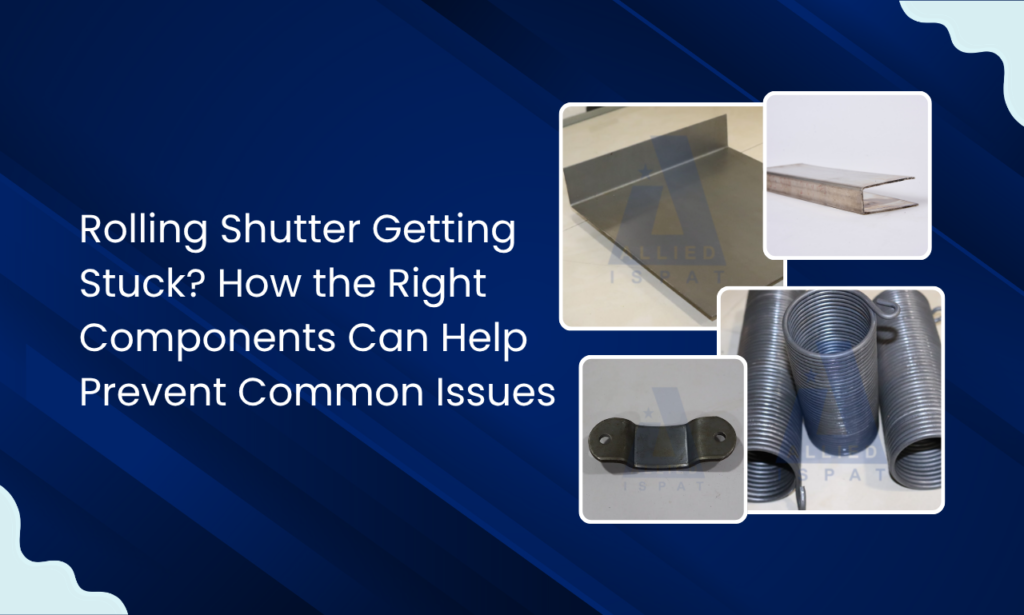
For rolling shutter manufacturers and fabricators, the same system based thinking is valuable during production. Guide channels, bottom sections, springs, brackets and fittings should correspond with the intended shutter design. Steel grade, component dimensions, profile geometry and manufacturing repeatability can influence how efficiently the parts move through fabrication and assembly. Where additional corrosion protection is specified, galvanized rolling shutter parts can be considered according to the application.
Allied Ispat Pvt. Ltd. works with OEMs, shutter manufacturers, fabricators, dealers, distributors, contractors and industrial buyers. As a Rolling Shutter Parts Manufacturer in India, we manufacture components for regular production requirements as well as customized and bulk procurement.
Our manufacturing works at MIDC Taloja support customers across Maharashtra and other industrial markets. Businesses evaluating a Rolling Shutter Parts Manufacturer in Mumbai can connect with our team to discuss component specifications, steel materials, profile requirements and quantities without treating procurement as a simple catalogue purchase.
What Makes a Rolling Shutter Get Stuck?
There is rarely one universal reason for a shutter to jam. Rolling shutters combine moving profiles with supporting and mechanical components, which means an issue in one area can influence movement elsewhere.
A useful inspection therefore starts with the symptom and follows the complete movement of the shutter.
Is Something Blocking the Guide Channel?
Guide channels provide the route through which the curtain edges travel. If this route becomes obstructed, movement can become increasingly difficult.
Dust, packaging material, small debris and accumulated dirt can enter the guide area, particularly in factories and warehouses. Impact from vehicles or material handling equipment may also deform a guide.
A shutter that catches at approximately the same position during each operation may therefore require the guide path to be inspected for obstruction or visible damage.
Could the Shutter Be Out of Alignment?
A curtain should move through both side guides in a coordinated manner. Misalignment can cause one side to experience greater contact or resistance.
Operators may notice that the shutter appears tilted, drags on one side or needs additional effort to continue moving.
Alignment problems can originate from installation, impact or changes within the supporting assembly. Replacing components without addressing the alignment issue may allow the same operational problem to continue.
Can a Spring Problem Make the Shutter Difficult to Move?
Yes. Springs form part of the operating mechanism in many rolling shutter systems.
If a spring or associated mechanism develops a problem, the shutter may become unusually heavy or behave differently during operation.
Spring mechanisms can contain significant stored energy. Inspection, adjustment and replacement should therefore be carried out by appropriately trained technicians rather than attempted as an unplanned repair.
Can Brackets Affect Shutter Movement?
Brackets support important mechanical parts of the shutter system. Their position and condition can influence how associated components remain arranged.
A damaged or incorrectly positioned bracket may contribute to changes in shaft or mechanism alignment.
For manufacturers, this means brackets should be purchased according to the intended shutter configuration rather than treated as generic rolling shutter hardware.
What Role Does Normal Wear Play?
Rolling shutters are mechanical systems, and repeated use naturally creates working wear.
A warehouse shutter operating many times during a working day experiences different conditions from a shutter used occasionally. Dust, moisture, impact and surrounding industrial activity can add further variables.
Planned inspection helps maintenance teams identify gradual changes before they develop into a larger operational interruption.
Guide Channels: Where Smooth Shutter Movement Begins
Guide channels have a straightforward purpose but a demanding job. They define the side path followed by the moving shutter curtain.
For fabricators, they also need to integrate predictably into production. This makes profile geometry, dimensions and consistency important purchasing considerations.
The Relationship Between the Curtain and Guide
The curtain edges move inside the guide channels every time the shutter operates.
The dimensions of the guide must therefore correspond with the intended curtain arrangement. Excessive restriction, physical deformation or an unsuitable profile can affect movement.
Correctly specifying the guide is consequently part of shutter design rather than an afterthought during installation.
Why Does Profile Consistency Matter to a Fabricator?
Repeat production depends on repeatable inputs.
Suppose a manufacturer has established cutting, fabrication and assembly methods around a particular guide profile. If subsequent batches vary unexpectedly, the production team may need to modify its established process.
Consistent rolling shutter guide channels help reduce these avoidable adjustments and support a more predictable manufacturing workflow.
Manufacturing Accuracy Cannot Correct Poor Installation
A precisely manufactured profile still needs to be installed correctly.
Guide channels on both sides of the opening must work with the curtain and supporting assembly. Incorrect positioning can create friction even when there is nothing wrong with the profile itself.
For maintenance teams, separating a manufacturing issue from an installation or alignment issue is important before ordering replacement components.
When Are Customized Guide Channels Required?
Standard components satisfy many shutter designs, but not every OEM works with identical profiles.
Existing manufacturing setups may require particular dimensions, shapes or materials. Custom production becomes relevant in these situations.
At Allied Ispat Pvt. Ltd., OEMs and fabricators can discuss custom guide channel requirements using dimensions, drawings, samples or other defined specifications.
Springs and Brackets: Supporting the Mechanical Side of the Shutter
Guide channels control the curtain path, while springs and brackets contribute to the mechanical arrangement that supports shutter operation.
Their function makes compatibility particularly important. Selecting a component simply because it appears similar to an existing part can be an unreliable procurement approach.
What Does a Rolling Shutter Spring Do?
A shutter spring operates within the broader opening and closing mechanism.
Its specification needs to correspond with the shutter design. Changes in spring condition can affect the behaviour of the mechanism and may make operation noticeably different.
For OEM procurement, the required spring should therefore be clearly identified rather than selected only by visual comparison.
Why Are Brackets More Important Than They Look?
A bracket may occupy relatively little space within the shutter assembly, but it supports key mechanical elements.
Dimensions, construction and positioning all influence how it integrates with the system.
Manufacturers producing repeat shutters benefit from purchasing brackets that correspond consistently with their established configuration.
Why Should Components Be Evaluated as a Set?
A shutter mechanism involves relationships between springs, brackets, shafts, guides and the curtain.
Changing one part can influence how another operates. This is why component compatibility is a central consideration for OEM manufacturers.
Before ordering rolling shutter spare parts, buyers should verify that the replacement corresponds with the existing shutter configuration.
Professional Attention for Spring Related Problems
Spring systems deserve particular care during maintenance.
A shutter that becomes unexpectedly heavy or develops an obvious mechanical problem should be inspected rather than repeatedly forced to operate.
Qualified technicians should handle spring adjustment, dismantling and replacement because stored mechanical energy can create serious safety risks.
Bottom Sections, Steel Coils and Fittings: Completing the Shutter
Reliable shutter manufacturing depends on the combined quality of major and minor components. Bottom sections, fittings, accessories and steel material all contribute to the finished product.
For OEM buyers, these items should be included in the overall specification from the beginning.
Why Is the Bottom Section Important?
The bottom section completes the lower edge of the curtain and forms part of the overall shutter configuration.
Its dimensions need to match the manufacturer’s intended design.
For repeat production, consistent bottom sections can make fabrication more straightforward by reducing unexpected dimensional differences between batches.
Selecting Steel Before Manufacturing Begins
Every steel shutter component starts with material selection.
GI, CR and HR steel can be used for different component and fabrication requirements. The appropriate material depends on the profile, production process, project conditions and customer specification.
Buyers should therefore include the material requirement when communicating the component dimensions and quantity.
Where Galvanized Material Can Be Relevant
Galvanized steel uses a protective zinc coating to help reduce corrosion of the underlying steel.
For suitable installations, galvanized rolling shutter parts can be included where the project specification calls for additional corrosion protection.
The choice should still reflect the actual application rather than the assumption that one material is automatically suitable for every shutter.
Small Fittings Can Influence a Large Assembly
Rolling shutter fittings, accessories and handles may appear less significant than guide channels or bottom profiles, but they still contribute to assembly and use.
Their compatibility and dimensions matter, particularly when manufacturers are producing shutters in volume.
Sourcing a broader range of related components from an established B2B manufacturer can also simplify purchasing and supplier coordination.
Choosing Materials for Different Rolling Shutter Requirements
Material selection should answer a practical question: what does this particular component and application require?
There is little value in specifying a material simply because it is commonly used elsewhere. Steel selection should correspond with component design, manufacturing requirements and operating environment.
GI Steel and Corrosion Protection
Galvanized Iron or GI material incorporates zinc protection over steel.
The zinc layer helps protect the steel substrate against corrosion and makes GI material relevant for various formed steel applications.
Where shutter specifications call for this protection, galvanized rolling shutter parts can provide an appropriate material option.
CR Steel in Component Manufacturing
Cold Rolled steel is used across numerous precision formed steel applications.
Whether CR material is suitable for a rolling shutter component depends on the required profile and manufacturing specification.
OEM customers should communicate material requirements clearly, particularly when recurring batches need to remain aligned with an existing product design.
HR Steel for Relevant Fabrication Needs
Hot Rolled steel is another material used across industrial fabrication and component manufacturing.
Its suitability depends on the intended part and required manufacturing process.
A technical purchasing decision should therefore consider application and specification rather than comparing steel materials solely on purchase price.
Material Consistency Matters Across Repeat Orders
An OEM manufacturer may purchase the same component multiple times throughout the year.
Unexpected material changes between batches can affect downstream manufacturing. Defining the required steel at the beginning helps create a clearer procurement standard.
This becomes particularly important when components are incorporated into established production lines.
Galvanization Is Not a Substitute for Maintenance
The corrosion protection offered by galvanized steel is useful, but it does not make the complete shutter maintenance free.
Coating damage, moisture, contamination and service conditions can still affect components over time.
Regular inspection should therefore continue even where galvanized rolling shutter parts have been selected.
Why Manufacturing Precision Matters for Rolling Shutter Components
For B2B manufacturing, consistency often becomes more valuable with every repeat order.
A first batch may work perfectly with a fabricator’s setup, but the real test comes when subsequent quantities need to fit into the same production process.
Repeatable Dimensions Reduce Production Adjustments
Manufacturers build processes around defined inputs.
If guide channels, bottom sections or brackets vary unexpectedly, fabrication teams may need additional adjustments before assembly can continue.
Producing components according to clearly defined dimensions helps support repeatability across manufacturing runs.
How Roll Forming Creates Steel Profiles
Roll forming progressively shapes steel strip through a sequence of forming stations.
Each stage contributes to the development of the final profile. Tooling design, machine setup and material characteristics all influence the finished section.
Allied Ispat Pvt. Ltd. uses its steel processing and roll forming experience to support profile manufacturing for rolling shutter and other industrial requirements.
Mechanical Presses for Suitable Components
Rolling shutter components do not all share the same geometry, so one manufacturing process cannot serve every requirement.
Mechanical pressing can be used for suitable parts according to their design.
Our manufacturing infrastructure allows different component requirements to be evaluated according to the process needed to produce them.
Quality Checks Support Production Consistency
Inspection is most useful when quality considerations are incorporated throughout manufacturing.
Material identification, component dimensions, profile condition and finished requirements all contribute to production control.
Allied Ispat Pvt. Ltd. operates with an ISO 9001:2015 quality management approach as part of our commitment to structured manufacturing practices.
Custom Manufacturing for OEM Customers
An OEM may already have a shutter design that has been manufactured successfully for years.
Changing the profile simply to accommodate a generic component can create unnecessary disruption. Customized manufacturing provides an alternative where clearly defined dimensions or geometry are required.
As a Rolling Shutter Parts Supplier in India, Allied Ispat Pvt. Ltd. works with OEM and fabrication customers to understand these specifications before production begins.
Matching Rolling Shutter Components to the Application
The environment in which a shutter operates should influence procurement decisions.
Usage frequency, exposure, surrounding activity and maintenance conditions can vary significantly between industrial, warehouse and commercial applications.
Factory Entrances
Factories may install shutters at production entrances, storage areas, loading zones and internal access points.
These locations can experience dust, repeated operation and movement of industrial equipment.
The specification should therefore consider the complete system, including guide profiles, mechanical components, material and maintenance conditions.
Warehouses and Logistics Facilities
Warehouse rolling shutters frequently operate around loading and material movement areas.
Repeated access increases the importance of monitoring shutter movement and visible component condition.
Consistent industrial rolling shutter parts can also help businesses standardize components across multiple similar openings or facilities.
Shops and Commercial Properties
Retail and commercial shutters often operate on a daily schedule.
Smooth operation is therefore important for routine opening and closing.
Guide alignment, appropriate fittings, component compatibility and material selection should be considered together. Depending on environmental exposure, galvanized rolling shutter parts may also be included within the specification.
What Should a Procurement Enquiry Include?
A clear enquiry saves time for both parties.
Buyers should provide the component name, dimensions, material, profile details, quantity and application wherever possible. For custom requirements, a drawing or physical sample can provide additional clarity.
OEM buyers should also communicate whether the requirement is likely to recur so that future supplies can follow the established specification.
Why Is Supplier Continuity Important?
Manufacturers do not always purchase components only once.
Recurring production requires continuing access to parts that correspond with the established design.
Evaluating manufacturing capability, communication, customization and repeat supply can therefore be more valuable than making each purchasing decision solely around the lowest quotation.
Why Allied Ispat Pvt. Ltd. for B2B Rolling Shutter Component Requirements?
Rolling shutter manufacturers need components that become part of their own finished products. We keep that downstream requirement in mind when discussing specifications with customers.
At Allied Ispat Pvt. Ltd., our objective is to understand what the buyer needs to manufacture, assemble or supply rather than simply treating every enquiry as an individual steel part.
A Practical Range of Rolling Shutter Components
Our rolling shutter manufacturing range includes guide channels, bottom sections, springs, brackets, fittings, accessories and other related components.
We also work with steel requirements connected with shutter fabrication.
Having access to multiple component categories can help OEMs, dealers and fabricators simplify procurement.
Multiple Steel Material Options
Different shutter requirements call for different steel specifications.
Our manufacturing work includes GI, CR and HR material for relevant applications.
Customers requiring galvanized rolling shutter parts can discuss material, profile dimensions and quantity together so that the requirement is clearly defined before production.
Steel Manufacturing Experience Since 1997
Allied Ispat Pvt. Ltd. has been serving steel processing and manufacturing requirements since 1997.
Along with rolling shutter components, our business includes POP and false ceiling profiles, trading coils and roll forming machinery.
Working across these product areas has given us practical experience with steel materials, formed profiles and industrial B2B requirements.
Support for Customized Profiles
Not every shutter manufacturer needs an off the shelf component.
We work with customers requiring specific guide channels, bottom sections, brackets and other profiles based on defined requirements.
Drawings, dimensions, samples and material details help our team evaluate customized manufacturing enquiries.
OEM and Bulk Supply Requirements
Manufacturers may need recurring production quantities, while distributors may purchase stock for continuing market requirements.
Contractors and project procurement teams can have different volume and scheduling needs.
As a Rolling Shutter Parts Manufacturer in India, Allied Ispat Pvt. Ltd. works with these varied B2B sourcing requirements.
Customers planning recurring procurement can also connect with us as a Rolling Shutter Parts Supplier in India for standard and customized component enquiries.
Mumbai Presence with Manufacturing at Taloja
Our commercial presence in Mumbai allows customers to communicate directly with our team, while our manufacturing works are located at MIDC Taloja in Raigad.
This positions us close to the wider Navi Mumbai and Maharashtra industrial ecosystem.
Businesses evaluating a Rolling Shutter Parts Manufacturer in Mumbai can contact Allied Ispat Pvt. Ltd. for product, material and customization discussions.
We also support manufacturers, fabricators, dealers and project buyers looking for a Rolling Shutter Parts Supplier in Mumbai for repeat and bulk sourcing.
Frequently Asked Questions About Rolling Shutter Parts
1. Why does a rolling shutter keep getting stuck?
A rolling shutter may stick because of guide obstruction, incorrect alignment, component wear, physical damage or problems within the operating mechanism. Allied Ispat Pvt. Ltd. recommends evaluating the complete assembly before deciding which component needs attention.
2. What components are commonly required for rolling shutters?
Guide channels, springs, brackets, bottom sections, fittings, accessories and related steel profiles are commonly used within rolling shutter systems. Allied Ispat Pvt. Ltd. manufactures multiple rolling shutter components for OEM, fabrication and industrial B2B requirements.
3. How can guide channels affect shutter movement?
Guide channels determine the side path followed by the moving curtain. Damage, debris or incorrect alignment can create additional resistance. Allied Ispat Pvt. Ltd. manufactures guide channels for customers requiring consistent profiles for rolling shutter production.
4. Can a damaged spring make a rolling shutter difficult to operate?
Yes. A problem involving the spring mechanism can change how easily the shutter operates. Allied Ispat Pvt. Ltd. recommends professional inspection of spring related issues because adjustment or dismantling can involve stored mechanical energy.
5. Why is material selection important for rolling shutter parts?
Material influences manufacturing characteristics, surface condition and suitability for the intended application. Allied Ispat Pvt. Ltd. works with GI, CR and HR steel for relevant rolling shutter component requirements based on customer specifications.
6. What are galvanized rolling shutter parts?
These are rolling shutter components made using galvanized steel, which incorporates a zinc coating for additional corrosion protection. Allied Ispat Pvt. Ltd. works with GI steel for suitable OEM, industrial and commercial shutter component requirements.
7. How do I select a Rolling Shutter Parts Manufacturer in India?
Consider manufacturing capability, profile consistency, material options, quality management, customization and support for repeat orders. Allied Ispat Pvt. Ltd. works with OEMs, fabricators, contractors, dealers and industrial buyers requiring rolling shutter components.
8. Can Allied Ispat Pvt. Ltd. manufacture custom rolling shutter parts?
Yes. Allied Ispat Pvt. Ltd. works with customized requirements based on profile geometry, dimensions, material and quantities. OEMs and fabricators can share drawings, samples or detailed specifications to help define the required component.
9. Where can B2B customers source rolling shutter parts in Mumbai?
Allied Ispat Pvt. Ltd. has a Mumbai presence supported by manufacturing operations at MIDC Taloja, Raigad. B2B customers can discuss guide channels, springs, brackets, bottom sections and other rolling shutter component requirements with our team.
10. Can Allied Ispat Pvt. Ltd. handle bulk and repeat orders?
Yes. Allied Ispat Pvt. Ltd. supports bulk and recurring requirements from OEMs, shutter manufacturers, fabricators, dealers, distributors, contractors and project procurement teams. Customers can discuss specifications and expected quantities directly with our team.
Conclusion: Reliable Shutter Operation Starts with the Complete System
When a rolling shutter starts sticking, dragging or becoming difficult to operate, replacing the nearest visible component may not solve the underlying problem. Guide obstruction, alignment, springs, brackets, installation, wear and environmental conditions can all contribute. Examining how these elements interact gives maintenance teams a clearer path toward identifying the actual issue.
For manufacturers, the opportunity to reduce avoidable problems begins much earlier. Appropriate material, consistent dimensions, accurate profile geometry and compatibility between components support more predictable fabrication and assembly. Where the operating environment requires additional corrosion protection, galvanized rolling shutter parts can be considered as part of the project specification while regular inspection and maintenance continue throughout service.
Allied Ispat Pvt. Ltd. works with OEMs, fabricators, dealers, distributors, contractors and industrial procurement teams requiring rolling shutter components. As a Rolling Shutter Parts Manufacturer in India, we manufacture guide channels, bottom sections, springs, brackets, fittings, accessories and related steel components for standard and customized requirements.
Our Mumbai presence is supported by manufacturing operations at MIDC Taloja. Businesses seeking a Rolling Shutter Parts Manufacturer in Mumbai can discuss their drawings, dimensions, materials, quantities and repeat manufacturing needs directly with our team.
For buyers managing ongoing procurement, Allied Ispat Pvt. Ltd. also serves as a Rolling Shutter Parts Supplier in India for recurring, OEM and bulk component requirements. Our objective is to understand the specification clearly and support a consistent sourcing process.
Businesses requiring local procurement support can also approach us as a Rolling Shutter Parts Supplier in Mumbai. Whether the requirement involves an established standard component or a customized profile, our team can discuss the product in relation to the buyer’s manufacturing or project needs.
More Steel Solutions Engineered for Modern Manufacturing and Construction
Allied Ispat Pvt. Ltd. brings its steel processing and manufacturing experience across multiple product categories. Along with rolling shutter components, we support manufacturers, fabricators, contractors and project buyers with roll forming machinery, trading coils and POP ceiling profiles for diverse industrial and construction requirements.
Shape Better Profiles with Allied Ispat Roll Forming Machines
Looking to strengthen your steel profile production? As a Roll Forming Machine Manufacturer in India, Allied Ispat Pvt. Ltd. provides roll forming solutions for producing consistent metal profiles across different manufacturing applications. Our machines are developed with a focus on practical production requirements, profile accuracy and dependable operation.
Quality Trading Coils for Your Next Manufacturing Requirement
Every well-formed steel product starts with the right material. As a Trading Coil Manufacturer in India, Allied Ispat Pvt. Ltd. supplies GI, PPGI and GL coils for fabrication, profile manufacturing and other industrial applications. We support B2B buyers requiring suitable steel coil materials for regular as well as bulk procurement.
Strong False Ceilings Start with the Right POP Framework
A finished ceiling depends on the steel framework working behind it. As a POP Parts Manufacturer in India, Allied Ispat Pvt. Ltd. manufactures ceiling sections, intermediate sections, perimeter channels, angles, C-studs and floor channels for false ceiling and partition framework requirements.
Contact Allied Ispat Pvt. Ltd. for Rolling Shutter Parts
Manufacturers, fabricators, contractors, dealers, distributors and industrial procurement teams can contact us for standard components, customized profiles, OEM sourcing and bulk rolling shutter part requirements.
Allied Ispat Mumbai Central
Address: Shop 69, Maulana Shaukat Ali Road, Chhota Sonapur, Siddharth Nagar, Mumbai Central, Mumbai, Maharashtra 400008
Phone: 098211 77009
Get Directions: https://maps.app.goo.gl/gyEqxBGcw9jLsYm26
Allied Ispat Works:
Plot no. C-17 9, MIDC Road behind Bank of Baroda Bank Taloja Panvel, Maharashtra 410208 India
Get Directions: https://maps.app.goo.gl/6ujLCuHpQLu1Uy3r8
Phone: 087790 51606
Email: info@alliedispatindia.com | sales@alliedispatindia.com
Website: www.alliedispatindia.com
Contact Allied Ispat Pvt. Ltd. to discuss rolling shutter guide channels, springs, brackets, bottom sections, fittings, customized steel profiles, OEM requirements and bulk component sourcing for your business.
